


Navigating in a microgravity environment is a challenge even for trained human astronauts, but it is even more challenging for autonomous robots, limiting their use in places like a space station.
Now, however, Stanford researchers have used artificial intelligence to steer a free-flying robot aboard the International Space Station (ISS), potentially paving the way for more autonomous space missions in the future.
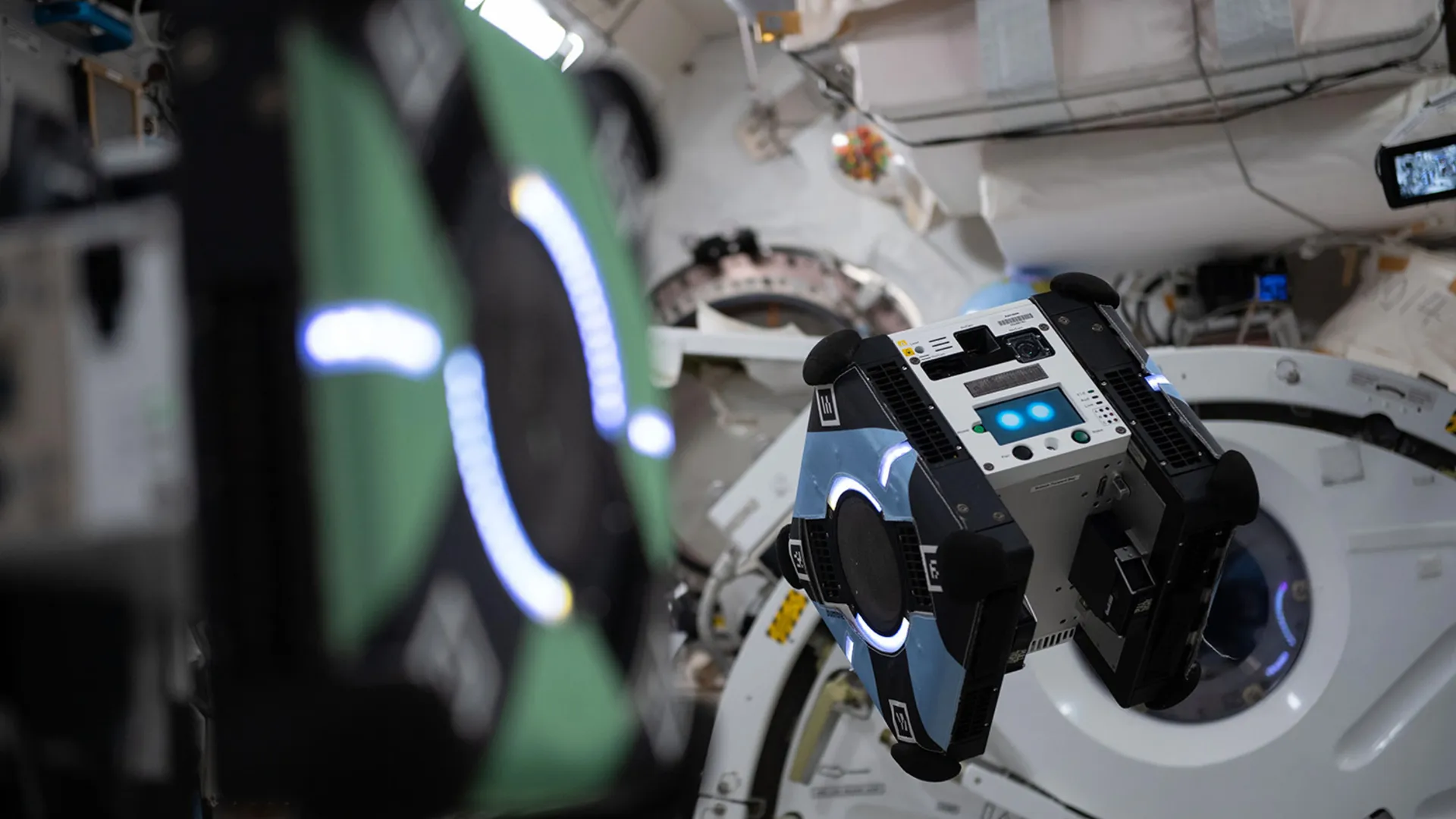
Working with NASA's cube-shaped Astrobee robot, the Stanford research team demonstrated how a machine-learning system can plan safe routes through the ISS' crowded modules significantly faster than existing methods. The advances address a long-standing hurdle for space robotics — namely, how to move quickly and safely with limited computing power and minimal human input in one of the most extreme engineering environments possible.
Lead researcher Somrita Banerjee, a Stanford Ph.D. candidate, said that the station's maze of equipment and experiments makes motion planning especially challenging, as algorithms that work well for robots on Earth often bog down when run on the older, radiation-hardened computers certified for spaceflight.
To get around those constraints, Banerjee and her colleagues started with a standard optimization approach, described in a new paper presented earlier this month at the International Conference on Space Robotics, which breaks a complex motion-planning problem into many smaller steps. They then trained an AI model on thousands of previously computed paths, so the system could begin each new plan with an informed "warm start" instead of calculating from scratch.
"Using a warm start is like planning a road trip by starting with a route that real people have driven before, rather than drawing a straight line across the map," Banerjee said in a Stanford University statement. "You start with something informed by experience and then optimize from there."
This approach allows for strict safety checks before runs, while cutting actual computation time. In tests on the station, routes generated with the AI warm start were roughly 50% to 60% faster to compute than conventional plans, according to the researchers.
"This is the first time AI has been used to help control a robot on the ISS," Banerjee said. "It shows that robots can move faster and more efficiently without sacrificing safety, which is essential for future missions where humans won't always be able to guide them."
Setting the stage for AI robots on the ISS and beyond
Before the in-orbit trial, the system was first validated at NASA's Ames Research Center in Silicon Valley using a granite table testbed with a compressed air cushion that allows a robot to glide over it like an air hockey puck, mimicking the microgravity found on the ISS. In orbit, astronauts performed a brief setup and then left Astrobee to be commanded from the ground in what NASA calls a "crew-minimal" experiment.
Over a four-hour session, mission controllers at NASA's Johnson Space Center in Houston directed Astrobee to fly 18 trajectories, each run twice with and without the AI-generated warm start. Additional safeguards, including virtual obstacles and the ability to halt a run, were used to avoid collisions.
The team says that similar AI-guided planning could eventually allow robots to handle inspections, logistics and science tasks on future missions to the moon, Mars and beyond, freeing astronauts to focus on higher-priority work.
"As robots travel farther from Earth and as missions become more frequent and lower-cost, we won't always be able to teleoperate them from the ground," Banerjee said. "Autonomy with built-in guarantees isn't just helpful; it's essential for the future of space robotics."