You are now subscribed
Your newsletter sign-up was successful
Want to add more newsletters?

Delivered daily
Daily Newsletter
Breaking space news, the latest updates on rocket launches, skywatching events and more!

Once a month
Watch This Space
Sign up to our monthly entertainment newsletter to keep up with all our coverage of the latest sci-fi and space movies, tv shows, games and books.

Once a week
Night Sky This Week
Discover this week's must-see night sky events, moon phases, and stunning astrophotos. Sign up for our skywatching newsletter and explore the universe with us!

Twice a month
Strange New Words
Space.com's Sci-Fi Reader's Club. Read a sci-fi short story every month and join a virtual community of fellow science fiction fans!
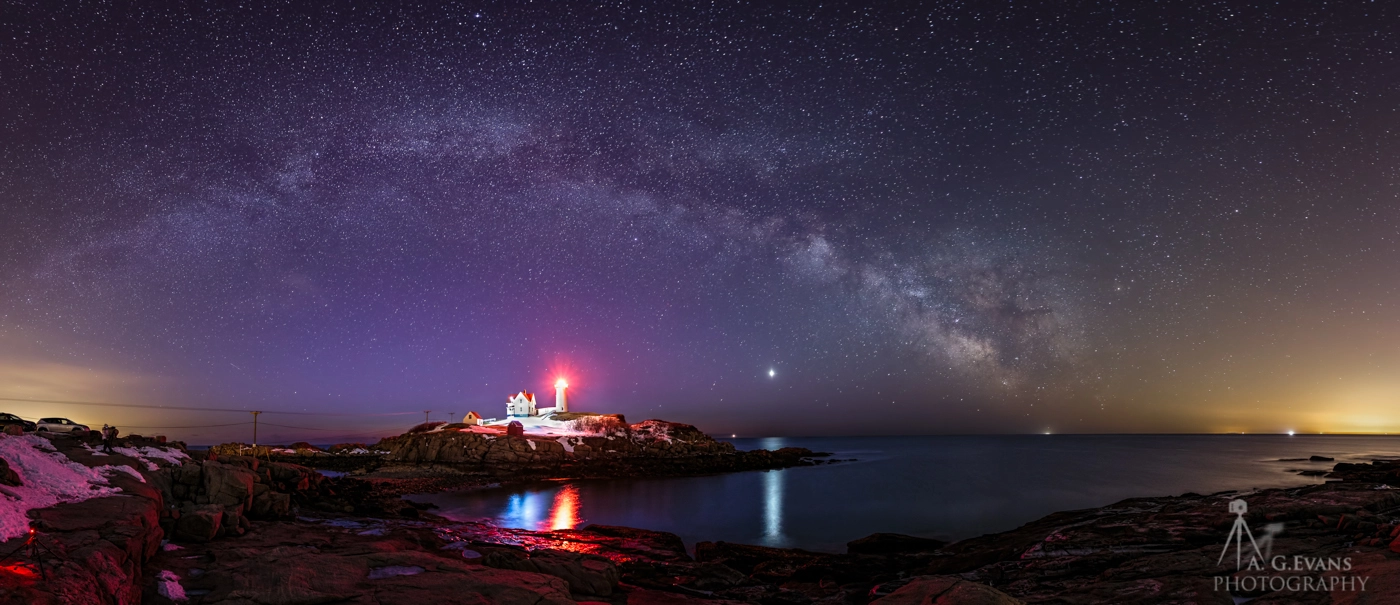
The arc of the Milky Way dazzles over Cape Neddick Lighthouse in this spectacular nine-image panorama recently sent to Space.com.
Veteran astrophotographer A. Garrett Evans of central New Hampshire endured the bitter cold of York, Maine, on March 3 to take this stunning panorama.
"The temperature was in the single digits all night, but that did not keep us from staying out to capture this beautiful scene," Evans wrote Space.com in an email. [Stargazing Photos: April's Night Sky Revealed]
Evans' covers nearly 180 degrees and was taken with a Canon 6D camera, Canon 16-35mm @ 16mm, ISO 4000, f/2.8, 30 sec.


Venus can be seen in the image toward the left, just below the core. The planet's reflection also appears in the ocean. Light pollution from York and other towns appears on each edge of the frame. Boon Island Lighthouse, about 7 miles (11 kilometers) offshore, is a small speck just to the left of Venus on the horizon. Lights from a few large ships can also be seen below the core of the Milky Way and off to the south into the light pollution, according to Evans.
Our host galaxy, the Milky Way is a barred spiral galaxy spanning between 100,000 to 120,000 light-years in diameter. It comprises gas, dust and roughly 400 billion stars. The dazzling band we see from Earth is the center portion of the galaxy where a gigantic black hole billions of times the size of the sun resides. A light-year is the distance light travels in one year, or about 6 trillion miles (10 trillion kilometers).
To see more amazing night sky photos submitted by Space.com readers, visit our astrophotography archive.
Editor's note: If you have an amazing night sky photo you'd like to share for a possible story or image gallery, please contact managing editor Tariq Malik at spacephotos@space.com.
Follow Space.com on Twitter @Spacedotcom. We're also on Facebook & Google+. Original article on Space.com.
