Winning the Red Planet race: Returning Mars samples before China should be a top US priority, experts say
Moon boots and Mars boots: anyway you look at it there are a lot of NASA shoes still to drop.
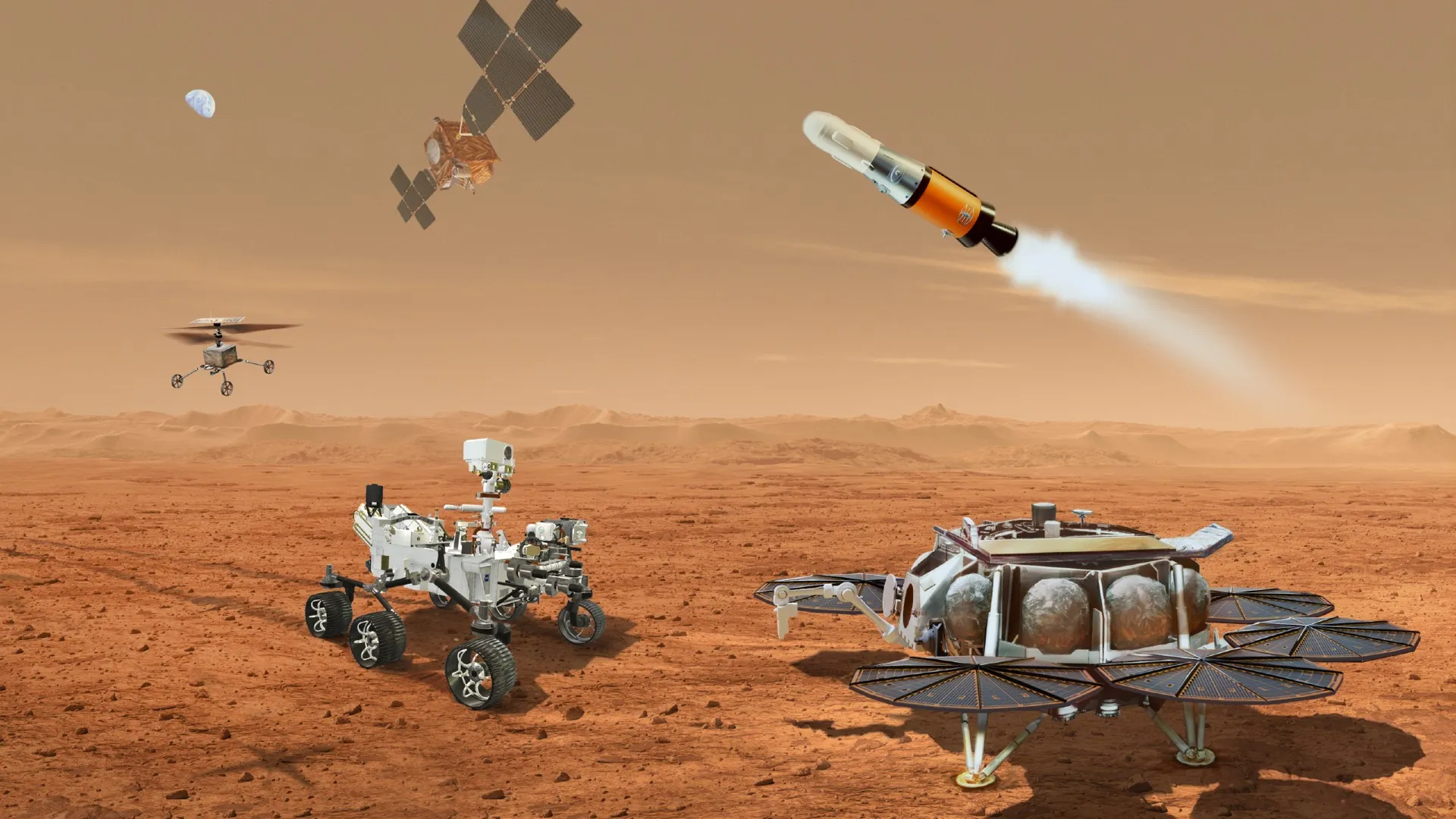
Among the agency's missions in perpetual déjà vu status is Mars Sample Return (MSR), an attempt to bring samples of the Red Planet back to Earth, an endeavor viewed as a U.S. high priority.
However, there's also been a recurrent whirlwind of fallout about Mars Sample Return in recent years, namely over its budget and feasibility. Is it too costly, too far in the future, too debatable? Experts say that despite the concerns, the mission should proceed and with great haste due to the fact that China is making great strides in advancing its own Red Planet sample return program.
Techno-squabbles
Following multiple reviews of the now joint NASA/European Space Agency MSR undertaking, there has been sticker-shock in recent years. A last estimate was about $11 billion, with samples being returned to Earth in 2040. Following that estimate, MSR's mission cost was deemed too costly, and the mission's complexity meant it would not be achieved on an acceptable timeline by NASA's former Administrator, Bill Nelson.
Throughout this time, squabbles over MSR have been ongoing. Meanwhile, NASA's Perseverance Mars rover has remained doggedly on the hunt for evidence of past life within Mars' Jezero Crater.
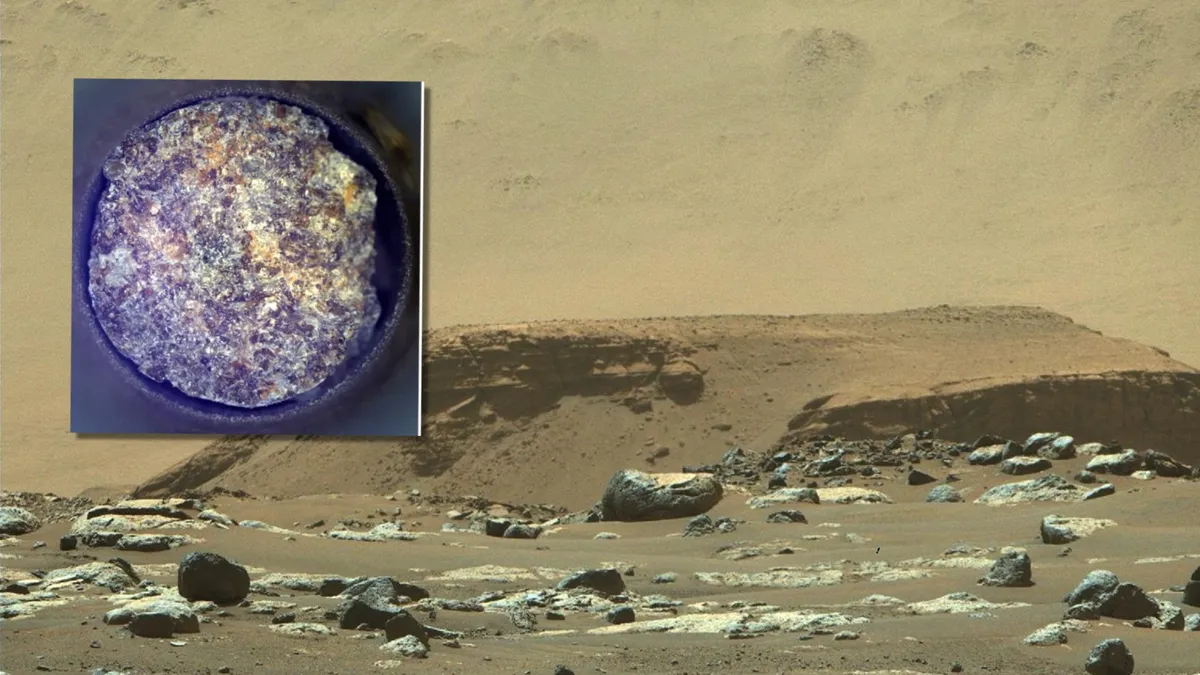
Since soft landing on Mars in February 2021, the car-sized robot has been hard at work obediently gathering rock samples across the Martian landscape. Some of those now-sealed specimens it has congregated may well contain signs of past life on the Red Planet. They are deemed rocket-ready for pick-up and express sendoff to Earth.
Whereas NASA's Perseverance rover has been barking up the tree of possible life on Mars, the White House released President Trump's 2026 Discretionary Funding Request calls for ending financially unsustainable programs - including Mars Sample Return. Even this week, the existing NASA/European Space Agency effort to establish a MSR program is slated to be discontinued. That's the word according to the Commerce, Justice, Science, and Related Agencies Appropriations Act, 2026.
China's Mars card
All that said, China is revving up its own effort to grab, bag, and tag Mars samples.
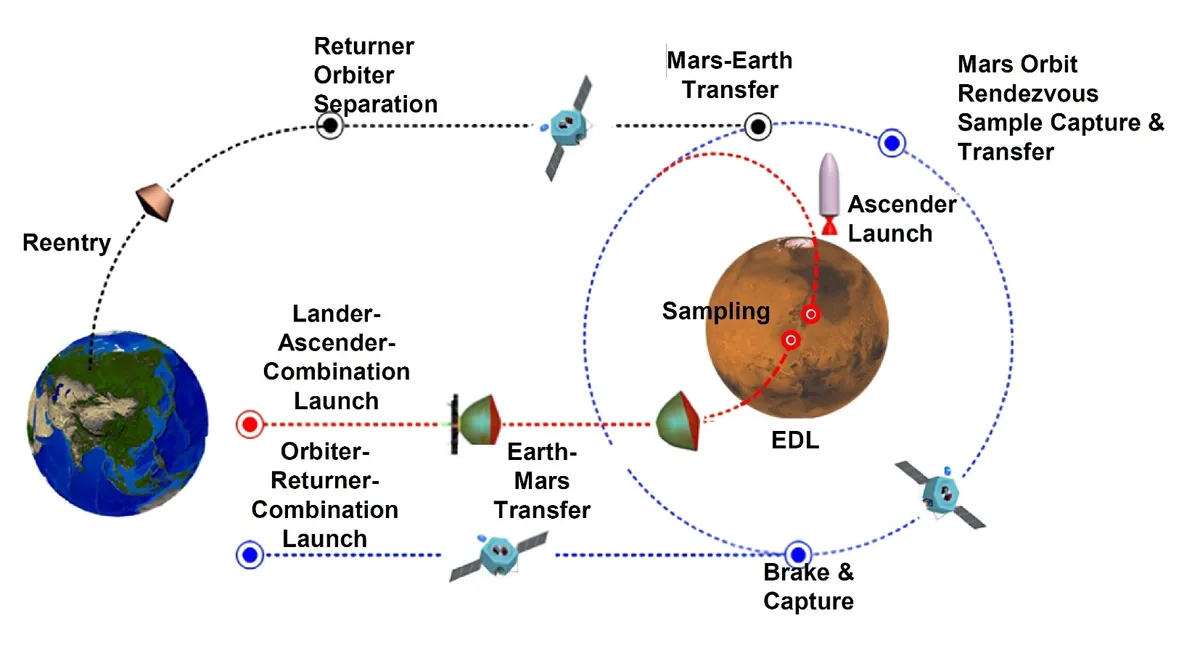
China is targeting its Tianwen-3 mission to haul back to Earth bits and pieces of Mars, an effort to collect and rocket to our planet at least a pound (500 grams) of the extraterrestrial goodies around 2031.
The preliminary proposed payload for the lander has reportedly been completed, as have preliminary studies on a strategy for the selection of the landing site.
China's landing zone stems from a review of 86 preliminary landing sites. The final, chosen site will favor the emergence and preservation of evidence of traces of life and detection of potential biosignatures in the returned samples.
Extant and past life
The Chinese mission aims to provide insights into nine scientific themes centered around the spacecraft's main focus - the search for extant and past life on Mars, explains Zengqian Hou of the Institute of Deep Space Sciences, Deep Space Exploration Laboratory, in Hefei, China, in a paper published June 2025 in Nature.
The plan is to launch two boosters in 2028 in support of MSR, and haul samples from Mars to Earth in 2031. A drill mounted on the lander will penetrate to a depth of 6.5 feet (2 meters) to collect several grams of subsurface samples, while a robotic arm will gather more than 400 grams of surface material from the landing site.
According to some scientific papers from China, there is also the likely use of a robot-armed helicopter. This drone is to be deployed for rock sampling at locations greater than 300 feet (over 100 meters) from the lander.
New space race — old news
In the interim, U.S. Senator Ted Cruz (R-Texas), Chairman of the Senate Committee on Commerce, Science, and Transportation, unveiled in early June of 2025 his legislative directives for Senate Republicans' budget reconciliation bill, shaped to beat China to Mars and the moon.
It dedicates almost $10 billion to win the new space race with China and ensure America dominates space by making, for one, targeted, critical investments in Mars-forward technology.
In the lawmaker's directive, Cruz calls for a Mars Telecommunications Orbiter, pegging $700 million for the commercial procurement of the dual-use orbiter. Its assignment is to handle communications for both a Mars Sample Return mission as well as future human Mars sojourns.
For its part, NASA is reviewing studies that detail more affordable and faster methods of robotically bringing samples from Mars' surface to Earth.
Still to weigh in on MSR decision-making is the newly seated NASA chief; Jared Isaacman is the 15th Administrator of NASA. He was formally confirmed by the United States Senate on December 17, 2025.
Red, white, and blue blueprint for Mars
So what could be the makeup of a detailed red, white and blue blueprint for human exploration of the Red Planet?
A study released Dec. 9, 2025 — "A Science Strategy for the Human Exploration of Mars" — comes from the National Academies of Sciences, Engineering and Medicine. It was sponsored by NASA.
The highest-priority, top of the list, science objective identified for the first human mission to Mars is the search for life. A blue-ribbon study group presented four possible campaigns for the human exploration of that planet.
The top ranked campaign involves human scrutiny of Mars lasting 30 sols — Mars days are slightly longer than an Earth day — steadfastly progressing to a longer 300 sol mission of a human expedition.
Flags and footprints?
That recent report provides a solid basis for how to proceed with a sustainable humans-to-Mars mission, well beyond "flags and footprints," said G. Scott Hubbard of Stanford University's department of aeronautics and astronautics.
As a major voice in shaping Red Planet exploration goals, Hubbard was director of NASA's Ames Research Center. He also served as the first "Mars Czar" by directing the space agency's Mars program at NASA Headquarters.
"My personal opinion is, if I was the Mars Czar once again, I would lobby very hard to have the robotic MSR go as soon as possible," Hubbard told Space.com, for the following reasons:
- Based on the on-the-spot measurements by NASA's Perseverance rover, there is a high-likelihood that the organic materials detected will show the fingerprints of life.
- For astronaut safety and to bolster success of the human exploration to come later, NASA needs an end-to-end demonstration of traveling to Mars, doing something scientifically useful, and returning safely. No one has ever launched to Mars orbit from the surface and MSR doing so would be a huge risk reduction.
- The detailed analysis of the samples will tell scientists definitively the level of toxicity risk to the astronauts.
"The Chinese may well beat the U.S. with a grab sample," Hubbard said. "Not nearly as scientifically useful as the well-selected Perseverance samples," he said, "but my impression is that the People's Republic of China cares much more about the headlines than the science."
Science-driven exploration
Bruce Jakosky is with the Laboratory for Atmospheric and Space Physics (LASP) at the University of Colorado in Boulder and Department of Earth and Space Sciences at the University of Washington.
Jakosky called the December issuance of the National Academies of Sciences report "an impressive job" of outlining the goals, concepts, and missions that can provide the science from the human Mars missions.
"They were agnostic on Mars Sample Return, but MSR may be the most-effective means for reducing risk and developing science," Jakosky told Space.com.
The report calls for "science-driven exploration", Jakosky said, reinforcing the previous NASA statements that science is a fundamental part of human missions to Mars. "This is a really important issue," he said.
Starting now
Jakosky said that, although the report didn't say this explicitly, planning for science to be integrated into the human-mission architecture should be carried out starting now.
"It is clear that there is a requirement for an ongoing robotic Mars program that would utilize precursor missions to help define the human-mission science and implementation at Mars and to reduce mission and astronaut risk," Jakosky said.
Jakosky's personal view is that it's now up to NASA. "Will NASA respond quickly and adequately to this report," he said, "by starting now to implement the committee recommendations and to plan for science on human missions?"
Without a strong response, said Jakosky, "it's not clear that science could be appropriately integrated later into architecture planning, and there is a risk that human missions could devolve into just 'flags and footprints.'"