






Space Weather Bill Introduced in US Senate
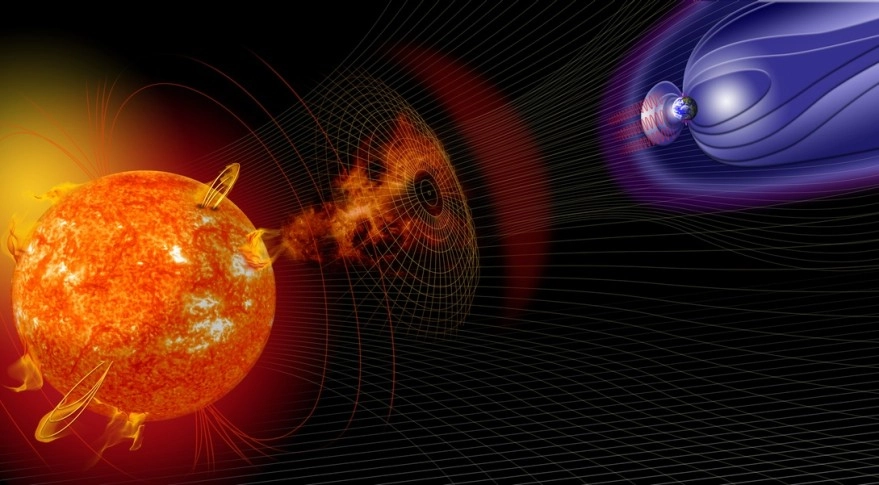
WASHINGTON — A bipartisan group of senators introduced legislation April 20 to improve space weather forecasting and preparedness efforts in parallel with a space weather strategy released by the White House last year.
The Space Weather Research and Forecasting Act is intended to codify into law the responsibilities various government agencies have for forecasting and studying space weather, as well as assessing the vulnerability of the electrical grid and other critical infrastructure to geomagnetic storms.
"We must ensure that we have the tools and resources to research and predict these events, and protect our nation's infrastructure so we can avoid an economic catastrophe in the event of severe space weather," said Sen. Gary Peters (D-Mich.), the lead sponsor of the bill, in a statement. Cosponsoring the bill are Sens. Cory Gardner (R-Colo.) and Cory Booker (D-N.J.). [The Worst Solar Storms in History]
Under the bill, the Department of Defense and the National Oceanic and Atmospheric Administration would take responsibility for providing operational space weather forecasts. NASA and the National Science Foundation would support that forecasting through basic space science research.
The bill directs NOAA to develop backup plans should satellites that currently provide data fail. Of particular concern is the Solar and Heliospheric Observatory, launched in 1995 and well past its design life. Agencies would also create plans for the development of next-generation space weather instruments, leaving open options to fly such instruments on small satellites or as hosted payloads, as well as commercial and international options for obtaining required data.
Other sections of the bill cover the development of space weather "benchmarks" that can be used to better understand the strength and frequency of solar storms, and requires that the Department of Homeland Security study the vulnerability of critical infrastructure to solar activity.
The bill parallels many aspects of a National Space Weather Action Plan released by the White House Office of Science and Technology Policy last year. That plan also called for the development of benchmarks, infrastructure assessments and improvements to space weather forecasting.
The White House developed the plan in response to growing concerns that the satellite navigation and communications systems, the electrical grid and other systems could be vulnerable to a powerful solar system that creates geomagnetic currents. One such powerful storm in 1859, known as the Carrington Event, created currents that shocked telegraph operators and started fires.
"Over the last several years, the potential impacts of a severe space weather storm on our critical infrastructure has captured the attention of senior government officials in the White House and Congress," said Tamara Dickinson, principal assistant director for environment and energy at OSTP, in a March 31 speech at a space weather forum here. That attention, she said, led to the development of the action plan and accompanying strategy.
The administration is also working with other nations to support international cooperation in solar storm forecasting and mitigation. The State Department hosted representatives of several countries April 4 for a discussion on space weather topics.
However, that action plan is simply administration policy, subject to change by future administrations. Officials in both industry and academia see the bill as a means of putting key elements of the action plan into law to avoid any potential disruptions created by the upcoming change in administrations.
“Early warning and prediction of space weather can help mitigate the economic effects both in space and here on the ground,” said Tom Stroup, president of the Satellite Industry Association (SIA), in a statement. “In this regard, SIA and its members support the Space Weather Research and Forecasting Act that codifies several actions identified in the National Space Weather Action Plan.”
This story was provided by SpaceNews, dedicated to covering all aspects of the space industry.
