Jupiter, the largest planet in our solar system, boasts a whopping 95 moons, making it the second-most populous planet in terms of its companions (Saturn has the most moons.)
Four of Jupiter's moons: Io, Europa, Ganymede and Callisto — known as the Galilean moons — were the first celestial objects to be discovered orbiting an object other than the sun or Earth when Galileo Galilei first observed them in 1610.
Most of Jupiter's moons are small, with about 60 of the satellites measuring less than 6.2 miles (10 kilometers) in diameter. Unusually, the outer moons orbit in the opposite direction to which Jupiter spins, suggesting they may have been captured by Jupiter's gravitational field after the initial system was formed.
Related: The 10 weirdest moons in the solar system
Jupiter's official moons: Names and discovery dates
Here is a list of 57 officially named moons of Jupiter along with details on their discovery, according to NASA.
Adrastea: Discovered in July 1979 by the Voyager science team.
Aitne: Discovered on 9 December 2001 by Scott S. Sheppard, David C. Jewitt and Jan T. Kleyna during observations at the Mauna Kea Observatory, Hawaii.
Amalthea: Discovered on September 9, 1892, by American astronomer Edward Emerson Barnard.
Ananke: Discovered on September 28, 1951, by American astronomer Seth Barnes Nicholson from a photograph made using the 100-inch (2.5 meter) Hooker telescope at the Mount Wilson Observatory in California.
Aoede: Discovered on February 8, 2003, by Scott S. Sheppard, David C. Jewitt, Jan T. Kleyna, Yanga R. Fernandez, and Henry H. Hsieh during observations at the Mauna Kea Observatory in Hawaii.
Arche: Discovered on October 31, 2002, by Scott S. Sheppard at the Mauna Kea Observatory in Hawaii.
Autonoe: Discovered on December 10, 2001, by Scott S. Sheppard, David C. Jewitt, and Jan T. Kleyna at the Mauna Kea Observatory in Hawaii.
Callirrhoe: Discovered on October 19, 1999, by Jim V. Scotti, Timothy B. Spahr, Robert S. McMillan, Jeffrey A. Larsen, Joe Montani, Arianna E. Gleason, and Tom Gehrels from observations made with the 36-inch telescope on Kitt Peak. The discovery was made during a course of observations by the Spacewatch program of the University of Arizona.
Callisto: Discovered on January 7, 1610, by Italian scientist Galileo Galilei.

Carme: Discovered on July 30, 1938, by Seth Barnes Nicholson during observations made with the 100-inch (2.5 m) Hooker telescope at the Mount Wilson Observatory in California.
Carpo: Discovered on February 26, 2003, by a team of astronomers from the University of Hawaii's Institute for Astronomy led by Scott S. Sheppard. The discovery was made using the 12-ft. (3.6-m) Canada-France-Hawaii telescope at the Mauna Kea Observatory in Hawaii.
Chaldene: Discovered on November 23, 2000, by Scott S. Sheppard, David C. Jewitt, Yange R. Fernandez, and Eugene Magnier at an observatory on Mauna Kea in Hawaii.
Cyllene: Discovered on February 9, 2003, by Scott S. Sheppard and his team from the University of Hawaii at the Mauna Kea Observatory, Hawaii.
Dia: Discovered on December 5, 2000, by Scott S. Sheppard, David Jewitt, Y. R. Fernandez, and G. Magnier with the 2.2-m reflector on Mauna Kea, Hawaii.
Eirene: Discovered on February 6, 2003, by Scott S. Sheppard, David C. Jewitt, and Jan T. Kleyna at the Mauna Kea Observatory in Hawaii.
Elara: Discovered on January 5 1905, by American astronomer Charles Dillon Perrine while looking at photographs taken with the Crossley 36-inch (0.9 meter) reflector of the Lick Observatory on Mount Hamilton at the University of California, San Jose.
Erinome: Discovered on November 23, 2000, by Scott S. Sheppard, David C. Jewitt, Yanga R. Fernandez and Eugene Magnier at the Mauna Kea Observatory in Hawaii.
Ersa: First spotted in 2017, the moon's discovery by Scott S. Sheppard and his team was announced in July 2018.
Euanthe: Discovered on December 11, 2001, by Scott S. Sheppard, David C. Jewitt and Jan T. Kleyna at the Mauna Kea Observatory in Hawaii.
Eukelade: Discovered on February 6, 2003, by Scott S. Sheppard at the Mauna Kea Observatory in Hawaii.
Eupheme: Discovered on March 4, 2003, by Scott S. Sheppard at the Mauna Kea Observatory in Hawaii
Euporie: Discovered on December 11, 2001, by Scott S. Sheppard, David C. Jewitt and Jan T. Kleyna at the Mauna Kea Observatory in Hawaii.
Europa: Discovered on January 8, 1610, by Italian scientist Galileo Galilei.
Eurydome: Discovered on December 9, 2001, by Scott S. Sheppard, David C. Jewitt and Jan T. Kleyna at the Mauna Kea Observatory, Hawaii.
Ganymede: Discovered on January 7, 1610, by Italian scientist Galileo Galilei.
Harpalyke: Discovered on November 23, 2000, by Scott S. Sheppard, David C. Jewitt, Yanga R. Fernandez, and Eugene Magnier at the Mauna Kea Observatory, Hawaii.
Hegemone: Discovered on February 8, 2003, by Scott S. Sheppard, David C. Jewitt, Jan T. Kleyna, Yanga R. Fernandez, and Henry H. Hsieh at the Mauna Kea Observatory, Hawaii.
Helike: Discovered on February 6, 2003, by Scott S. Sheppard at the Mauna Kea Observatory, Hawaii.
Hermippe: Discovered on December 9, 2001, by Scott S. Sheppard, David C. Jewitt and Jan T. Kleyna at the Mauna Kea Observatory, Hawaii.
Herse: Discovered on February 27, 2003, by Brett J. Gladman, John J. Kavelaars, Jean-Marc Petit, and Lynne Allen.
Himalia: Discovered on December 3, 1904, by American astronomer Charles Dillon Perrine while looking at photographs taken with the Crossley 36-inch (0.9 meter) reflector of the Lick Observatory on Mount Hamilton at the University of California, San Jose.
Io: Discovered on January 8, 1610, by Italian scientist Galileo Galilei.

Iocaste: Discovered on November 23, 2000, by Scott S. Sheppard, David C. Jewitt, Yanga R. Fernandez, and Eugene Magnier at the Mauna Kea Observatory, Hawaii.
Isonoe: Discovered on November 23, 2000, by Scott S. Sheppard, David C. Jewitt, Yanga R. Fernandez, and Eugene Magnier at the Mauna Kea Observatory, Hawaii.
Kale: Discovered on December 9, 2001, by Scott S. Sheppard, David C. Jewitt and Jan T. Kleyna at the Mauna Kea Observatory, Hawaii.
Kallichore: Discovered on February 6, 2003, by Scott S. Sheppard at the Mauna Kea Observatory, Hawaii.
Kalyke: Discovered on November 23, 2000, by Scott S. Sheppard, David C. Jewitt, Yanga R. Fernandez, and Eugene Magnier at the Mauna Kea Observatory, Hawaii.
Kore: Discovered on February 8, 2003, by Scott S. Sheppard, David C. Jewitt and Jan T. Kleyna at the Mauna Kea Observatory, Hawaii.
Leda: Discovered on September 14, 1974, by American astronomer Charles Thomas Kowal during observations of plates taken from Sept. 11 through 13, 1974 at the Palomar Observatory, California.
Lysithea: Discovered on July 6, 1938, by American astronomer Seth Barnes Nicholson with the 100-inch (2.5 m) Hooker telescope at the Mount Wilson Observatory, California.
Megaclite: Discovered on November 25, 2000, by Scott S. Sheppard, David C. Jewitt, Yanga R. Fernandez, and Eugene A. Magnier at the Mauna Kea Observatory in Hawaii.
Metis: Discovered in March 1979 by the Voyager science team.
Mneme: Discovered on February 9, 2003, by Scott S. Sheppard and Brett Joseph Gladman at the Mauna Kea Observatory, Hawaii.
Orthosie: Discovered on December 11, 2001, by Scott S. Sheppard, Yanga R. Fernandez and David C. Jewitt at the Mauna Kea Observatory, Hawaii.
Pandia: First spotted in 2017, the moon's discovery by Scott S. Sheppard and his team was announced in July 2018.
Pasiphae: Discovered on January 27, 1908, by British astronomer Philibert Jacques Melotte with the Greenwich Observatory's 30-inch Cassegrain telescope.
Pasithee: Discovered on December 11, 2001, by Scott S. Sheppard, David C. Jewitt and Jan T. Kleyna at the Mauna Kea Observatory, Hawaii.
Philophrosyne: Discovered in April 2003 by Scott S. Sheppard at the Mauna Kea Observatory in Hawaii.
Praxidike: Discovered on November 23, 2000, by Scott S. Sheppard, David C. Jewitt, Yanga R. Fernandez, and Eugene Magnier at the Mauna Kea Observatory, Hawaii.
Sinope: Discovered on July 21, 1914, by American astronomer Seth Barnes Nicholson during observations of photographic plates taken with the Lick Observatory's 36-inch (0.9 meter) telescope in California.
Sponde: Discovered on December 9, 2001, by Scott S. Sheppard, David C. Jewitt and Jan T. Kleyna at the Mauna Kea Observatory, Hawaii.
Taygete: Discovered on November 25, 2000, by Scott S. Sheppard, David C. Jewitt, Yanga R. Fernandez, and Eugene Magnier at the Mauna Kea Observatory, Hawaii.
Thebe: Discovered in 1980 by the Voyager science team investigating images captured by Voyager 1.
Thelxinoe: Discovered on February 9, 2003, by Scott S. Sheppard and Brett J. Gladman at the Mauna Kea Observatory, Hawaii.
Themisto: Discovered initially on September 30, 1975, by American astronomers Charles Thomas Kowal and Elizabeth Roemer. The little moon was then lost until 2000 when it was rediscovered by Scott S. Sheppard, David C. Jewitt, Yanga Roland Fernandez and Eugene A. Magnier during their search for small irregular Jovian moons using the 27-foot (8.3m) Subaru telescope and the 11.8-foot (3.6m) Canada-French-Hawaii telescope at Mauna Kea Observatories, Hawaii.
Thyone: Discovered on December 11, 2001, by Scott S. Sheppard, David C. Jewitt and Jan T. Kleyna at the Mauna Kea Observatory, Hawaii.
Valetudo: First spotted in 2017, the moon's discovery by Scott S. Sheppard and his team was announced in June 2018.
Galilean moons: Jupiter's biggest satellites
1. Ganymede
Diameter: 3,270 miles (5,260 kilometers)
Jupiter's moon Ganymede is the biggest moon in the solar system, it is even larger than the planet Mercury. It is also the only moon that we know of to have its own magnetic field, which causes impressive polar light shows — auroras. Furthermore, the giant moon could harbor a subsurface saltwater ocean which has been theorized to hold more water than all the water on Earth's surface, according to NASA Science.
2. Europa
Diameter: 1,940 miles (3,100 km)
Europa is thought to have an iron core, rocky mantle and a surface of frozen water ice that sits atop a vast saltwater ocean. According to NASA, the icy moon Europa is thought to be the most promising place to find an environment that could support life forms beyond Earth. The theorized subsurface saltwater ocean could contain twice as much water as Earth's oceans combined and have existed long enough for life to have possibly begun and even evolved.
3. Io
Diameter: 2,260 miles (3,640 km)
The most volcanically active place in the solar system, Io is a remarkable world locked in a "tug-of-war" between Jupiter's gravity and pulls from neighboring Galilean moons Europa and Ganymede. The turbid environment continually renews itself, smoothing out craters with vast lakes of lava spewed from one of the hundreds of volcanoes that blanket the landscape.
4. Callisto
Diameter: 2,995 miles (4,820 km)
Jupiter's second-largest moon Callisto is the third-largest moon in the solar system. The moon's surface is thought to be about 4 billion years old, making it the oldest icy surface in the solar system. After being pummeled for4 billion years by impactors such as meteors, it comes as no surprise that Callisto also holds the record for the most heavily cratered body in the solar system.
Exploration of Jupiter and its moons

The Jovian system is no stranger to guests. Since its first visitor in December 1973 when NASA's Pioneer 10 spacecraft conducted a flyby of the gas giant, Jupiter has attracted numerous flybys and close encounters from trailblazing probes. Pioneer 11 made a close approach a year after Pioneer 10 in December 1974 and Voyager 1 and Voyager 2 flew past Jupiter in 1979.
But it wasn't until NASA's Galileo spacecraft approached the Jovian system in December 1995 that the gas giant finally had a guest stay for any significant length of time. Galileo was the first spacecraft to orbit Jupiter and made substantial discoveries about the gas giant and its moons. The spacecraft spent almost eight years in Jupiter's neighborhood, revealing its many secrets, from a possible subsurface ocean on Jupiter's icy moon Europa, to volcanoes on the moon Io. At the end of its stay in September 2003, Galileo intentionally crashed into the gas giant to prevent collisions and subsequent contamination with the Jovian moons.
The NASA-ESA Ulysses mission used Jupiter for a couple of gravity-assist maneuvers in 1992 and 2004 while en route to the sun and NASA's Cassini-Huygens spacecraft also paid Jupiter a brief visit while journeying to Saturn. Cassini made its close approach to Jupiter in December 2000 and collected around 26,000 images of the gas giant in the process. Then NASA's New Horizons spacecraft called in on Jupiter in February 2007 during its trip to Pluto and revealed impressive nighttime auroras and lightning near the planet's poles.
The Jovian system is currently being explored by NASA's Juno mission which arrived in July 2016. Juno is only the second spacecraft to orbit Jupiter and is busy investigating its composition, atmosphere, gravity and magnetic field. Juno aims to learn more about the origin and evolution of Jupiter and the solar system.
Next on the roster to visit the Jovian neighborhood is ESA's Jupiter Icy Moons Explorer, JUICE. JUICE successfully launched on April 14, 2023, at 8:14 a.m. EDT (1214 GMT) from Europe's Spaceport in Kourou, French Guiana. But be patient, it will take nearly eight years to reach the largest planet in the solar system. The mission will explore Jupiter and three of its Galilean moons: Ganymede, Callisto and Europa.
NASA's Europa Clipper mission is scheduled to launch in October 2024. The mission will focus on Jupiter's icy moon Europa and investigate whether the strange world harbors conditions that could accommodate life.
How to see Jupiter's moons for yourself
With the right equipment, it is possible to spot Jupiter and its four Galilean moons. Our visible planets guide tells you where you can find the brightest planets that month and the best times to view them.
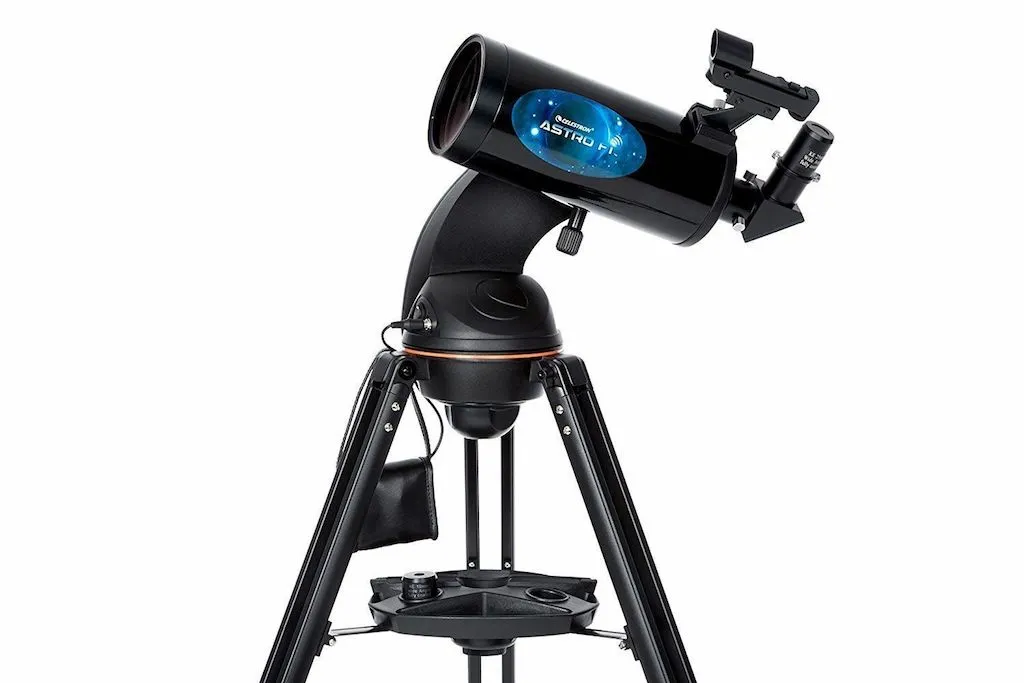
Looking for a telescope to view the planets? We recommend the Celestron Astro Fi 102 as the top pick in our best beginner's telescope guide.
Jupiter can reach magnitude -2.94 at this brightness you can spot the gas giant with the naked eye, a pair of binoculars or a small telescope. (On the magnitude scale used by astronomers, lower numbers signify brighter objects. For example, at its brightest, the planet Venus shines with a magnitude of about -4.6). You'll need a good pair of binoculars (at least x10 magnification) or a small telescope to see the Galilean moons.
To find out where and when to look out for Jupiter's moons, we recommend using skywatching apps like SkySafari or software like Starry Night. Our picks for the best stargazing apps may help you with your planning.
If you're looking for a telescope or binoculars to observe Jupiter and its moons, our best telescopes for seeing planets guide can help. We also have guides on the best binoculars deals and the best telescope deals, which may come in useful when hunting for a bargain.
Additional resources
Learn more about ESA's JUICE mission to Jupiter's icy moons with this video from ESA. Read more about whether there could be life on Jupiter's moons with this article by Jonathan O'Callaghan in the EU Research and Innovation magazine Horizon. Do you think you've discovered a new moon or something else exciting? The International Astronomical Union Report has a guide to the most common objects that you may have observed as well as information on how to officially report your findings.
Bibliography
ESA. Missions to Jupiter. ESA Science & Technology. Retrieved October 21, 2022, from https://sci.esa.int/web/juice/-/59909-missions-to-jupiter
NASA. Callisto. NASA. Retrieved October 21, 2022, from https://solarsystem.nasa.gov/moons/jupiter-moons/callisto/in-depth/
NASA. Europa Clipper. NASA. Retrieved October 21, 2022, from https://www.jpl.nasa.gov/missions/europa-clipper
NASA. Io. NASA. Retrieved October 21, 2022, from https://solarsystem.nasa.gov/moons/jupiter-moons/io/in-depth
NASA. Jupiter moons. NASA. Retrieved October 21, 2022, from https://solarsystem.nasa.gov/moons/jupiter-moons/overview
NASA. Europa. NASA. Retrieved October 21, 2022, from https://solarsystem.nasa.gov/moons/jupiter-moons/europa/overview/
NASA. Ganymede. NASA. Retrieved October 21, 2022, from https://solarsystem.nasa.gov/moons/jupiter-moons/ganymede/overview/
Williams, M. (June 10, 2015). The moons of Jupiter. Phys.org. Retrieved October 21, 2022, from https://phys.org/news/2015-06-moons-jupiter.html