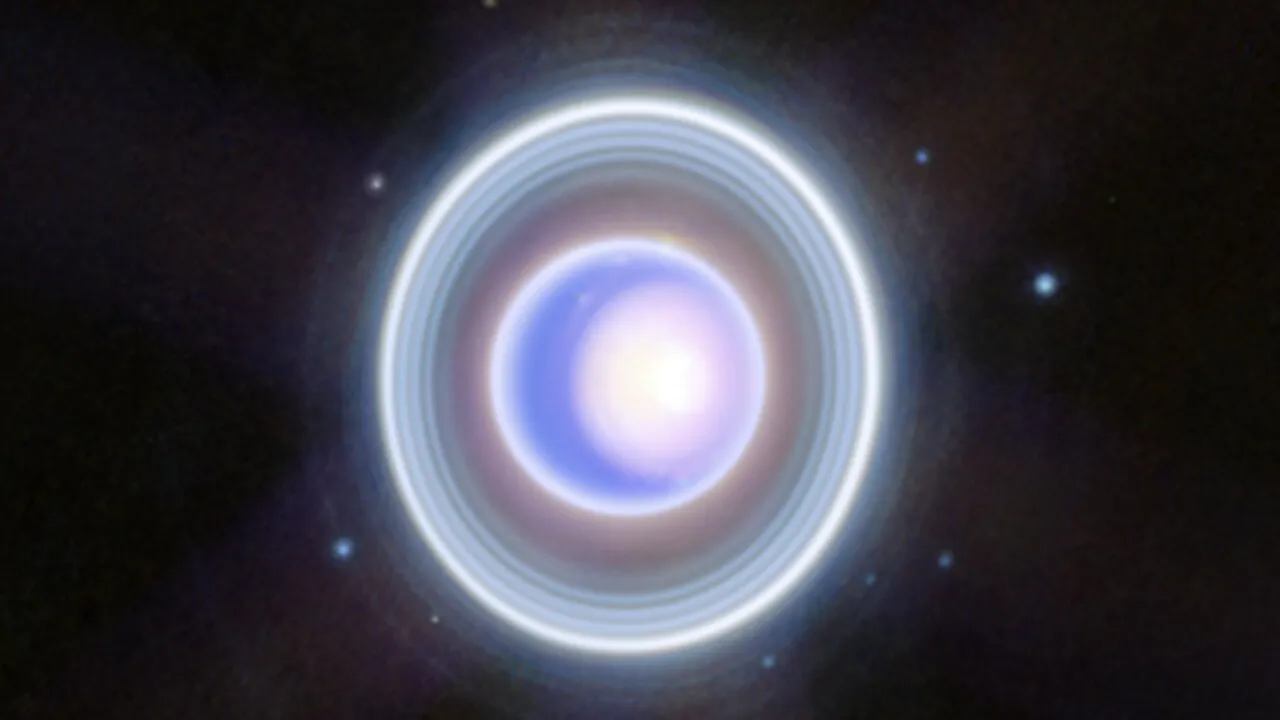
New observations of Uranus's enigmatic outer rings have shown them to be even more mysterious than astronomers had thought, and their unusual properties hint at some puzzling things going on with the planet's system of moons.
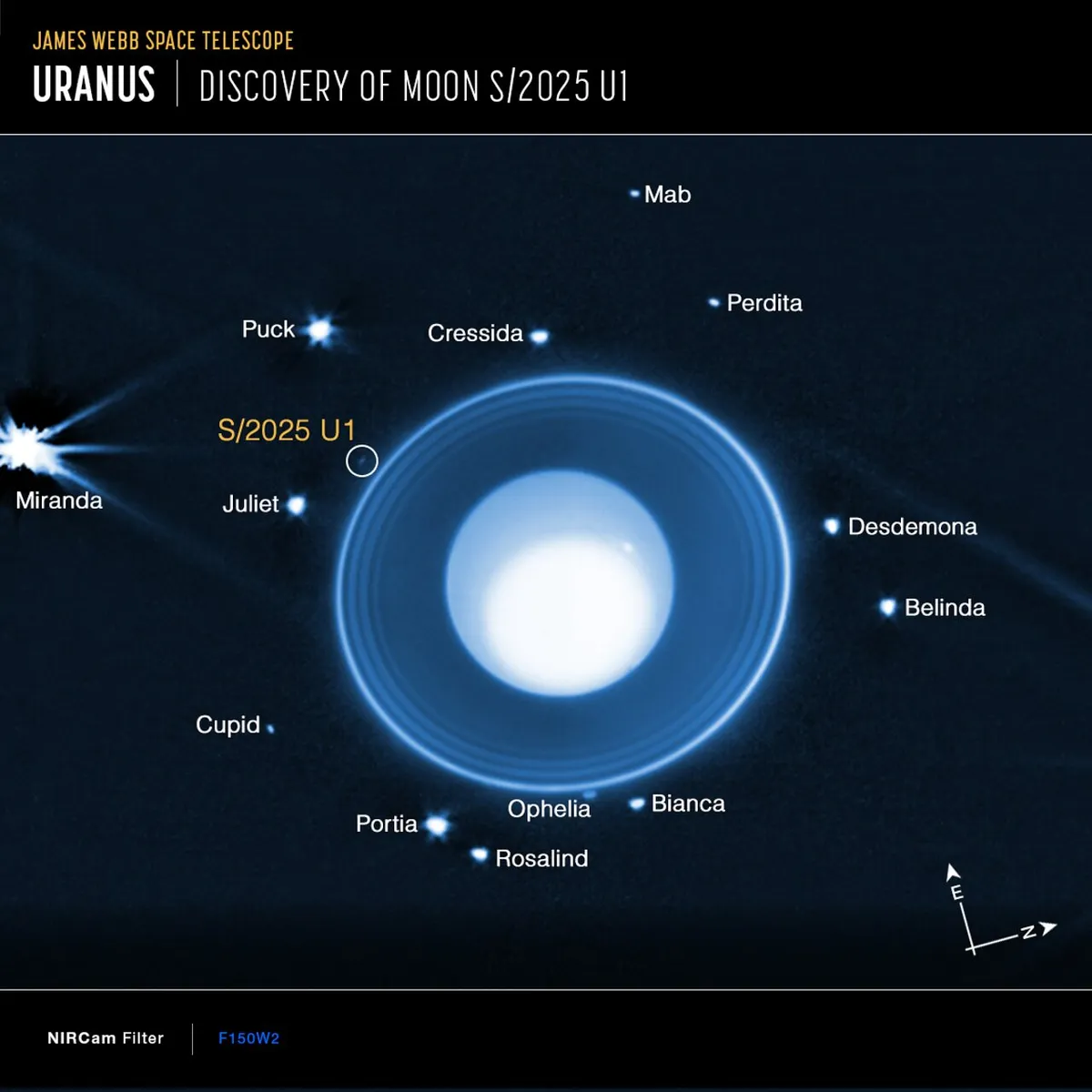
These observations suggest that small, mysterious moons with surprisingly different natures are the source of the particles that make up the two outermost rings, and that there are probably even more undiscovered moons to add to the 29 already known around Uranus.
Uranus's rings are not like the bright, intricate structure of Saturn's famous rings. Quite the contrary: Uranus' rings were only discovered in 1977 when they were noticed to block the light of background stars during stellar occultations, when Uranus was seen to move in front of a star from our point of view on Earth.
Voyager 2 captured the first images of Uranus's rings when it flew past the seventh planet from the sun in January 1986, and since then the Hubble Space Telescope and the ten-meter telescopes at W. M. Keck Observatory on Mauna Kea in Hawaii have discovered further faint rings around the ice giant, bringing the total to 13. The rings are named after the Greek alphabet and the last two, outermost, rings named (𝛍) and nu (𝛎) were not discovered until a period of observations between 2003 and 2005 by a team led by the SETI Institute's Mark Showalter.
The mu- and nu-rings are especially puzzling. Those initial observations showed that the mu-ring was bluer than the nu-ring, which has a red tint. The colors are informative of their composition. Blue implies very small particles, while red is indicative of dust. It would seem that the mu- and nu-rings have very different origins, but no one knew what those origins were.
Now, by adding infrared data from the James Webb Space Telescope to the older Hubble and Keck observations, a team led by Imke de Pater of the University of California, Berkeley and including Showalter, has been able to produce the first complete reflectance spectrum of the rings, which refers to how they reflect sunlight. The spectrum confirmed their colors and provided some indication of their origin.
"By decoding the light from these rings, we can trace both their particle size distribution and composition, which sheds light on their origins, offering new insight into how the Uranian system and planets like it formed and evolved," said de Pater in a statement.
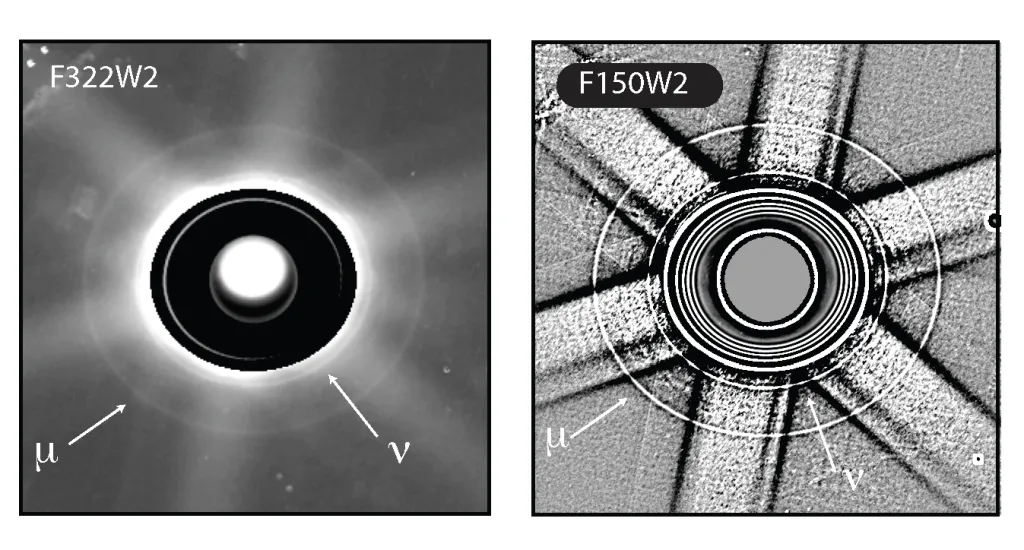
Uranus's moons are named after characters from the plays of William Shakespeare and a poem by Alexander Pope, a convention begun by John Herschel. The five large moons — Miranda, Oberon, Titania, Umbriel and Ariel — orbit Uranus farther out, but 14 of the small moons orbit Uranus closer than those five moons, and it is among these 14 moons that the mu- and nu-rings are found.
The reflectance spectrum shows that the mu-ring is made from particles of water-ice. This matches the only other blue ring in the solar system, namely Saturn's E-ring that is produced by cryovolcanism on Saturn's moon Enceladus, which squirts geysers of water into space. The icy particles in the mu-ring have even been traced back to their source: an irregular, 12-kilometer (7.5-mile) wide moon called Mab that was discovered by Showalter in 2003. Yet most of the other inner moons tend to be dustier and rockier. Why is Mab largely ice?
Meanwhile, the nu-ring is dirtier, with 10 to 15% of its composition made from carbon-rich organic compounds of the type typically found in the cold environs of the outer solar system. It would seem that the nu-ring is being produced by dust sputtered off undiscovered moonlets that reside within the group of inner moons.
"The nu-ring material is sourced from micrometeorite impacts on and collisions between unseen rocky bodies rich in organic materials, which must orbit between some of the known moons," said de Pater. "One interesting question is why the parent bodies sourcing these rings are so different in composition."
There are hints that the mu-ring is changing in brightness subtly, though what this clue is telling us is not yet understood. However, given the small size and faintness of these tiny moons, it would seem that solving the mysteries of Uranus and its system of rings and moons must await a new mission.
"I suspect we will need close-up images from a future spacecraft mission to Uranus in order to answer that question," said Showalter.
Fortunately a mission is in the works — funding permitting — since returning to Uranus was the top planetary priority in the most recent Decadal Survey from the National Academy of Sciences.
The findings were published on April 16 in the Journal of Geophysical Research: Planets.