The June evening sky this year is exceptionally interesting.
A spectacular gathering of three planets, two bright stars, plus, later this month, a slender crescent moon, will be the chief celestial attraction in the evening sky during the next few weeks. It will, in fact, be possible for anyone with a clear and unobstructed view of the western sky to see all three planets at a single glance.
And two of these planets — Venus and Jupiter — are by far the brightest of those that are readily visible with the unaided eye. In fact, on one particular evening, Tuesday, June 9, these two worlds will seem to "call attention to themselves," even to those who normally do not look up into the night sky.
Jupiter and Venus draw together
No doubt during the past week or so, even casual sky watchers have already taken note of Venus and Jupiter in the guise of two very bright "stars" that have been evident in the west-northwest sky for at least a couple of hours after sunset.
Both shine with a silvery-white luster and one — Venus — appears considerably brighter. And especially noticeable over the course of recent nights is that they seem to be drawing closer to each other. In fact, at this moment in time, from our earthly viewpoint, they literally are like two celestial ships passing in the night. Jupiter will appear about one-seventh as bright as Venus.

On June 7, the two planets will appear side-by-side as they descend toward the horizon, with Jupiter on the left and Venus on the right. They'll be separated by 2.3 degrees. On June 8, Venus will have moved to the upper right of Jupiter, the gap between them having been reduced to 1.8 degrees.

As we have just noted, the two planets will appear closest on June 9. The actual closest approach, with Venus sliding just 1.6 degrees above (north) of Jupiter, will take place at 12 hours Universal Time (UT), which is during the daytime for North America. At that time, just over three times the apparent width of the full moon will separate these two planets. Nonetheless, even though they will already be in the process of slowly separating as darkness falls later that evening, the two planets will still appear practically as close as they were just hours before.
Thereafter, Jupiter will appear to drop rapidly away from Venus, setting progressively earlier and becoming more and more deeply immersed in the bright evening twilight during the balance of June. It will likely disappear in early July.

Venus, on the other hand, reaches its highest altitude in the western evening twilight during June for this current apparition and captures the gaze of millions. All through June, it will appear each evening more than 25 degrees high in the west right after sunset and will not drop below the horizon until at least 2.5 hours later. During this time, Venus will be setting unusually late in the evening, not disappearing beyond the west-northwest horizon until after 11 p.m.
Mercury joins the lineup
While all this is taking place, a third planet will be evident below Venus and Jupiter. That third planet will be Mercury.
Mercury is often cited as the most difficult of the five bright planets to see. Called an "inferior planet" because its orbit is nearer to the sun than the Earth's, Mercury –scarcely more than half as far from the sun as Venus is — always appears from our vantage point to be in the same general direction as the sun and it's usually lost in the sunlight. Yet it's not really that hard to see. You simply must know when and where to look and find a clear horizon.
And for those living in the Northern Hemisphere, a great "window of opportunity" for viewing this rocky little world in the evening sky has just opened. That window, in fact, will remain open through at least June 22, giving you an ample number of chances to see this so-called "elusive planet" with your own eyes.
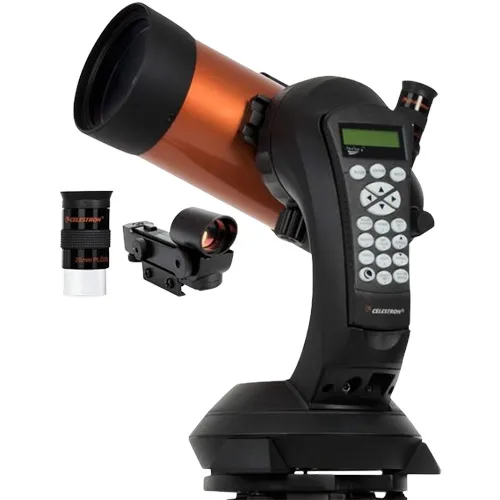
Looking for a telescope to explore the planets in more detail? We recommend the Celestron Nexstar 4SE as our top telescope for beginners.
Currently, Mercury is visible about 45 minutes after sunset. You can use Venus to guide you to Mercury. Just look low toward the west-northwest horizon and you'll readily see Venus shining brightly in the twilight sky. Then look about 15 degrees below and to the right of Venus — your clenched fist held at arm's length measures 10 degrees. Much fainter Mercury will be roughly "one and half fists" from Venus and will be shining with just a trace of a yellowish-orange tinge.
And Mercury will be shining at a very respectable magnitude of -0.2, rivaling orange Arcturus, the fourth brightest star in brilliance. Venus, however, will appear some 33 times brighter.
In the evenings that follow, Mercury will slowly diminish in brightness, but it will also slowly gain altitude as it gradually moves away from the vicinity of the sun. It will achieve its greatest eastern elongation — its greatest angular distance when it will be 25 degrees removed from the sun at magnitude +0.4 — on June 15.
By the evening of June 23, Mercury's brightness will have dropped to magnitude +1.3, equal to the star Regulus in Leo; only one-quarter as bright as it was on June 5. In telescopes, it will appear as a narrowing crescent phase. This will probably be your last view of it. Thereafter, the combination of its lowering altitude, plus its descent into a much-brighter sunset glow, should finally render Mercury invisible. It will pass through inferior conjunction — between the sun and Earth — on July 12.
Enter Gemini's twin stars
Amidst this planet array is a pair of bright stars: Pollux and Castor. They are often considered winter stars, though they remain evident in the west-northwest sky well into the spring. They are the brightest stars in the zodiacal constellation of Gemini, the Latin word for "twins." The two stars represent their heads.
Pollux is slightly brighter (1st magnitude with a slight orange-yellow color) and Castor (2nd magnitude, white). They are a scant 4.5 degrees apart, making good measuring points. In telescopes, Castor is more interesting: it is one of the many "double" stars in the sky. As a matter of fact, it's a triple star, and each of its three components is a double star (six in all!). Through it all, the Twins serve as bystanders, seemingly watching as Venus, Jupiter and Mercury scurry past them during the first three weeks of June.
The moon completes the show
The moon, our nearest neighbor in space, will join the planetary/stellar parade during the third week of June. On June 16, it will appear as a slender sliver of light, just two days past new phase and sitting a little less than 3 degrees above Mercury and 5 degrees to the lower right of Jupiter. Then on June 17, the slightly wider lunar crescent will appear just a couple of degrees to the left of brilliant Venus; the two brightest objects in the night sky adorning the west-northwest evening sky.
Here is a chance to see for yourself that nearby solar system objects generally seem to move faster than more distant ones. Indeed, on June 16 and June 17, as darkness falls, we will have a configuration laid out before us consisting of the moon at 224,000 miles (361,000 km) from Earth; Mercury at 75 million miles (120 million km); Venus at 107 million miles (171 million km) and Jupiter at 568 million miles (914 million km). The motion of the moon can be detected with the naked eye in less than an hour, that of Mercury and Venus from night to night, but Jupiter's travel among the background stars is not very noticeable in even a week. In small telescopes, each object has high interest: Mercury and Venus for their phases, Jupiter for its cloud belts and four Galilean satellites, and finally the moon for its rich surface detail.
The planets in the night sky are always shifting in and out of celestial liaisons and a wide variety of different conjunctions and configurations typically occur during any given year. It is highly unusual, however, when three or more bright planets appear to reside in the same area of the sky. So, in the evenings ahead, everyone should make a concerted effort to go out and look, since similar planet gatherings will be few and far between in the future.

Incidentally, the next time such a favorable June gathering of Mercury, Venus and Jupiter along with Pollux and Castor and the crescent moon occurs again won't come until the year 2085! In fact, on June 14 of that year, those three planets will form an eye-catching compact triangle less than 2 degrees wide.
Mark your calendars.
If you're looking for a telescope or binoculars to observe the night sky, our guides for the best binocular deals and the best telescope deals can help. Our best cameras for astrophotography and best lenses for astrophotography can help you get ready to capture the next stunning skywatching event.
Joe Rao serves as an instructor and guest lecturer at New York's Hayden Planetarium. He writes about astronomy for Natural History magazine, Sky and Telescope, The Old Farmer's Almanac and other publications.