Mars missions have been launching from Earth with regularity since the 1960s, bent on exploring our planetary neighbor. With its potential for liquid water — and therefore, life — Mars is an alluring target.
But it's a difficult journey, and only about half of all Mars missions successfully make it to the Red Planet, according to NASA. A "Great Galactic Ghoul" must be consuming them, joked a journalist and a NASA scientist corresponding in 1964, reported the Economist.
Since the first successful flyby in 1965, several space agencies have successfully made it to Mars. NASA, the former Soviet Union space program, the European Space Agency (ESA) and the Indian Space Research Organization each met with earlier successes.
Related: How long does it take to get to Mars?

A significant batch of Mars-bound missions arrived in February 2021. NASA's Perseverance rover and Ingenuity helicopter reached Mars that month, along with the United Arab Emirates' Hope orbiter (a first interplanetary mission for that country) and the China National Space Administration's Tianwen-1 orbiter and lander-rover mission, which was China's first successful mission to the Red Planet.
Coming up in the 2020s and 2030s, the Japan Aerospace Exploration Agency (JAXA) is planning a sample-return mission from Mars' moon Phobos, and NASA has teamed up with the ESA on a sample-return mission from Mars itself.
Early Mars missions

Humanity first attempted to reach Mars near the dawn of the space age. The first satellite, the Soviet Union's Sputnik, launched in 1957; only three years later, the Soviet space program looked to extend its reach to Mars.
More formally known as the Union of Soviet Socialist Republics (USSR), the Soviet Union made multiple attempts in the 1960s to reach the Red Planet, and NASA soon followed with its Mariner 3 spacecraft. None of these early missions reached their target, or even got close, according to the NASA historical log of all Mars missions and RussianSpaceWeb.com.
First success and more attempts,1964 - 1971

NASA's Mariner 4 was the first craft to finally reach Mars. The spacecraft launched on Nov. 28, 1964, and was the first to fly by the planet on July 14, 1965. It sent 21 photos of its target back to Earth.
Two days after Mariner 4 launched, the Soviet Union tried again with Zond 2. The spacecraft passed by Mars, but its radio failed and it did not return any planetary data.
The U.S. also launched Mariner 6 and Mariner 7 in 1969, both of which reached Mars and sent back a few dozen photos, according to NASA JPL. All of these spacecraft happened to fly over areas of Mars that were covered in craters, giving astronomers the false first impression that Mars looked like the moon.
Several more attempts were made between 1969 and 1971, but most failed to reach their target.
More failed missions:
- March 27, 1969: Mars 1969A (USSR) launched but was destroyed before reaching Earth orbit.
- April 2, 1969: Mars 1969B (USSR) failed during its attempted launch.
- May 8, 1971: Mariner 8 (U.S.) failed during its attempted launch.
- May 10, 1971: Kosmos 419 (USSR) launched and achieved Earth orbit before suffering a fatal issue.
In 1971, the Soviet Union finally reached the Red Planet. Its Mars 2 orbiter, which launched May 19, 1971, arrived on Nov. 2. However, when the Mars 2 lander was deployed it crashed, inoperable, on the surface. Mars 3, another orbiter and lander mission, launched on May 28, 1971, and arrived on the Red Planet Dec. 3.
The Mars 3 lander was the first spacecraft to successfully complete a soft landing on another planet, but was lost nearly immediately thereafter. While the lander worked for only a few seconds on the surface before failing, the orbiter remained operational.
Mariner 9 and the Viking missions, 1971-1980s

The public's image of Mars changed with the arrival of NASA's Mariner 9 in November 1971. The spacecraft, which launched on May 30, 1971, arrived at Mars when the entire planet was engulfed in a dust storm. What's more, something mysterious was poking above the plumes of dust.
When the debris settled to the surface, scientists discovered those unusual features were the tops of dormant volcanoes. Mariner 9 also discovered a huge rift across the surface of Mars, later called Valles Marineris — after the spacecraft that discovered it. Mariner 9 spent nearly a year orbiting the Red Planet, and returned 7,329 photos.
As the Soviet Union continued its Mars series of spacecraft, it garnered partial success. But out of four spacecraft aimed for the Red Planet, only one orbiter and one lander briefly returned data in 1974:
- July 21, 1973: Mars 4 (USSR) launched and then flew by Mars on Feb. 10, 1974. It was intended to orbit the planet, not keep going.
- July 25, 1973: Mars 5 (USSR) launched and settled into orbit around Mars on Feb. 12, 1974, but lasted only a few days.
- Aug. 5, 1973: Mars 6 (USSR) launched with a flyby module and lander that arrived at the Red Planet on March 3, 1974, but the lander was destroyed upon impact.
- Aug. 9, 1973: Mars 7 (USSR) launched again with a flyby module and lander, and arrived at the Red Planet on March 3, 1974, but the lander missed the planet.
Meanwhile, NASA sent two pairs of orbiters and landers toward Mars in 1975. Viking 1 and Viking 2 both arrived at the Red Planet in 1976, and sent their lander to the surface while the orbiter remained working above. The Viking program represented the first extended exploration of Mars, as each spacecraft lasted years and transmitted reams of information back to Earth. Hopes of finding life on the Red Planet, however, were dashed when the probes could not definitively prove the existence of microbes on the surface.
The Viking missions also revealed that the composition of Mars was almost identical to certain meteorites found on Earth. This suggested that some meteorites found on Earth were originally from Mars.
The Soviet Union also made two attempts to reach one of the moons of Mars, Phobos, in the 1980s, but both missions failed. The Soviet Union was dissolved in 1991, and the Russian space program took over where the USSR left off, according to a 1994 paper published in the journal Science and Global Security.
Faster, better, cheaper in the 1990s

NASA's Mars Observer launched on Sept. 25, 1992. Just before it was supposed to achieve Mars orbit on Aug. 21, 1993, the spacecraft was lost. While the communication failure was never fully explained, the most likely cause was a fuel tank rupture that caused the spacecraft to spin out of contact with Earth, according to the 2018 book "Beyond Earth: A Chronicle of Deep Space Exploration" by Asif Siddiqi.
The loss was especially painful because the spacecraft had cost so much: an estimated $813 million, nearly four times the original budget for the project. The exorbitant cost and the spacecraft's failure sparked a new movement within NASA to create missions that would take advantage of advanced computer electronics and new team management techniques. NASA called it the Faster, Better, Cheaper program (FBC).
In the meantime, NASA's Mars Global Surveyor (MGS) left Earth on Nov. 7, 1996, and arrived at Mars on Sept. 12, 1997. Its mission was extended several times until NASA lost contact with it in 2006. MGS mapped the Red Planet from pole to pole, revealing many ancient signs of water, such as gullies formed by moving liquid and hematite (a mineral that forms in water). Data from MGS helped NASA decide where to land its future Mars rovers. MGS also took pictures of public interest, including re-imaging the famous "face on Mars."
The Russian space agency continued the Soviet quest for Mars with their Mars 96 mission, which launched on Nov. 16, 1996. However, the orbiter, two landers and two penetrators were lost after the rocket failed.
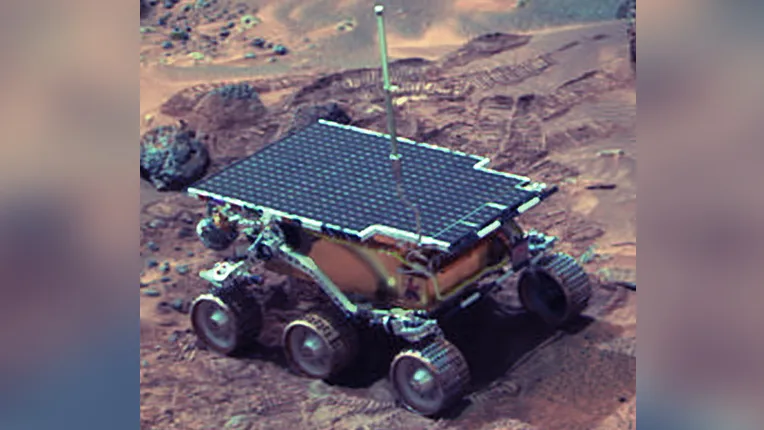
On the other side of Earth, the FBC program's first mission was a great success. The NASA Pathfinder lander and Sojourner rover arrived at Mars in July 1997. The lander was the first to use a set of airbags to cushion the landing, and Sojourner was the first rover to trundle around on the surface of Mars. Pathfinder was expected to last a month and Sojourner a week, but both remained in operation until September 1997, when NASA lost contact with Pathfinder.
The first mission to Mars from neither the U.S. or the Soviet Union, Japan's orbiter Nozomi, launched on July 4, 1998. The spacecraft made it to Mars but failed to enter orbit in December 2003. However, it did collect data on interplanetary space, according to the Japan Aerospace Exploration Agency (JAXA).
Two other FBC missions never made it to the Red Planet. The Mars Climate Orbiter launched on Dec. 11, 1998, and disintegrated in the Martian atmosphere after arriving in September 1999. This spacecraft was an illustration of how important it is to label units in all calculations: the crash was caused by a failure to convert English units to metric when directing the spacecraft into Mars orbit, according to NASA.
NASA's Mars Polar Lander (MPL) and two space probes with it (called Deep Space 2) were launched on Jan. 3, 1999. All were lost before finishing their journey. NASA researchers speculated that the failure could have resulted from faulty signals to the lander's legs. If MPL determined it had landed before actually reaching the surface, the scientists thought, it may have shut off its engine prematurely.
The rover explosion, 2000 to 2020
The new millennium was a renaissance in Mars exploration.
NASA's Mars Odyssey launched March 7, 2001 and arrived at the Red Planet on Oct. 24, 2001. As of early 2022, the orbiter was still conducting its extended science mission more than two decades later. Mars Odyssey has returned more than a million images, mapped Mars global distributions of several elements, and relayed more than 95 percent of all data from the Spirit and Opportunity rovers back to Earth.
The ESA launched a lander-orbiter called Mars Express/Beagle 2 on June 2, 2003. The lander was lost on arrival on Dec. 25, 2003, but the orbiter completed its primary mission in November 2005. As of early 2022, the orbiter remains functional on an extended mission returning photos of Martian geology, according to ESA.
NASA's two rovers, Spirit and Opportunity, arrived at the surface of Mars in 2004. Each discovered ample evidence that water once flowed on the Red Planet. Spirit went inoperational in a sand dune in March 2010, while Opportunity continued to work for nearly another decade. Opportunity fell silent during a sandstorm in summer 2018 and NASA declared the mission over in early 2019.

NASA's Mars Reconnaissance Orbiter, launched on Aug. 12, 2005. It began orbiting the planet on March 12, 2006. The mission has returned more data than all previous Mars missions combined and as of early 2022 continues to send high-resolution data of Red Planet features and weather. It also relays data from Martian surface missions back to Earth.
On Aug. 4, 2007, NASA launched a stationary lander called Mars Phoenix, which arrived at Mars on May 25, 2008, and found water ice beneath the surface. Phoenix's solar panels suffered severe damage from the harsh Martian winter, and communication with the $475 million lander was lost in November 2008. After repeated attempts to re-establish contact, NASA declared Phoenix dead in May 2010. The damage was confirmed in photos taken from orbit at the Red Planet.
The Russian space agency, Roscosmos, made another attempt to reach Phobos with the Phobos-Grunt mission, which launched in 2011 and crashed Jan. 15, 2012, after failing to leave Earth orbit. Phobos-Grunt was also carrying China's first attempt at a Mars orbiter, along with an experiment run by the U.S.-based Planetary Society designed to study how a long journey through deep space affects microorganisms.
NASA's powerful rover Curiosity arrived at Mars' Gale Crater in 2012 to search for signs of ancient habitable environments. Its major findings include the discovery of previously water-soaked areas, methane on the surface and organic compounds in the crust. Its mission continues as of early 2022.

India's MOM (Mars Orbiter Mission) successfully achieved orbit in 2014 to image the entire planet, providing a unique perspective on its weather and surface features.
NASA's MAVEN (Mars Atmosphere and Volatile EvolutioN), launched in November 2013, achieved orbit on Sept. 21, 2014, and continues to observe changes in the Martian atmosphere to better understand why it thinned over billions of years.
The European Space Agency's ExoMars program, which is a collaboration with Russia, launched an orbiter called the Trace Gas Orbiter (TGO) and a demonstration lander called Schiaparelli in 2016. Although Schiaparelli crashed on the Martian surface, TGO is still operational and investigating the composition of the Martian atmosphere.
NASA sent the Mars InSight lander to the Red Planet in 2018 to probe the interior structure of Mars in detail for the first time. InSight was approved for an extended mission in 2021 based on its findings so far about Martian history, although efforts to dig a heat-seeking probe (or "mole") below the surface turned up short as the regolith was harder than expected. InSight also carried the first Martian cubesats, tiny satellites that hitchhiked along on the same launch to document InSight's landing from orbit.
Now on Mars, 2021 to present
The Curiosity rover inspired another, called Perseverance, which landed successfully in Mars' Jezero crater on Feb. 18, 2021. Its quest is foremost to find samples with potential signs of life in them, although it also carries equipment for its numerous other investigations. Perseverance will cache its most promising samples for a future sample-return mission, tentatively scheduled for later in the decade and involving both NASA and the European Space Agency.
Perseverance brought with it the first interplanetary helicopter, called Ingenuity, which proved the feasibility of flying on Mars. While it was originally intended to fly a maximum of five missions, as of early 2022 Ingenuity had overcome a dust storm and flown 19 times, on a new mission to accompany Perseverance as it journeys across Mars.
Related: Mars helicopter Ingenuity spots Perseverance rover from the air (photo)
– Listen to the Mars wind blow in these first-ever sounds recorded on another planet
– Perseverance bites into layered rocks in hunt for clues of ancient water
– After a year on Mars, NASA's Perseverance rover is on course for big discoveries
– 12 amazing photos from the Perseverance rover's 1st year on Mars
– NASA's Perseverance rover finds organic chemicals on Mars
– Perseverance rover does the 'twist' on Mars to shake loose stuck rocks
Other countries are accumulating Martian experience, too.
The United Arab Emirates' Hope mission, which arrived in February of 2021, is intended to examine Martian weather and atmospheric layers. In Hope's first year, the orbiter confirmed the existence of a discrete aurora, a highly localized atmospheric phenomenon on the night side of the planet, and took note of water-bearing clouds that grow and shrink daily.
China's Tianwen-1 mission included a lander, rover and orbiter for a multi-mission investigation of Mars. It arrived in Mars orbit in February 2021; some of its planned work includes looking at the water content of the soil and examining Martian climate and environment. In the first year of China's first mission to successfully arrive at the Red Planet, the agency landed and deployed the rover Zhurong, making it the first non-U.S. agency to operate a rover on Mars.
ExoMars, the ESA and Roscosmos collaboration, is at work on the Rosalind Franklin rover and its companion lander, which are scheduled to leave Earth in 2022 following a two-year delay due to technical problems and the coronavirus pandemic.
Japan also plans to return to the Martian system in 2024, when it will launch the Mars Moons Exploration (MMX) mission to bring back rock samples from Phobos, one of the two moons of Mars.
Additional resources
For more context on early Mars missions and their connection to today, read this article from Radio Free Europe/Radio Liberty on the massive crowdsourced search for the USSR lander Mars 3, more than three decades after its launch and loss. If you want to know more about humanity's fascination for the Red Planet, check out this National Geographic article on why we've collectively sent so many missions there. If you'd like the whole story of NASA's JPL through the early years of Mars missions, go for former JPL director Bruce Murray's 1989 book "Journey into Space: The First Three Decades of Space Exploration."
Bibliography
- Barnett, Amanda. "In Depth | Mars Climate Orbiter." NASA Solar System Exploration. Planetary Science Communications. Accessed Feb. 22, 2022. https://solarsystem.nasa.gov/missions/mars-climate-orbiter/in-depth.
- NASA's Mars Exploration Program. "Historical Log | Missions." NASA Science Mission Directorate. Accessed Feb. 22, 2022. https://mars.nasa.gov/mars-exploration/missions/historical-log.
- "Making a Splash in a Lava Sea." The European Space Agency, Jan. 26, 2022. https://www.esa.int/Science_Exploration/Space_Science/Mars_Express/Making_a_splash_in_a_lava_sea.
- NASA's JPL. "Mariner Program." Mission and Spacecraft Library. Jet Propulsion Laboratory. Accessed Feb. 22, 2022. https://space.jpl.nasa.gov/msl/Programs/mariner.html.
- Institute of Space and Astronautical Science. "NOZOMI | Spacecraft." Japan Aerospace Exploration Agency. Accessed Feb. 22, 2022. https://www.isas.jaxa.jp/en/missions/spacecraft/past/nozomi.html.
- Rincon, Paul. "How Many Mars Missions Have Been Successful?" BBC News, July 30, 2020, sec. Science & Environment. https://www.bbc.com/news/science-environment-53589767.
- Siddiqi, Asif. "Beyond Earth: A Chronicle of Deep Space Exploration." Text. NASA, Sept. 20, 2018. http://www.nasa.gov/connect/ebooks/beyond_earth_detail.html.
- T. C. "Borscht, Mars and the Great Galactic Ghoul." The Economist, Nov. 14, 2011. https://www.economist.com/babbage/2011/11/14/borscht-mars-and-the-great-galactic-ghoul.