newsarama.com
advertisement
Columbia FAQ
By Robert Roy Britt
Senior Science Writer
posted: 30 June 2005
05:19 am

Last update: April 23, 2003

Editor's Note: With the cause all but determined, no significant further updates are planned for this page. Coverage of further developments will continue, however, in SPACE.com's Special Report on the Columbia Disaster

Common questions about the Columbia tragedy (last updated April 1, 2003, except as noted):

More Questions

A note to our readers: You have sent in countless insightful questions. Thank you for all of them and please accept my apologies for not answering each one. -- RRB


What caused the disaster?

April 23, 2003: The independent investigation team has all be arrived at a firm conclusion. A seal on the left wing was struck by foam during liftoff and fell off the next day, they believe, creating a gap that let hot gas enter the ship during re-entry. Story


Note: The material below stands as an archive and was last updated on April 1.

A sort of "black box" recently recovered on the ground reveals that hot gas penetrated the left wing earlier than previously known. The newfound data, thought scant, suggests Columbia probably had a problem before it began re-entry into Earth's atmosphere and that the problem was likely on or near the leading edge of the left wing, officials said March 31.

A Florida Today investigation recently showed that NASA fueled and launched Columbia in weather ripe for producing ice on the external fuel tank, potentially setting up a situation in which insulation foam, possibly heavy and laden with ice, might have damaged the craft shortly after liftoff.

Separately, officials have said a mystery object that floated away from Columbia during its second day in orbit may have had something to do with the disaster. Some experts speculate the object, which fell into the atmosphere a couple days later, could have been a heat protection tile or some other piece of the shuttle, reports SPACE.com's Leonard David. A data processing issue meant the U.S. Air Force did not recognize the object for what it was and NASA was not informed of it until after the disaster.

The investigation board, meanwhile, said on March 18 that super-heated air rushing inside the space planes left wing was now the leading candidate to explain Columbia's demise.

Meanwhile, lab tests are underway to help determine what might have caused the breakup. But so far there are no firm results and several possibilities remain on the table. Even some new scenarios were being discussed last week.

Investigators have not ruled out pilot error, though there are no indications that this was the cause. They are also studying additional stress load experienced on the left side of the shuttle 62 seconds after liftoff. The space plane's age is also being looked into as a possible factor. [Story on these aspects]

Officials now say that during liftoff, three distinct pieces of material came off the external fuel tank and may have hit parts of the left wing (on Feb. 21, they had said at least two pieces, and possibly three, were involved). Though long said to be insulation foam, this stuff might also have been ice, a combination of ice and foam, or possibly material applied under the foam, investigators now say.

Columbia as it broke apart.
Initial story

Meanwhile, preliminary lab experiments have surprised researchers, showing that high-speed foam hitting the shuttle wing and its thermal protection tiles might harm the aluminum structure underneath, without leaving visible damage at the surface. SPACE.com reported March 13 that tests are planned for early April to shoot external tank foam at shuttle wing material.

On March 4, officials announced that melted aluminum was found on recovered thermal tiles and inside the leading edge of the left wing. The shuttles' skins are aluminum, protected by the heat-resistant tiles. Officials said this finding supports the possibility that the shuttle was destroyed by hot gas that penetrated a damaged spot on the wing. They have not yet determined, however, how that gas was allowed entry.

On March 11, investigators explained that when aluminum is vaporized, as it might have been from hot gas inside the wing or wheel well, its particles become volatile. Rapid burning of those particles could behave like a bomb, and might explain one or more of the bright flashes observed from the ground as the shuttle broke apart.

E-mail exchanges

In late February and early March, NASA detailed how engineers, flight planners and outside contractors debated disaster scenarios that, in retrospect, contained hauntingly accurate aspects. Officials first acknowledged Wednesday, Feb. 26 that engineers had exchanged e-mails during the mission discussing whether damage that might have occurred during liftoff would cause problems during re-entry or landing.

Otherwise, the list of possible answers has grown along with a list of questions. Even space weather experts are looking over data for signs that something abnormal might have occurred on Feb. 1 where solar energy interacts with Earth's atmosphere and magnetic field.

The idea that hot gas entered the shuttle through a breach in the left wing or wheel well goes back to Feb. 13. Many experts suspected then that a reinforced carbon-carbon (RCC) panel on the forward edge of Columbia's left wing was the first major piece to break loose during re-entry as the shuttle approached the California coast. In a step-by-step account published Wednesday, Feb. 19, SPACE.com's Jim Banke explains how this might have happened and how a missing panel could have led to the disastrous cascade of events that brought Columbia down.

The hot gas was likely not "plasma," as had been first reported, officials said. Hot gas surrounding the shuttle during re-entry had not yet reached the plasma stage, which would occur lower in the atmosphere.

The independent investigation board acknowledged late Tuesday, Feb. 18, that the shuttle's problems began when it was over the Pacific Ocean, well before it broke apart above Texas. Investigators are gathering data from ground-based "microbarometers," sensors all across the west that might have detected minute anomalies in Columbia's movement as the problems developed. The sensors detect minor changes in air pressure that propagate through the atmosphere.

One of these sensors, in Texas, recorded an explosion equal to a few pounds of TNT. "Our guess is that it could have been caused by a rapid decompression, which is what would have happened if you ruptured the crew compartment,'' said Eugene Herrin, a geophysicist at Southern Methodist University.

The breach

Outside experts said the shuttle's aluminum skin and overall construction is not designed to handle an infusion of hot gas, which can reach temperatures of up to 3,000 degrees and is very expansive. A 1997 independent report by the National Security Council warned that a bit of manmade space debris or a natural meteorite could cause a hole in the vulnerable leading edge of a shuttle wing upon re-entry, and that the result would be a "blowtorch" effect, leading to the demise of the craft.

NASA cast some doubt on whether the hot gas -- not yet plasma -- that likely breached Columbia would have had this blowtorch effect.

Shuttles, like all spacecraft, are routinely peppered by meteoroids the size of sand grains, paint chips, and other debris. The shuttle is designed, in theory, to handle minor impacts. Heat tiles sustaining minor damage, typically small divots, are routinely replaced after flights.

Columbia was the oldest shuttle in the fleet. In the last major overhaul, done in 2001 by the Boeing Co, the entire shuttle was inspected for damaged tiles and stress to its aluminum frame and modifications were made. The independent investigation team is looking into the details of the overhaul as part of the inquiry but officials said they are not yet aware of any link to the problems on the ship's final flight. Columbia flew one successful mission after the overhaul.

Other scenarios for breaching the shuttle that have not been elimated:

The waste vent is in front of the left wing. It expels urine and excess water created by the power system. In a 1984 flight, a basketball-sized chunk of ice developed on Discovery. The crew broke it off prior to re-entry using the shuttle's robot arm. Columbia did not need the arm for its science mission and so it was not available. Earlier in the investigation, it was learned that a military radar detected some object, which might have been ice, near the shuttle early in the mission.

Search continues

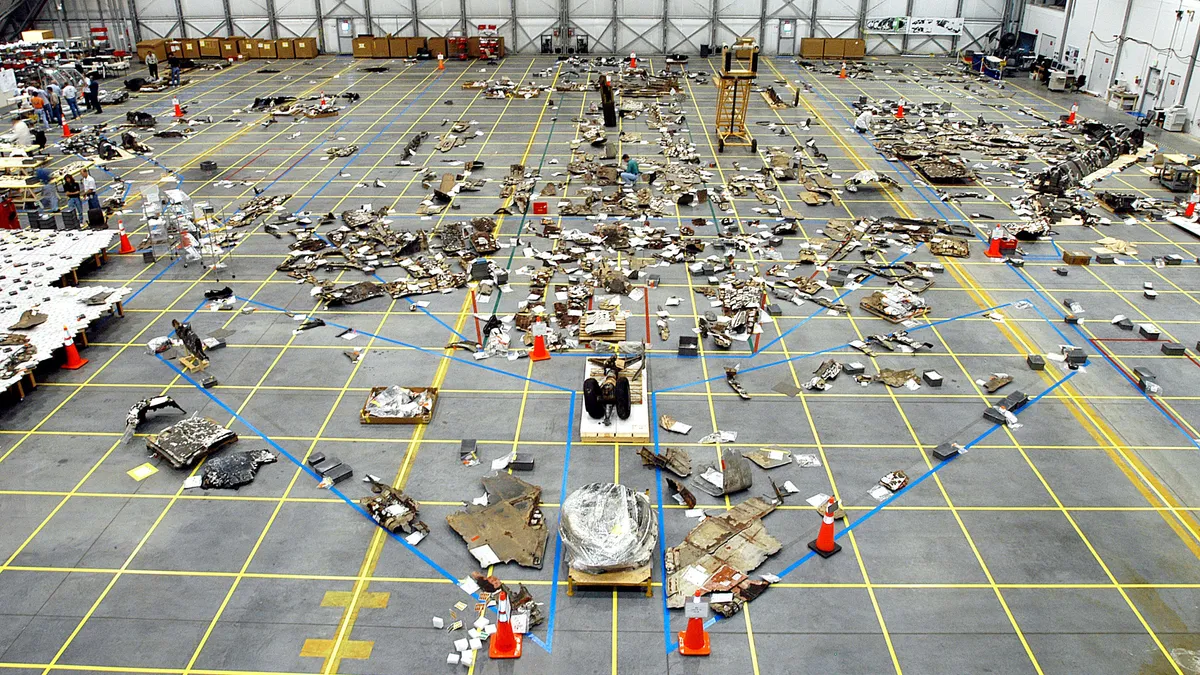
On March 12, Columbia Accident Investigation Board (CAIB) chairman, retired Admiral Hal Gehman, said as many as 5,000 people were still conducting daily searches for debris, though the findings lately have been mostly small pieces. In all, more than 28,000 bits of debris, small and large, had been collected as of March 10. Gehman expects more stuff to turn up when weather improves, when snow melts, and farmers begin plowing fields.

On Feb. 19, NASA asked for public help in finding debris in Arizona, Nevada, New Mexico, and Utah. Search teams have had little luck finding Columbia debris significantly west of Fort Worth, Texas. Experts in tracking the breakups and paths of space rocks through Earth's atmosphere have been called in to help determine where debris might have fallen. The effort is intended to locate possible debris in the mountains of California that might be among the first telling pieces to have separated from the shuttle.

Much of the investigation centers on increased heat detected by sensors in and around the left wing and left wheel well moments before all contact was lost with Columbia.

After analyzing the data, officials say the first problems were noted at 8:52 a.m. ET on Feb. 1 in a brake line behind the left wheel well and a failing sensor on the aircraft's skin, near the rear of the left wing on the underneath side. A tire in the left wheel well then showed signs of problems before a pressure gauge failed. By 8:59, elevated temperatures had been noted in at least four other sensors, including two on the fuselage, and a handful had gone offline.

Shuttles are not equipped with the "black boxes" that airliners carrry to store onboard data and communications. It is not yet known how much data might have been sensed in the final seconds, before the shuttle came apart, but not transmitted to Earth.

Other evidence:

A portion of Columbia's left wing was recovered. It was further west than most of the other debris, and it could be a "significant" find, officials said. NASA planned to test a mockup of the wing in high-speed wind tunnels, looking at possible patterns of damage, investigation team member Scott Hubbard said Feb. 11.

A photo of Columbia taken from the Starfire Optical Range shows what might be a jagged leading edge of the left wing and a plume behind it. Contrary to early reports, the photo was not taken with any sort of advance military technology. Story

A military facility in the Southwest captured pictures of Columbia, taken during the re-entry phase. One image shows what might be jaggedness on the leading edge of the left wing near the fuselage and a plume of something trailing the left wing. But officials were not confident enough in the resolution of the image to draw any conclusions.

The eerie, dark silhouette of Columbia was photographed at the Starfire Optical Range (SOR) at Kirtland Air Force Base outside Albuquerque. Contrary to initial reports, however, it was not taken with the facility's high-tech equipment. Instead, it was taken by engineers who had connected a commercial 3 1/2-inch telescope to an 11-year-old Macintosh computer.

The investigation team, meanwhile, asked the Air Force Space Command to review data from spy satellites that might contain useful information.

Earlier stages of the investigation

NASA has been warning since the day of the disaster that no one should jump to conclusions. Yet the agency's early and frequent release of information -- sketchy as much of it was -- had been compelling and led to near-conclusions in many minds. The open policy was remarkable compared to how things were handled after the 1986 Challenger explosion. Once incredibly tight-lipped, NASA was thinking out loud in the initial days of the Columbia investigation. That changed, however, when the independent investigation board took over.

Until Feb. 4, the case had seemed relatively strong that missing heat tiles were to blame, related to a root cause of a launch problem. A bit of insulation foam from the external fuel tank used to boost the shuttle into space came off just after liftoff and hit the left wing. It might have ripped off tiles that protect the shuttle from the heat of re-entry. More likely, officials said, it would have only damaged the tiles. In fact, during the mission they concluded that there was no significant damage, which explains why no extraordinary efforts were mounted to look into the matter further prior to reentry.

Yet once Columbia came apart, the foam seemed a likely culprit. Thinking on this has see-sawed ever since.

Continuing Columbia Coverage | Archive of all Columbia Stories


SOLID
LIQUID
GAS
PLASMA
The state of normal matter depends on temperature, which regulates how fast molecules move and therefore how far apart they are. Plasma, a superhot gas, is an entirely different animal, being electrically charged and very expansive.

PLASMA: What is it?

[IMPORTANT NOTE: Officials now say that the hot gas that surrounded Columbia and appeared to breach the craft had probably not yet reached the plasma state.]

Plasma is sometimes called a fourth state of matter (in addition to solid, liquid, gas). It's created when gas is superheated and electrons are stripped out, leaving electrically charged particles.

Plasma occurs naturally in interstellar space and in the atmospheres of our Sun and other stars. Scientists also create plasma in labs in order to study emissions from the violent regions around black holes. A fluorescent lamp is an example of a highly contained plasma.

Plasma reaching as much as 3,000 degrees surrounds the shuttle during re-entry as the craft plows through Earth's atmosphere. Plasma can also be created by impacts from meteoroids or space debris. NASA has not said how Columbia's problem-causing plasma was allowed under the craft's skin, though they know there must have been some sort of hole or gash.

How plasma can damage a satellite. NASA says hot gas, but probably not plasma, breached Columbia.

Click to see animation

Satellite operators worry about impact-generated plasma. Even a relatively small meteoroid would vaporize upon impact, generating a cloud of plasma. (IMPORTANT: Small meteoroids hit shuttles frequently without causing problems other than minor pits in heat tiles.)

On a satellite, however, electrical parts are exposed. Because the plasma is electrically charged, short circuits can result. An electrical current flows from one electrical part of the satellite to another location, through the cloud, and damages an instrument. It is similar to the damage a lightning strike might cause.

In 1993, during the August Perseid meteor shower, a meteor hit an Olympus communications satellite. The impact formed a plasma cloud, and the craft's attitude control system was zapped. By the time operators could stabilize it, they had depleted all of its attitude-control propellant and the satellite was lost.

Continuing Columbia Coverage | Archive of all Columbia Stories


Did Columbia have a "black box" like airliners?

Not exactly. But it did carry a data recorder, found intact in Texas on March 19, that holds 9,400 feet of magnetic tape containing clues that have proven helpful in the investigation. Otherwise, the shuttle's communication system is designed to constantly download information to ground control. It is not clear how much data might have been lost in the final moment of the shuttle flight that might possibly have been retrieved had there been a black box aboard.

In an interview with Computerworld, Steve Schwartz, CTO and founder of UniTrends Software Corp., a backup and crash-recovery company in Myrtle Beach, S.C., explained the technical aspects of the shuttle downloading: "There's a network that uses a protocol named SCPS (Space Communications Protocol Standard), an improvement over TCP (Transmission Control Protocol). The network is IP-based and runs under a virtual LAN; astronauts are able to send/receive e-mail."

Last-minute data that might have gone into a black box might not have been transmitted to the ground, though what actually happened has not been laid out by NASA. Schwartz, however, said the download system is sometime busy acknowledging transmissions and retransmitting previous blocks of data that were not properly received. So sometimes current data sits in a buffer, awaiting its trip to Earth.

NASA did say early on in the investigation that the final 32 seconds of data transmitted by the shuttle was ragged and not readily readable. Officials planned to work with the data to try and make sense of it.

Continuing Columbia Coverage | Archive of all Columbia Stories


What is the Starfire Optical Range?
The Starfire Optical Range (SOR) is at Kirtland Air Force Base outside Albuquerque. The facility routinely tracks shuttles. The SOR houses a 11.5-foot (3.5-meter) telescope designed for satellite tracking. It also has a 5-foot (1.5 meter) telescope. Both use an advanced system of adaptive optics (AO), which counteract the blurring effects of Earth's atmosphere.


The Starfire Optical Range uses a laser to create a fake star in the sky. The telescope then uses known parameters of the reflected fake star to compensate for blurring effects of Earth's atmosphere while making an image of a real object. The facility, below.

Constantly changing turbulent air makes stars and other objects twinkle, and it also makes them hard to image. The more powerful a telescope, the more impact the problem has. So instead of one single mirror, AO uses several, and they are adjusted on the fly during observations. Adaptive optics is all the rage in astronomy right now. The primary mission SOR is to develop new optical and imaging technologies to support Air Force aerospace missions. SOR's larger telescope, using AO, could spot a basketball 1,000 miles away.

In May 1991, the Department of Defense declassified much of its research and development of adaptive optics. Laser beacon adaptive optics technology, developed at the 1.5-meter telescope, has the potential to revolutionize ground-based astronomy.

The facility also has some clever engineers who took a now-infamous photo of Columbia during re-entry with a commercial 3 1/2-inch telescope hooked up to an 11-year-old Macintosh computer.

-- SPACE.COM's Leonard David contributed to this answer

Continuing Columbia Coverage | Archive of all Columbia Stories


Re-entry: What were the astronauts doing, and were they aware of the problem?

Columbia's communications with the ground were normal, and then they stopped, so little is known about what went on inside the craft thereafter. A tape of the final communications were released Feb. 12.

The astronauts would have had on their orange pressure suits, equipped with parachutes that would be of no use at the altitude of the disaster. They were strapped in tight.

As the shuttle moved into denser atmosphere over California, the outside of the craft heated up, as always. The craft began to slow, much like the water in a pool gently slows a diver.

Sally Ride, the first American woman in space, says the process of re-entry takes about an hour but seems like it flies by.

"When you look out the windows, all you see is orange and pink glow, seemingly surrounding the shuttle -- almost looks like flames licking the shuttle," Ride said.

Columbia was more than 200,000 feet up (roughly 38 miles or 60 kilometers) moving at about 12,500 mph (20,120 kph) when communications were lost.

A final 32 seconds of data was beamed down after voice communications ceased with Columbia. That data has been hard to decipher, however. Todd Curtis, former airline safety analyst with Boeing Co., said: "West of Fort Worth they lost communications but had signals transmitting data. That says to me the voice communication system was off-line but parts of the data communication system were broadcasting. This implies the antennas for broadcasting this data were still intact,'' said Curtis. "You could conclude certain systems, such as power sources, were still running."

That analysis must be considered speculative at this point.

Many people have asked what might have then transpired, and how much time the astronauts might have had to contemplate their fate. This is not really known, and it seems appropriate to not speculate.

Continuing Columbia Coverage | Archive of all Columbia Stories


Could Columbia have been damaged by a meteor or space junk?

NASA has not ruled this out. A 1997 report by the National Research Council warned NASA of the threat to shuttles from both natural and man-made stuff in space [Story].

Small rocks in space pose a threat to all spacecraft, particularly small satellites. Meteors have caused minor damage on shuttles in the past, and the phenomenon is well-studied (The Hubble Space Telescope, in space for more than a decade now, is loaded with pits).

The shuttles are designed, in theory, to handle impacts of marble-sized objects.

The Risk of Metoeroids and Junk | Continuing Columbia Coverage | Archive of all Columbia Stories


EXPLOSIVES: Why does the shuttle carry small pyrotechnic devices?

A space shuttle contains many small explosives used for deploying certain gear during a mission and for emergencies. If a shuttle's landing chute ever deployed early, pyrotechnic devices could also be employed to detach it, for example.

The shuttle's landing gear compartment contains small explosives designed to deploy the gear if the normal system fails. An accidental triggering, possibly by heat, could be catastrophic. NASA is now looking into this possibility as a cause of the Columbia disaster. But the measured rise of 30 to 40 degrees in the wheel well is not, for now, seen as a likely trigger.

In some cases, the explosives are integrated into a nut-and-bolt setup, and are designed to destroy it. A small hole is drilled into a nut, and something akin to a small firecracker is inserted. A computer-controlled explosion detonates the charge, which splits the metal. Referring to the nuts and bolts as "explosive" is a bit misleading, engineers say. It implies that the firing is uncontrolled and random. Computers handle the split-second timing of the detonation.

Continuing Columbia Coverage | Archive of all Columbia Stories


Foam: What is the foam insulation and why does it fall off?

Foam insulation is sprayed onto the the external fuel tanks in a gooey form and then becomes hard as a brick but light, like Styrofoam. It keeps the liquid hydrogen and the liquid oxygen fuel super cold. Shuttles ride these 15-story tanks during liftoff, then the tanks separate.

NASA video showed that 81 seconds into the flight, a 20-inch, 2 1/2-pound piece of the foam fell off and struck Columbia's left wing. The shuttle Columbia was moving more than at twice the speed of sound. The impact is thought to have involved a relative speed of no more than 500 mph.

The foam is fragile enough to have been damaged once in a hailstorm, forcing a previous shuttle mission to be delayed while the insulation was repaired. Chunks have come off in flight before, too. They can be ice-coated, making them heavy projectiles. Columbia sustained damage in this way in 1992 and 1997, and foam struck a booster rocket of Atlantis in October.

"The thing of this is, almost since Day One, the insulation has been a pain," said Seymour Himmel, a retired NASA executive who served two decades on an aerospace safety panel and looked into the potential dangers of the foam. "Pieces break off,'' Himmel said.

More on the Foam & Tiles | Continuing Columbia Coverage | Archive of all Columbia Stories


Tiles: What are they made of and what do they do?

Columbia's aluminum skin was covered with more than 20,000 heat-resistant tiles. They protect the craft against temperatures that can reach 3,000 degrees Fahrenheit on the leading edge of a wing during re-entry.

Several have been damaged in past shuttle flights and later replaced. Some of the tiles are made of silica fibers, derived from sand in a process similar to making glass.

Much of the Columbia investigation centers around critical reinforced carbon-carbon (RCC) panels on the forward edge of Columbia's left wing. The gray, U-shaped RCC panels are bolted in four places to a flat area on the front of the wing structure. Reinforced carbon-carbon is a manmade composite material that binds carbon-based material with other carbon-based material in a molecular structure designed to withstand re-entry's hottest temperatures, which can approach 3,000 degrees Fahrenheit. The shuttle's nose cap and a "chin panel" forward of the nose landing gear are made of the RCC material.

Some news reports have called these RCC panels brittle. Composites in general can be considered brittle, but not in the same sense as uncooked noodles or grandma's bones. You couldn't go up to an RCC panel and snap it in two. They are built to be tough -- but they have had minor surface defects from time to time that have required some attention during maintenance.

-- SPACE.com's Jim Banke contributed to this answer

More on the Foam & Tiles | Continuing Columbia Coverage | Archive of all Columbia Stories


If NASA knew something might have been wrong, why did they try the re-entry?

People wonder why the astronauts did not do a spacewalk to fix the problem before trying to return to Earth. NASA engineers scrutinized launch video and determined there was nothing to be overly concerned about. They did not know if heat tiles were missing but made the decision that the craft was safe. Subsequent decisions (including not requesting special photographs) were made with this in mind.

At any rate, in this situation, a useful spacewalk would have been particularly dangerous. There is nothing to hold onto underneath the wing, where the possible damage was, and the astronauts did not have jetpacks aboard. In any case, no spare tiles are carried aboard shuttle flights.

  • Could the damage have been investigated with satellites? Perhaps, but that was tried during a 1998 mission and the pictures were of little use.
  • Could the Columbia astronauts have gone to the orbiting International Space Station? No. Because Columbia was in a lower orbit than the ISS -- one designed for the shuttle's science mission -- it didn't have enough fuel to boost itself up to the ISS.
  • Could another shuttle have been sent up? Shuttle Atlantis might have been rushed into service, and if normal testing were skipped, it might have been in space in a week or so. The Columbia crew had enough supplies to last through Wednesday, Feb. 5 and might have been able to stretch those supplies a few more days.
  • What about the robotic arm? Columbia was not equipped with its 50-foot robot arm because it was not needed for this science-based mission.

Early story on these limited options | Continuing Columbia Coverage | Archive of all Columbia Stories


Will human spaceflight continue?

Almost certainly. In fact, an eventual human mission to Mars is strongly indicated in the newly announced NASA budget for 2004 and in a NASA statement made Feb. 5, just four days after the disaster.

Shuttle flights could resume this fall. On March 12, William Readdy, NASA associate administrator for space flight, signed a memorandum establishing a formal "Return to Flight" team. NASA Administrator Sean OKeefe indicated that while the cause of the Columbia disaster needs to be determined for flights start again, the agency needs to begin preparing for the next launch, which could come this fall. The Return to Flight team will look at possible ways to improve safety based on several scenarios now being considered as possible causes of the disaster. Clearly, some measures might prove warranted, while others would perhaps become moot depending on the outcome of the investigation.

Amid their grief, space officials inside and outside NASA who have spoken about the disaster have expressed the need to press ahead. This is not the first space accident, and unfortunately it probably will not be the last, but spaceflight is an important component in advancing modern science and technology, they say.

Further, there is a strong underlying sentiment among people connected with the space program which holds that the collective human spirit needs to continue pushing the boundaries of exploration with an ultimate goal of loosening our ties to this planet. Teachers will continue to participate in NASA space flights, too, officials said in the days following the disaster. Even the grieving families of the astronauts said "the bold exploration of space must go on."

But it will not be easy to start up again. The next shuttle mission to the space station had been slated for March 1 but is now on hold. Japan, one of several international partners on the space station, echoed NASA in saying its astronauts will not fly until the shuttle fleet is determined safe.

Columbia's Effect on Space Policy | Continuing Columbia Coverage | Archive of all Columbia Stories


Will shuttles be upgraded or scuttled?

It seems unlikely the existing shuttles will be scuttled. NASA began preparing, in fact, for the next flight (as of March 12) while awaiting a green light and, probably, a determination of the cause of the Columbia disaster. Coincidentally, on Feb. 3, two days after the disaster, NASA unveiled its budget request for 2004, an announcement that had been planned for weeks. The budget request was mapped out with White House assistance. It calls for increased spending on shuttle upgrades with an eye toward keeping them operational until 2025.

Some space experts have called for a new generation of space planes to be designed and built to replace the aged shuttle fleet. No one knows if the budget request will stand in the wake of the Columbia disaster, so all of this is very up in the air for the moment.

The 2004 NASA Budget | Continuing Columbia Coverage | Archive of all Columbia Stories


What was Columbia's Mission?

Unlike most shuttle missions during the past three years that have been devoted to building and supplying the International Space Station, STS-107 was purely dedicated to science and did not travel to the space station. More than six dozen experiments were being conducted. Some were a complete loss. The data from many, however, were beamed to Earth. Scientists said the results will lead to improved human health and save lives.


What is the status of the International Space Station (ISS) and its crew?
(And doesn't the station need periodic boosts?)

The crew is safe. But eventually astronauts Ken Bowersox and Don Pettit and cosmonaut Nikolai Budarin must be retrieved, and the best way to do that is with a shuttle. On Sunday, Feb. 2, a previously planned launch of an unmanned Russian supply ship, called Progress, went off as scheduled. It docked with the station two day later and the station crew unloaded one ton of food, fuel and other supplies.

They crew now has enough supplies to last through late June. The earliest they would likely come home is early May after a fresh Soyuz spacecraft is launched with a new crew. But the crew says they are prepared to stay a year if needed. A shuttle launch had been scheduled for March 1 to swap ISS crews, but that is on hold. NASA must now decide if and when it is safe to launch another shuttle. Aboard the ISS are.

If need by, the station crew could return in a Russian Soyuz, a "lifeboat" capsule that is always affixed to the orbiting outpost. NASA space station official Michael Kostelnik said that a fresh Soyuz would be sent to the station in April as planned. If needed, the Soyuz ships could swap crews until NASA's shuttle fleet is certified to fly again.

Doesn't the station need periodic boosts? Yes, sometimes by a dozen miles or so. Otherwise it would eventually fall to Earth. You might recall that Skylab burned up in the atmosphere on July 11, 1979 after its orbit deteriorated for 5 years. The Compton telescope and the Russian Mir space station met similar fates. The Hubble Space Telescope has no onboard boosters and is lifted back into higher orbit during shuttle servicing missions. The ISS boosts can be supplied by shuttles and the Russian Progress supply ships. The station was boosted Feb. 11 or 12. The next boost would come probably in or around June. Progress supply ships always bring fuel and do the reboosts. Shuttle can too. -- SPACE.com's Jim Banke contributed to this answer.

Meanwhile, NASA said on Feb. 12 that science experiment aboard the station continue. Basic and applied research is being conducted in biology, physics, chemistry, ecology, medicine, materials science, manufacturing and the long-term effects of space flight on humans. And on Feb. 14, a report said the United States and Russia would cooperate to keep the station going. Russian officials said they would build extra $22 million supply ships as long as othr partners in the 16-nation space station project would pay for them.

Continuing Columbia Coverage | Archive of all Columbia Stories


What should I do if I find Columbia debris?


Debris presumed to be from the shuttle Columbia landed in the driveway of Susie and Art Patterson's home in Nacogdoches, Texas. It is about a foot long.

NASA and the indpenedent investigation board are both interested in obtaining pictures and videos of the event. The Gehman Board has a Web site, http://www.caib.us, for information about the board's activities and to learn how to contact the board directly if you have any debris reports to make, or theories to offer.

You can also report debris or images to NASA at this phone number: 281-483-3388 or (936) 699-1032. Text reports and images should be e-mailed to: columbiaimages@nasa.gov or nasamitimages@jsc.nasa.gov.

Do not touch any debris you find. NASA officials have warned repeatedly that the debris "may be dangerously contaminated with toxic substances and cause serious injury if handled. Individuals who think they may have come in contact with shuttle debris should take a shower with soap and water and then seek medical attention.

NASA: "Individuals are advised to avoid all additional contact with the suspected shuttle material. Clothing that may have come in contact with the suspected debris should be removed with care to avoid skin contact with cloth that may have been contaminated. Place the clothing in a plastic bag for later analysis. If your physician has any questions, please have him or her contact the NASA Emergency Action Center at 281-483-3388."

Also dangerous are pyrotechnic devices that the shuttle carries and which may remain unexploded.

NASA wishes all debris be reported to them, so that the pieces can be used to help determine what caused the disaster. The space agency also warns that the debris is government property, and local law enforcement officials have been asked to aid in recovering it.

In fact, two Texans were arrested on federal charges they stole pieces of the debris and a Texas law enforcement official was charged in a separate case.

Continuing Columbia Coverage | Archive of all Columbia Stories


What is being done for the astronauts' families? And how can I send sympathies?

A fund is being set up. The Space Shuttle Childrens Trust Fund was established with the support of NASA after the 1986 Challenger disaster. The fund, which raised $1 million, will now work to raise money for Columbia families.

NASA held a private memorial for the astronauts Feb. 4 at the Johnson Space Center. President Bush and the first lady Laura Bush were accompanied on Air Force One by Neil Armstrong, the first astronaut to walk on the moon. Former senator and astronaut John Glenn and his wife, Annie, also attended, as did NASA Administrator Sean O'Keefe. Kathie Scobee Fulgham, whose father died on the space shuttle Challenger, was to speak to the children of the Columbia astronauts at the memorial.

A memorial ceremony for Columbia's astronauts was held Feb. 7 at the Kennedy Space Center. Florida Governor Jeb Bush, Administrator O'Keefe and former astronaut Robert Crippen, Columbia's first pilot on its maiden flight, STS-1, on April 12, 1981, attended.

People wishing to express their sympathies can send notes to this address:

Johnson Space Center
NASA Road 1
Houston, TX, 77058

Continuing Columbia Coverage | Archive of all Columbia Stories


More Questions

Could Columbia have been hit by an electrical discharge?
This should be considered highly speculative. A report last week in The San Francisco Chronicle says federal investigators (not the NASA team) are looking into this possibility. Data are being reviewed for evidence any high-altitude jets or sprites, which commonly occur above thunderstorms and are known to shoot nearly into outer space. "We're working hard on the data set," said Alfred Bedard, a scientist at the federal Environmental Technology Laboratory in Boulder, Colo. The lab is providing data to NASA, according to the story.

The Chron says NASA administrators confirmed that a photograph showing an odd streak of light, taken by a San Francisco amateur astronomer, is being evaluated by Columbia crash investigators. Shuttle investigators are not certain if the oddity is real or an artifact.

How did so much debris survive re-entry heat and make it to the ground?
Meteors often burn up before they reach the ground. But many survive. What happens depends on many factors:

  • Meteors are not typically in orbit around the planet. They come from elsewhere in the solar system and crash into our atmosphere at incredible velocities. The shuttle was traveling at about 12,500 mph. A meteor can reach speeds of 160,000 mph (72 kilometers per second) relative to Earth (many move at about half that speed).
  • The heating that can lead to vaporization of a meteor begins around 60 miles up. The shuttle was already down to around 40 miles altitude when problems began.
  • Meteors larger than baseballs frequently survive. Columbia's wreckage involved a lot of good-sized pieces.
  • Finally, natural meteors are hunks of stone and metal, often very loose agglomerations with surface roughness that enhances the tendency to vaporize. Columbia's parts were designed for strength and stability and were often smooth.

Could the Hubble Space Telescope have taken pictures of the shuttle?
No. Hubble is not equipped for the task of imaging a moving target. And it is so powerful that to image the entire Moon would require 130 separate exposures. [See what I mean in this Moon photo gallery]

Could the flight have been aborted before the shuttle entered outer space?
In theory, yes. The shuttle can abort and land before it reaches orbit. But NASA did not suspect there was a problem until after the craft was in orbit and the launch video was reviewed (and then officials determined there was no problem). Once in orbit, returning earlier would likely have yielded the same result, assuming the damage had in fact been done during launch, though it has not been determined for whether the damage, in part or total, occured during launch, in flight, or at re-entry.

Does the shuttle come back to Earth on the same path each time?
No. This mission involved a relatively low orbit. Missions to the International Space Station go higher, and due to the different orbit, those shuttles typically come back to Earth over Mexico and the open waters of the Gulf.

Were puffs of smoke in the contrail signs of an explosion or a result of the structure falling apart?
The puffs are almost surely telltale of something. But NASA has not yet determined what sorts of debris caused the earliest puffs seen in video, nor what specific process led to things falling apart. An amateur video shows what may be some of the earliest signs of problems over Reno, Nevada.

Was Columbia landing at the time that was scheduled at the outset of the mission?
Yes. Everything was going according to plan, and officials have said this seemed like one of the smoothest missions ever, up to the point of the disaster. Everyone in the space community was surprised to lose a shuttle upon re-entry; launch is considered the more dangerous event by far.

IMAGES: NASA

Can the external fuel tank be recovered and studied?
No. The external fuel tank (called ET by NASA) stays with the shuttle until about 9 minutes after launch. It then separates, falls back, and burns up as it comes through the atmosphere. This has confused some people because another part of the launch system is retrieved. Solid rocket boosters (SRBs), which provide most of the thrust for liftoff, detach about 28 miles (45 kilometers) up while the shuttle's main engines continue firing. The SRBs fall into the ocean off Cap Canaveral and are picked up, refurbished and re-used. [See our Interactive Shuttle Guide]

Solid rocket booster at separation on a previous shuttle mission (left) and an external fuel tank (right).

-- Associated Press contributed to some of the answers in this report


StarMax 102mm EQ Compact "Mak"
$429.95
Explore More


Site Map | News | SpaceFlight | Science | Technology | Entertainment | SpaceViews | NightSky | Ad Astra | SETI | Hot Topics
Image Galleries | Videos | Reader Favorites | Image of the Day | Amazing Images | Wallpapers | Games | Community
about us | FREE Email Newsletter | message boards | register at SPACE.com | contact us | advertise | terms of service | privacy statement
DMCA/Copyright
  What is This?