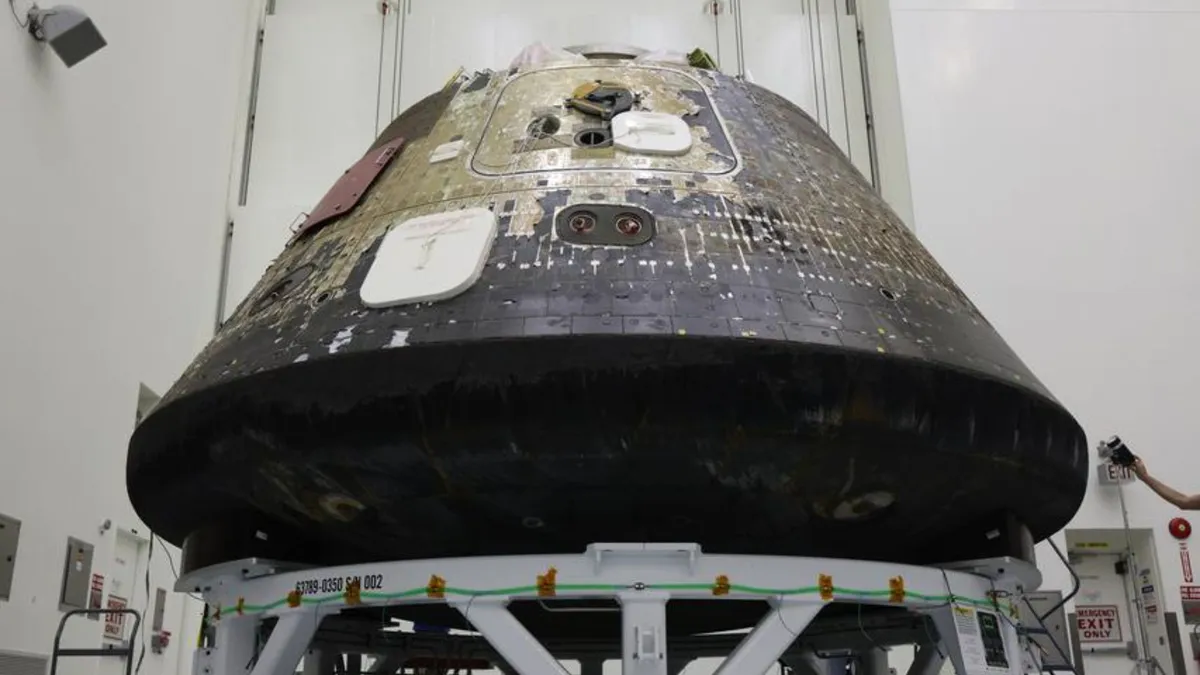
NASA's Artemis 2 Orion spacecraft rests after its flight around the moon, charred from the return to Earth.
The Artemis 2 mission launched four astronauts on a journey around the moon aboard an Orion capsule that its crew named "Integrity." Looking at the capsule now, you can see what it went through to get home.
What is it?
On April 1, NASA launched four astronauts on a 10-day journey around the moon and back to Earth. This mission, called Artemis 2, was the first time humans have traveled to the moon in over 50 years, since NASA's final Apollo mission in 1972.
On their trip home, the crew — NASA astronauts commander Reid Wiseman, mission pilot Victor Glover, mission specialist Christina Koch, and Canadian Space Agency mission specialist Jeremy Hansen — hurtled back through Earth's atmosphere before splashing down in the Pacific Ocean on April 10.
This return trip was no picnic. During its descent, temperatures around the capsule reached up to 5,000 degrees Fahrenheit (2,760 degrees Celsius). And while the capsule's heat shield kept the astronauts inside safe, this picture clearly shows the extreme environment that the craft had to ensure.
In the photo, the capsule sits, burned by its return journey, at NASA's Kennedy Space Center Multi-Payload Processing Facility in Florida.
Why is it incredible?
Launching to space is a spectacular feat. To have a rocket launch with astronauts on board go perfectly well is even more amazing. But once you're in space, whether it's on a mission to the moon or the International Space Station, at some point you have to come home to Earth. And returning can be just as tricky as getting there.
The Orion capsule, sitting propped up at NASA's Kennedy Space Center, is a charred testament to the challenge of that return trip. You can see the dark tiles on the capsule's side, and underneath it is entirely burnt.
Moving forward from Artemis 2, experts at NASA will take a closer look at the aftermath of this fiery return to better understand if and how the spacecraft and its heat shield might have to change with the program's upcoming mission, Artemis 3, which will stay in Earth orbit to perform rendezvous and docking tests.