The Lyrid meteor shower peaks tonight (April 21). And, if you spot any Lyrid meteors, you have something cool in common with an astronaut!
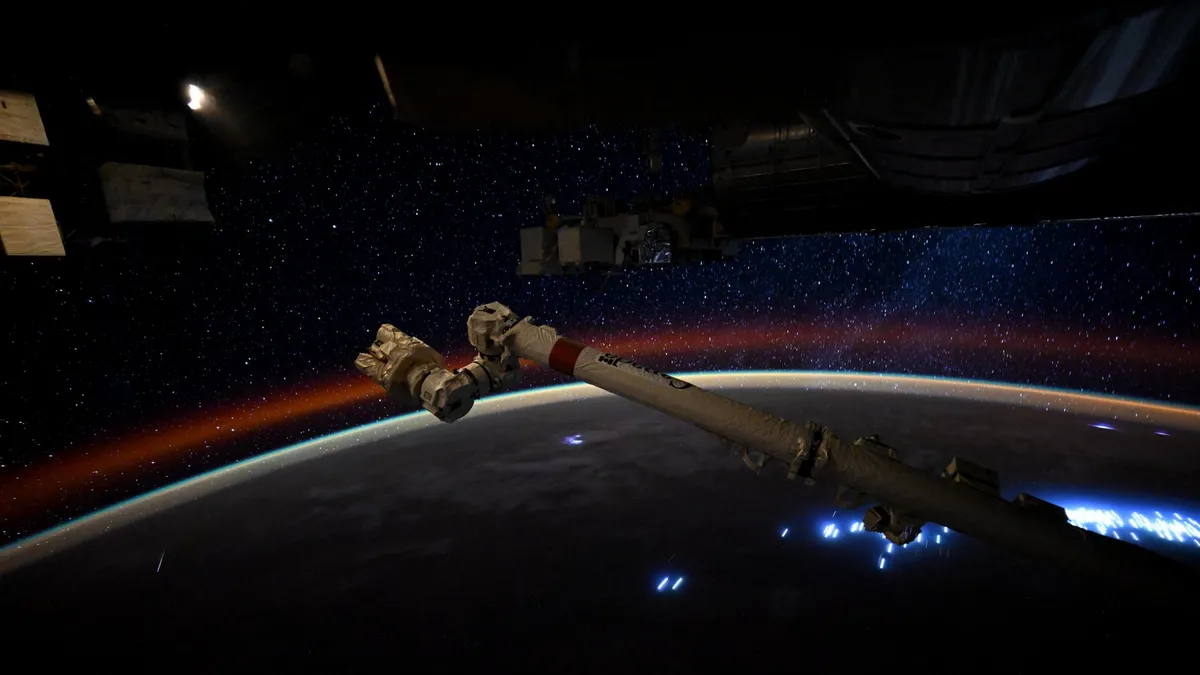
Yesterday (April 20), NASA astronaut Jessica Meir shared a photograph that she took of the Lyrid meteor shower from aboard the International Space Station (ISS). But her view was a bit different from yours, as she saw a Lyrid streaking through Earth's atmosphere from above.
What is it?
The Lyrid meteor shower is at its peak this week, with prime viewing happening overnight from April 21 to April 22.
The Lyrids are made up of bits of debris trailing the long-period comet C/1861 G1 Thatcher, which was discovered in 1861. Long-period comets have very long orbital periods, taking hundreds of years or more to orbit the sun.
Every year around this time, Earth passes through this comet's debris field. Pieces of it burn up in our atmosphere, creating the spectacular meteors that streak across the sky.
The shower produces up to 15 to 20 Lyrid meteors per hour. You can see the Lyrids radiating from around the constellation Lyra (hence their name). If you can, find dark skies for optimal viewing.
In a photograph snapped from aboard the ISS, Meir revealed that she was able to see a Lyrid meteor shower lighting up the dark night skies over Earth.
Have you seen any shooting stars lately? We’re in the midst of the Lyrid Meteor shower, and I was lucky enough to photograph some from the @Space_Station cupola. The Lyrids are an annual event best viewed in the Northern Hemisphere by looking toward the constellation Lyra in the… pic.twitter.com/B2FqMdEuqsApril 20, 2026
Why is it incredible?
This photograph is so much more than just proof of a successful meteor shower watch.
It is a stunning visual reminder that our planet is protected by a surprisingly thin atmosphere. As Meir shared in her post, you can see below the horizon where the meteor is streaking.
The experience of living in space aboard the ISS is unique for so many reasons. But what a remarkable moment, for astronauts in space to be able to look down at their home planet and watch our atmosphere interact with a comet like this.