HOUSTON -- With heartfelt hugs and widesmiles, sevenastronauts aboard NASA's shuttleDiscovery departed the International SpaceStation (ISS) Tuesday after eight days of orbital construction work.
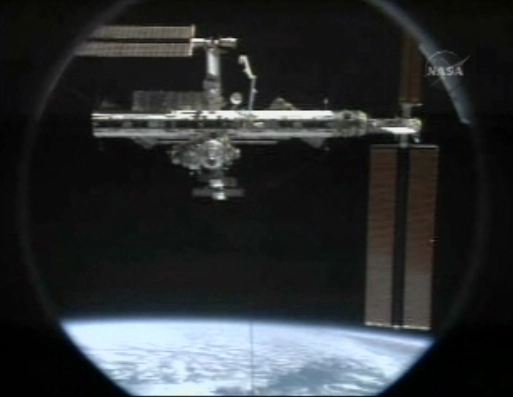
Discovery'sSTS-116 astronauts cast off from their ISS berth at 5:10 p.m. EST (2210 GMT), leavinga very different space station behind than the one they arrived at last week [image,video].
"ForAlpha, from the crew of Discovery, we wish you smooth sailing," STS-116commander Mark Polansky radioed to the ISS crew after undocking as both spacecraftflew over the eastern Pacific Ocean. "We hopeyou enjoy the new electrical system onboard station."

Polanskyand his STS-116 crewmates installed a newportside piece of the ISS, overhauledthe orbital laboratory's power grid and stayed an extra day for anunplanned fourthspacewalk to wrangle a wilysolar array into its storage boxes on Monday.
Theconstruction work leaves the station ready to accept new solar array segments,as well as Europeanand Japanese laboratories currently set to launch aboard shuttle flights inthe next two years. Discovery shuttlepilot William Oefelein flew the orbiter on apartial fly-around of the ISS after undocking, giving the STS-116astronauts a bird's eye view of their orbital handiwork [image].
"It'salways a goal to try and leave someplace in a better shapethan it was when you came, and I think we've accomplished that," Polansky said before leaving the ISS. "I hope that we'rereally on our way to a great start for [ISS] assembly completion."
The sevenSTS-116 astronauts and three Expedition 14 spaceflyers recorded video andsnapped photographs while exchanging handshakes, hugs and warm words to marktheir separation [image].
Discoveryis due to land at NASA's Kennedy Space Centeron Friday at 3:56 p.m. EST (1856 GMT). Discovery must land no later thanSaturday because of supply limitations.
"We bid abittersweet farewell to Discovery," Expedition 14 commander MichaelLopez-Alegria said during a brief ceremony. "And we'd like to welcome Sunito our crew."
ISS crewchange complete
One STS-116astronaut, first-time spaceflyer Sunita"Suni" Williams, is remaining behind onboard the ISS as a member of its Expedition14 crew. She is relieving European Space Agency (ESA) astronaut ThomasReiter, who has lived and worked aboard the station in his arrivalin July.
"I hopeDiscovery takes you home as smoothly and safely as it brought me here,"Williams told Reiter.
Reiter isreturning to Earth aboard Discovery,and received a warm send-off by Lopez-Alegria and fellowExpedition 14 flight engineer MikhailTyurin.
"By thepower vested in me, which I just invented, we would like to make you an honorarymember of NASA's astronaut corps," Lopez-Alegria said, dubbing the Germanspaceflyer a "model astronaut" and presenting him with makeshift NASA wings.
A veteranof two long-duration spaceflights, one to Russia'sMirand the other aboard ISS, Reiter's current mission returned the station tothree-astronaut operations for the first time since the 2003 Columbia accident.
"It's beenan exciting time, so it's hard to let go," Reiter said before leaving the spacestation. "I'm really excited to get back on the ground."
In additionto their ISS construction and crew exchange duties, Discovery's STS-116astronauts delivered about 5,215 pounds (2,365 kilograms) of spareparts, new equipment and fresh supplies for the space station's crew. Theorbiter left the outpost with about 3,725 pounds (1,689 kilograms) ofunneeded supplies, completed experiments and other hardware.
Shuttleinspections on tap
Beforelanding, Discovery's astronaut crew has a few more tasks ahead, including asecond heat shield survey and the launch of severalmicrosatellites from a palette at the rear of the orbiter's payload bay.
Known as a lateinspection, the heat shield survey is a mirror image of one performed onDec. 10 and includes scans of the orbiter's vital heat-resistant panels alongits wing leading edges and nose cap. Unlike the initiallook, which was aimed at identifying any damage caused by shuttle externaltank or ice during launch, late inspections target new impacts or dings from micrometeoritehits or orbital debris.
Discoverywill take up a position about 40 miles (64 kilometers) from the ISS until thelate inspection is complete, staying within range of the orbital laboratory -which can also serve as a shuttle safe haven - until the orbiter's heat shieldis once more cleared for landing, NASA officials said.
Discoverycarries three small technology-demonstrating satellites to be deployed in thenext two days. Two are due for deployment after the heat shield inspectionWednesday, with the third to fly on Thursday.
Missionmanagers hope to land Discovery and its STS-116 astronauts at the Kennedy SpaceCenter's Shuttle Landing Facility in Cape Canaveral, Florida,weather permitting. They are also preparing alternate runways at California's Edwards Air Force Base and New Mexico's White Sands Space Harbor if required.
- VIDEO: STS-116 Mission Profile: Undocking
- Images: The Spacewalks of NASA's STS-116
- Images: Discovery's STS-116 Launch Day Gallery
- STS-116 Video: Power is Everything
- STS-116 Video: Building Blocks
- Mission Discovery: The ISS Rewiring Job of NASA's STS-116
- Complete Space Shuttle Mission Coverage
- The Great Space Quiz: Space Shuttle Countdown
- All About the Space Shuttle
