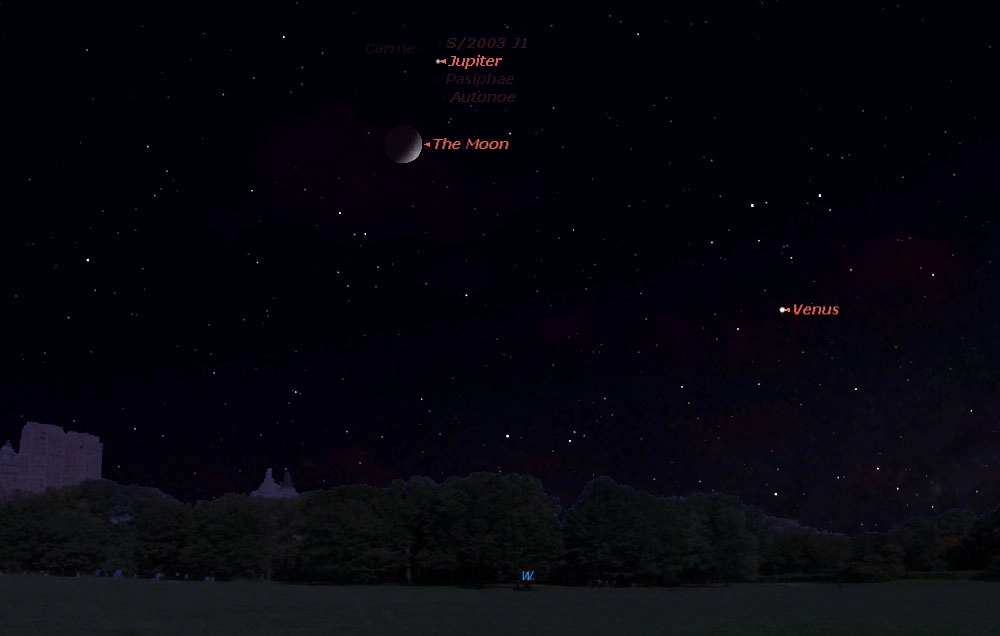
If your local weather is clear tonight (May 23), check out the western sky around mid-twilight – about an hour after sunset. There, about half way up from the south-southwest horizon to the overhead point, you’ll see an eye-catching sight for the Memorial Day weekend: Jupiter and the moon in a celestial display.
Tonight, a rather wide crescent moon, 34-percent illuminated will be visible against the darkening sky and hovering about 3 degrees almost directly above this lunar sliver will be a brilliant silvery white "star." But this isn't a star, but the planet identified with the supreme sky-god, Jupiter. To judge how far apart Jupiter and the moon will appear in the sky, remember that your clenched fist, correctly held, will measure 10 degrees of the night sky. So you can use your fist to make a reasonable estimate of degrees either horizontally or vertically.
In this case, Jupiter and the moon will appear relatively close together; roughly one-third of a fist apart. And because they will be the two brightest objects in the sky, the moon and Jupiter will likely attract the attention of even those who aren’t consciously looking up at the sky. [Astronomy Gear Guide to Start Stargazing]
The real drama, however, is only now getting underway.
As you admire Jupiter and the moon on tonight, take note of brilliant Venus glowing well down to their lower right. In the nights to come, Venus and Jupiter will slowly getting closer to each other. In less than a month from now – the nights of June 19 and 20, the moon will be back in their vicinity, with both planets appearing much closer together. But on the evening of June 30, Jupiter and Venus will appear exceptionally close together, being separated by just 20 arc minutes or one-third of a degree. That's closer together than the apparent width of the moon; a real head-turner that will likely attract considerable attention. Make a note on your calendar and let’s all hope for clear skies.
Editor's note: If you snap an amazing photo of Jupiter and the moon together tonight and would like to share it with Space.com for a potential story or gallery, send image details and comments in to Space.com at: spacephotos@space.com.
Joe Rao serves as an instructor and guest lecturer at New York's Hayden Planetarium. He writes about astronomy for Natural History magazine, the Farmer's Almanac and other publications, and he is also an on-camera meteorologist for News 12 Westchester, N.Y.Follow us @Spacedotcom, Facebook and Google+. Original article on Space.com