What's that bright light after sunset? Venus is dazzling the evening sky right now

"What's that bright light in the sky?" a friend messaged me the other evening. "Venus," I replied, without thinking about it. There was a pause, then: "How can you tell? And why is it suddenly so bright?"
People always notice Venus by accident. When it's low on the horizon after dark, but just high enough and bright enough, it suddenly becomes obvious. It's why Venus has a reputation for triggering UFO reports whenever it becomes the "Evening Star."
Nothing mysterious is happening — it's just the latest installment of a predictable eight-year pattern during which Venus orbits the sun 13 times and completes five apparent circuits around the sky, as seen from Earth. Each circuit includes one period when Venus appears east of the sun in the evening sky — becoming the Evening Star — and one period when it appears west of the sun before dawn as the Morning Star.
So, Venus becomes the Evening Star for a few months about five times every eight years. As a mathematical pattern, it's exquisite and — in my opinion — quietly awesome — but it's virtually unknown.
The good news, of course, is that after passing behind the sun earlier this year, the second planet from the sun is now rising to dominate as the "Evening Star" — and is set to be the centerpiece in a spectacular "summer of Venus."
What's happening and when to look at Venus

Right now, Venus is emerging into one of its evening apparitions — and beginning a slow, spectacular climb.
At the moment, Venus is about 84% illuminated — a gibbous phase — and decreasing. But that's not the key to its brightness. What matters is what it's doing.
Venus is currently moving along its orbit, bringing it closer to Earth. Night by night, the distance between our two planets is shrinking. As it does, Venus appears larger in the sky — and that increase in apparent size more than compensates for the fact that we're seeing less of its sunlit side.
So over the coming months, two things happen at once: Venus grows larger as it approaches Earth, and its phase shrinks from gibbous to a thin crescent. The result is counterintuitive: Venus gets brighter as it becomes less full.
By early June, Venus will be prominent well into the night, with key moments including:
- May 18 — Venus in conjunction with a 7%-lit waxing crescent moon
- May 20 — Venus is close to M35, an open cluster of stars about 150 million years old, in the constellation Gemini.
- June 9 — Venus passes closest to Jupiter in a striking evening conjunction low in the west.
- Early June — Venus reaches its highest altitude as the ecliptic stands steeply to the horizon in the evening sky after sunset, making it easier to see for longer.
- July 9 — Venus glides close to Regulus, the brightest star in the constellation Leo.
- August 12 — Venus will be 50% lit, thereafter being in its waning crescent phase, and becoming interesting in a telescope.
- August 15 — Venus, in conjunction with a 13%-lit waxing crescent moon, reaches its greatest elongation east, its widest separation from the sun.
- September 18 — Venus hits peak brightness (its "greatest illuminated extent") at around magnitude -4.8, outshining everything in the night sky except the moon.
How and when I'm watching Venus

Summer 2026 will be a great one for stargazers, with perhaps the highlight being August 12's triple header — a total solar eclipse (albeit only total in Greenland, Iceland and Spain, but visible as a partial across northwestern Europe), the peak of the Perseid meteor shower, and Venus entering its dazzling crescent phase.
I generally don't make a big deal of observing Venus when it's the Evening Star. If I'm camping or renting a cottage in the country, I'll check the aspect. Still, mostly I observe it casually, from my backyard after dinner, and when walking home, pausing on the sidewalk for a minute before going inside. I look west, find it quickly, and take a mental note. Is it higher than yesterday? Is it getting brighter? That's usually enough because what you're really watching is a nearby world overtaking us on the inside track.
There are exceptions to my casual planet-gazing. One is the Venus-Jupiter conjunction on June 9. The other is its greatest brilliancy on September 18, when it will be just 26% lit. This is when it shines at its absolute brightest — the turning point of the entire cycle.
By then, Venus is much closer to Earth, so its apparent disk has swollen dramatically. Even though only a crescent is sunlit, that crescent is huge in angular size — reflecting far more total light toward us than when it appeared smaller and fuller. It's a perfect balance between phase, distance and the high albedo of its global cloud deck. Not too far, not too thin, and just cloudy enough — just the point where geometry and meteorology deliver maximum brilliance.
With educated eyes, the question changes from, "What is that bright light?" to "Where is Venus in its journey?" Watching Venus rise and fall is going to be one of the highlights of summer.
Stargazer's corner: May 15-21, 2026

With a new moon on Saturday, May 16, this coming week is perfect for watching a crescent wax in the west just after sunset. On Monday, May 18, a 7%-illuminated crescent will hang about two degrees from Venus, with Jupiter about 20 degrees above. The distance between Venus and Jupiter will reduce with every passing night until they appear to pass close to each other on June 9 in a stunning close conjunction. Turn southeast, and you'll find Arcturus high in the sky with Spica lower down, while Vega rises in the northeast.
Constellation of the week: Corvus

Corvus is not a famous constellation, but it should be. Supposedly a crow or a raven, but looking more like a sail, Corvus is five stars that form a small, slightly skewed quadrilateral that stands out because it's in a part of the sky filled with faint constellations. Always low in the south during spring and summer, this week, Corvus is just below the right of bright star Spica. Its four brightest stars — Gienah, Algorab, Kraz and Minkar — are relatively easy to find, but it's the fifth star, Alchiba, which is very close to Algorab, but outside the sail, that gives Corvus its distinctive shape. Corvus is easy to overlook, but once you see it, you won't forget it.
My latest stargazing obsession
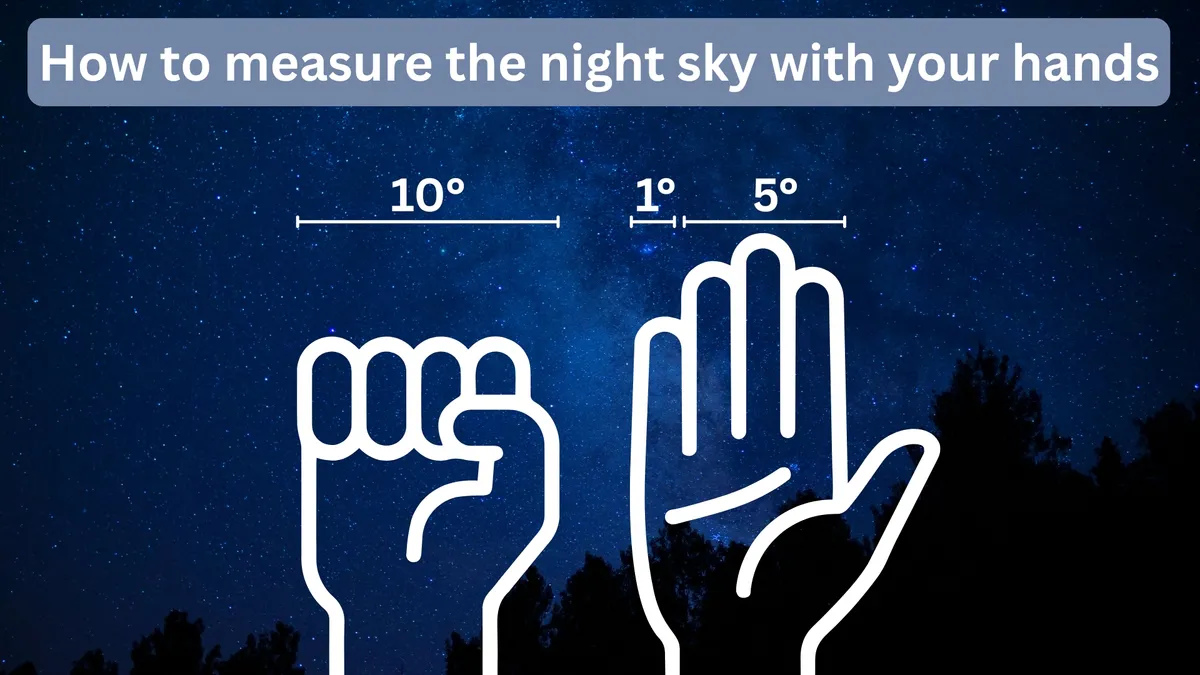
The night sky is a map, but it's always moving. That happens simply because Earth revolves, but the planets also move across the sky, further complicating things. It's why stargazers think in terms of separation — how far one thing sits from another — rather than looking for objects in the sky at fixed points. You'll often hear that the moon is five degrees from a planet, or that two planets are within a single degree. The night sky is a sphere, and we see 180° from horizon to horizon, with 90° directly above (the zenith). A simple way to measure degrees of distance is to use your outstretched hand as a scale. A finger-width is about a degree, three middle fingers are five degrees, and a fist is 10 degrees, giving you a rough but reliable measure of angular distance. By estimating distances in the night sky, you begin to read it, navigate it, and know it. It's what stargazing for life is all about.
If you're looking for a telescope or binoculars to observe the night sky, our guides for the best binocular deals and the best telescope deals can help. Our best cameras for astrophotography and best lenses for astrophotography can help you get ready to capture the next stunning skywatching event.