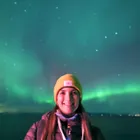
I should probably start with a confession for someone who writes about the night sky almost every day: until recently, I had never actually seen the Milky Way properly. Not as a bright, structured band stretching across the sky. Not in a way that made me stop and stare.
I knew my home skies in central England were light-polluted. I also thought I had experienced reasonably dark skies before, during trips away from city lights, where a few extra stars were visible.
But nothing prepared me for what I experienced in the Canary Islands of La Palma and Tenerife.
The sheer number of stars was so overwhelming that I found myself struggling to navigate constellations I thought I knew by heart. I've spent years editing skywatching guides, yet suddenly I was the one pausing, recalibrating, and quietly questioning my bearings.
Back home, the Pleiades is usually the highlight of my night sky — faint enough that I have to search for it, but bright enough to feel rewarding when it finally comes into view. In the Canaries, it required no effort at all. It stood out immediately, crisp and luminous, the stars sharply defined.
Then there was Andromeda (M31). At home, I'd never dream of seeing our neighboring galaxy without binoculars. Yet here it was, hovering above the volcanic landscape as a pale, unmistakable haze of light. I gazed up in awe. I'd never seen the night sky like this before.

Above the clouds on La Palma
I traveled to La Palma with New Scientist Discovery Tours, joining a group of astronomy enthusiasts ranging from curious beginners to seasoned observers. Our first major stop was Roque de los Muchachos Observatory on La Palma, one of the top three observing sites in the world, alongside Chile's Atacama Desert and Hawaii's Mauna Kea.
The drive to the observatory felt like a geological documentary unfolding in real time. As we climbed, the temperature dropped, the vegetation thinned out. Before long, we were navigating hairpin bends above a sea of clouds. Telescope domes appeared one by one, gleaming white against a landscape that looked more like something from the moon than anything earthly.

We visited the colossal Gran Telescopio Canarias, currently the largest single optical telescope in the world, with an impressive 10.4-meter mirror. Standing beneath the structure, its scale was difficult to process. After enjoying an astronomy presentation, we headed outside for some solar observing. Peering through a hydrogen alpha telescope, which filters the sun's light to isolate a narrow band emitted by hydrogen gas, the sun looked alive. A glowing, dancing surface covered in swirling filaments and looping prominences. It felt so incredible to witness the wonder of our star firsthand, with my own eyes.

That evening, as I bid goodnight to our star at the caldera viewpoint, I was met with a scene of unbridled beauty. As the sun dipped toward the horizon, the rugged volcano walls glowed gold while the sky melted into vivid pink and orange hues. In the opposite direction, the Belt of Venus appeared, a soft rose band that forms above Earth's shadow when sunlight scatters through Earth's atmosphere.

As the last light of day rapidly slipped below the horizon, the first stars began to emerge. Then more followed, and more still, until the sky seemed crowded with dots of light. Before long, there it was — the Milky Way, arching across the sky in a pale, luminous sweep, like a river flowing through the stars. I had written about it countless times, but seeing it with my own eyes, stretching overhead in such clarity, was something entirely different. It was the first time I truly understood what a dark sky could reveal.

Volcano country
Duration: 7 nights
Cost: From £3,376pp (newscientist.com/tours).
Departs: Dec. 3, 2026
If you're interested in booking the tour, head over to New Scientist Discovery Tours official site.
The wonders of the Canary Islands aren't confined to what unfolds above the sky after dark. The ground beneath your feet tells an equally dramatic story.
Exploring La Palma feels like you're experiencing a living record of eruptions, collapses and renewal. The ever-changing lunar-like landscape is a constant reminder that this unique place is still being shaped by the raw power beneath Earth's surface.
We explored deep ravines — barrancos — where dense vegetation defiantly clings to steep rock walls, creating unique environments that feel cut off from time. Later, standing on the fresh lava fields from the 2021 eruption, we traced the flow of molten rock all the way to the ocean. It was hard to believe that entire neighborhoods once stood in its path, now replaced by jagged basalt formations — with the occasional remnant of a house still visible, a roof or wall peeking through the hardened lava.


From the moon to Mars
If La Palma's dark volcanic rock evoked lunar landscapes, Tenerife felt closer to Mars, particularly around Teide National Park, where lighter, rust-colored rocks dominate the alien terrain.
As we crossed by ferry at dawn, the outline of Mount Teide — an impressive 12,198-foot (3,718-meter) volcano — emerged from the mist. A small group of us gathered on deck before sunrise, taking in the first light and catching a glimpse of the summit as it rose above the clouds.

After disembarking in Tenerife, we made our way directly into Teide National Park, the winding road climbing steadily, as the scenery grew more unfamiliar with every bend. Once inside, the landscape opened in all directions. Wide volcanic plains, sculpted rock formations and ancient lava flows stretched as far as the eye could see.
That night, the bright, nearly full moon cast long shadows across the volcanic rock, revealing a stark landscape set against a dense field of stars. The landscape felt entirely different after dark. With the day's visitors gone, the caldera turned quiet and faintly eerie, the wind howling through the few Canarian pines standing tall against the stark volcanic terrain.


Inside Teide Observatory
The next day, we visited Teide Observatory, a sprawling high-altitude site home to numerous solar, optical and radio telescopes. We were given an introduction to the differences between optical and infrared astronomy and why the Canary Islands are ideally suited for astronomy.
At the observatory, we explored several instruments, including the historic Carlos Sánchez Telescope, a long-standing leader in infrared observations of the night sky. We then turned our attention back to the sun, where once again the solar surface looked energetic and full of life.
Later, we took the cable car toward the summit of Teide. From the top, the scale of the caldera became fully apparent. Ancient lava flows traced dark paths across the landscape, their patterns still visible centuries later. Beyond it all, a sea of clouds lingered on the horizon, never rising high enough to reach us. Gazing out at the surreal scenery, I didn't feel like I was standing at the summit of an island, but rather on the preserved fragment of another world.

Defending the dark
What became increasingly clear throughout the trip was how seriously the Canary Islands take the protection of their night skies. Both La Palma and Teide National Park, Tenerife are designated Starlight Reserves, with strict lighting regulations designed to minimize light pollution.
Streetlights are shielded and directed downward, blue-rich LEDs are restricted and lighting levels are carefully managed, especially around observatory sites. The results are immediate and unmistakable. There were no glowing horizons, no clouds illuminated from below. The sky appeared dark and rich with starlight. It was a powerful reminder of how much of the universe we cannot usually see because we've simply drowned it out with artificial light.
The people beneath the stars

As with many astronomy- or adventure-focused journeys, the experience was shaped as much by the people as by the setting. Guided by astronomer Martin Griffiths and tour leader Christopher Monckton, our group shared observations, stories and long conversations as we explored the islands together.
Over the course of the week, it became clear that this wasn't a trip solely for astronomy specialists. The mix of observatories, stargazing, volcanic landscapes and wider Earth science — with the occasional wine tour — meant there was always something to discuss, long after the night's observing had ended.
If you have even a passing interest in astronomy, the Canary Islands offer one of the most extraordinary places on Earth to look up. And if you already love the night sky, be prepared — it may look very different here, in the best possible way.
Editor's note: This trip was made possible by travel provided by New Scientist Discovery Tours.