The Artemis 2 rocket that will send astronauts around the moon is back on the pad, and it could launch in less than two weeks.
NASA rolled Artemis 2's towering Space Launch System (SLS) rocket to Launch Complex-39B (LC-39B) at NASA's Kennedy Space Center (KSC) in Florida on Friday.
SLS and its Orion crew capsule arrived at the pad at 11:21 a.m. EDT (1521 GMT) on Friday. First motion occurred earlier that same morning at 12:20 a.m. EDT (0420 GMT), with SLS, Orion and their mobile launch platform (MLP) secured atop NASA's crawler-transporter 2 vehicle for the 4-mile (6.4 kilometers) trek.
The Artemis 2 stack spent the last three weeks inside KSC's Vehicle Assembly Building (VAB), undergoing maintenance to address issues that cropped up after the rocket's initial tests at the pad. With SLS now back at LC-39B, NASA aims to prepare the vehicle and ground systems in time for the start of the next Artemis 2 launch window, which opens April 1.
It was the second rollout for Artemis 2, which arrived at the pad for the first time on Jan. 17. During that initial launch campaign, NASA managed to successfully complete one of two "wet dress rehearsal" fueling tests in the leadup to launch, which was previously targeted for early March. A problem arose after testing, though, with helium pressurization in the rocket's upper stage, which couldn't be fixed out at the pad.
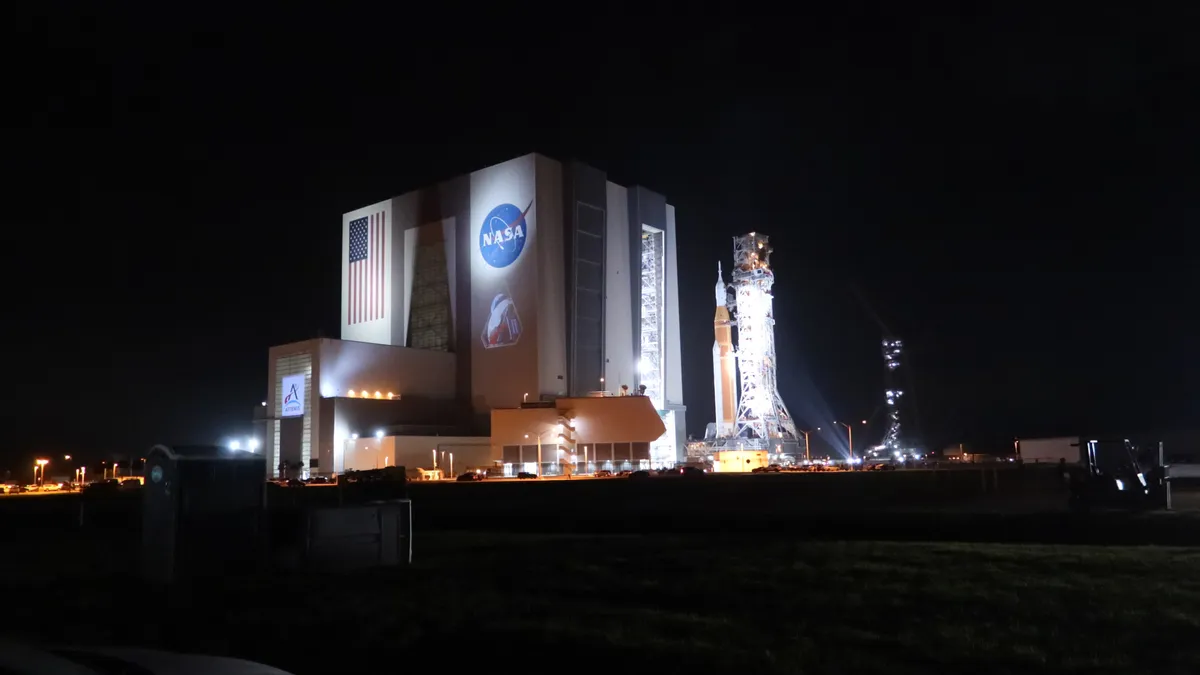
As a result, NASA rolled the SLS back to the VAB on Feb. 25, where engineers worked over the past few weeks to address the issue and swap out flight batteries and other minor components. One last-minute replacement — an electrical harness for the flight termination system — threatened to delay rollout to March 20, but NASA was able to complete the work in time to hit the March 19 target.
The Artemis 2 SLS stands a monumental 322 feet (98 meters) tall, weighs roughly 3.5 million pounds (1.6 million kg) "dry" and more than 5.75 million pounds (2.61 million kg) when fully fueled with its liquid hydrogen and liquid oxygen propellants.
To transport the massive vehicle and MLP without damage, the eight sets of 7.5-foot (2.3 meters) treads on the 114-foot-wide (35 m) wide crawler-transporter 2 roll at just 1 mph (1.6 kph). The 4-mile journey between the VAB and LC-39B runs along a roadway lined with imported river rocks, which, due to the more than 18 million pounds (8.1 million kg) combined weight of the crawler, SLS and MLP, are crushed to near sand as the treads pass over them.

It's the second SLS rocket to travel this path. The first, the vehicle that flew Artemis 1, was forced to roll back to the VAB three times before finally launching in November 2022. That uncrewed mission sent the Orion spacecraft into lunar orbit for nearly a month before returning to Earth.
Artemis 2 will be the first flight of the Artemis program to launch with astronauts aboard Orion, and the first major test of the spacecraft's life-support systems. Artemis 2 will be commanded by NASA astronaut Reid Wiseman, who is joined by pilot Victor Glover (NASA) and mission specialists Christina Koch (NASA) and Jeremy Hansen (from the Canadian Space Agency).
They will launch on a 10-day mission aboard Orion, flying on a single loop around the moon and back to Earth. The mission is a significant step in NASA's efforts to return astronauts to the lunar surface, where the agency hopes to establish a sustained presence.
NASA's ultimate goal is to land astronauts back on the moon before the end of 2028. Part of that plan requires maturing several new technologies, including the two commercial moon landers contracted under the Artemis Human Landing Systems program — SpaceX's Starship and Blue Origin's Blue Moon, both of which are still under development.
Either or both landers — NASA has indicated a willingness to fly with whichever is ready come mission time — will launch to Earth orbit as a part of Artemis 3, where astronauts aboard Orion will practice rendezvous and docking maneuvers between the spacecraft. That mission is slated for 2027, with Artemis 4 tapped as the program's first lunar landing a year later.
With SLS now back at the pad, the pre-launch clock has started ticking for the Artemis 2 crew. After a rollout date was finalized on Wednesday (March 18), the astronauts entered quarantine at NASA's Johnson Space Center in Houston, where they will remain for the next week before flying to KSC.
NASA is still targeting the beginning of the next launch window, which opens April 1, for liftoff of Artemis 2. If mission managers are forced to push past that date for any reason, opportunities exist through April 6, with another window opening April 30.