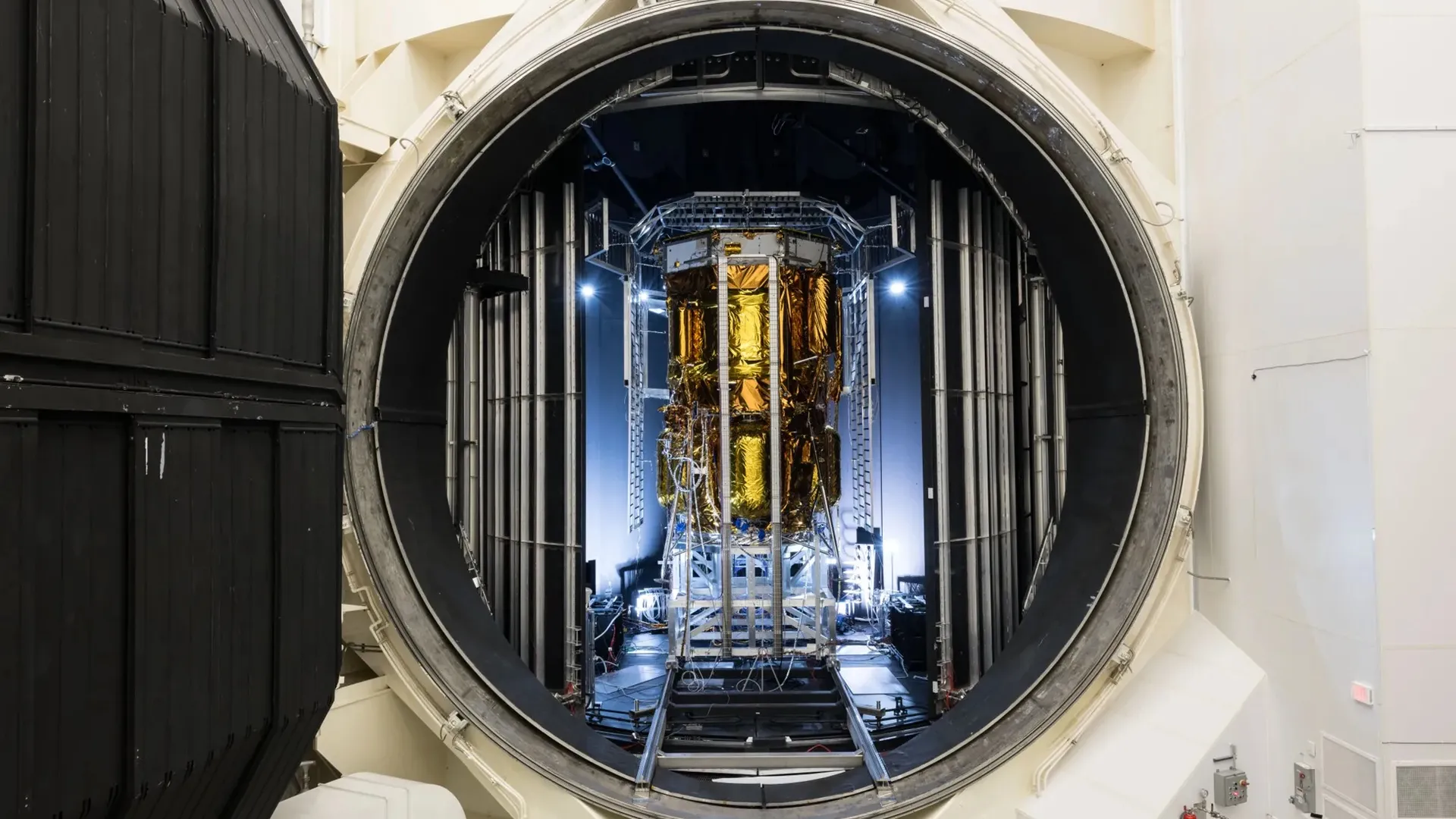
Blue Origin continues putting its first lunar lander through its paces, testing the spacecraft at NASA centers across the nation to prepare it for its upcoming mission to the moon.
That vehicle, named "Endurance," is Blue Origin's uncrewed Blue Moon MK1 test lander, which is designed to pave the way for the more advanced MK2 version that will be capable of flying astronauts to the moon's surface. Blue Moon is one of two private lunar landers, from Blue Origin and SpaceX, that NASA has contracted to support its Artemis program, and both of those vehicles have a lengthy list of tests and qualifications to check off in order to meet the agency's timeline.
NASA is targeting late 2027 for the launch of Artemis 3, which will fly four astronauts to Earth orbit aboard an Orion space capsule. The mission will practice rendezvous and docking maneuvers with either Blue Moon or SpaceX's Starship, or both. NASA has indicated a willingness to fly with whichever lander is ready when it comes time to launch.
Endurance recently completed vacuum chamber testing at NASA's Johnson Space Center in Houston and was shipped to Blue Origin's facilities near Kennedy Space Center (KSC) in Florida last month. Now, the lander is being prepared for radio frequency compatibility testing inside the company's Lunar Plant 1, to ensure the lander's communication systems won't experience any interference before flight.
📍 Lunar Plant 1 Testing in Florida continues for Endurance. Radio frequency compatibility testing is on deck. pic.twitter.com/PnXea1Z2rOMay 5, 2026
NASA is targeting 2028 for the first Artemis program moon landing on Artemis 4. However, before NASA certifies either Starship or Blue Moon to deliver astronauts to the surface, both must complete a series of qualifications, including an uncrewed lunar touchdown, which Blue Origin hopes to accomplish later this year with Endurance. In order to pull off a successful landing, the spacecraft will also need to demonstrate autonomous navigation, cryogenic fuel transfer and prolonged storage, and then prove its ability to launch back into lunar orbit.
Part of Endurance's landing mission will include two science demonstration payloads for NASA's Commercial Lunar Payload Services (CLPS) program, a side-by-side initiative with Artemis that partners with private industry to deliver payloads to the moon to further evolve the technologies needed to support future long-term lunar habitation missions with astronauts.
Whether Endurance can make it to space before the end of 2026 is dependent on how it fares in the tests ahead, and whether Blue Origin encounters any anomalies along the way. And, in addition to the prelaunch tests still ahead for the MK1, the lander's intended launch vehicle, Blue Origin's New Glenn rocket, is currently grounded pending an FAA investigation into a second-stage failure during its most recent mission.
Starship may have a leg up in its development timeline, with 11 test launches to space under its belt (and a 12th expected in a week or so) already. But the SpaceX vehicle hasn't actually flown a full orbit around Earth yet, and it faces the same list of to-dos as Blue Moon.
It's unclear to what extent NASA will require either lander's development to have progressed in order to qualify to fly on Artemis 3. For example, the agency hasn't announced whether or not the astronauts will enter the landers while in Earth orbit, or whether Orion will dock with the spacecraft at all, or simply perform proximity operations maneuvers around them.