


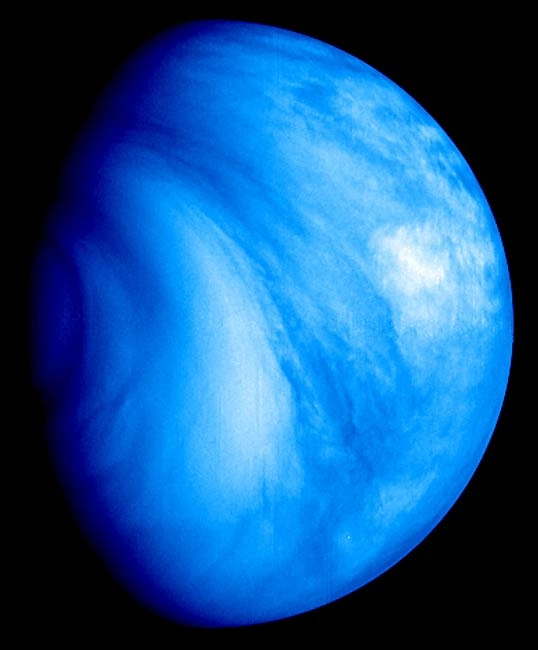
It's noteasy to find comfortable places to stay elsewhere in the solar system. However,Geoffrey Landis, a scientist at NASA's Glenn Research Center, suggests thatVenus might be a good place to look.
I know what you're thinking. Venus? Surface temperature of 914 degrees Fahrenheit (490degrees Celsius) with about 92 times the atmospheric pressure of Earth'ssurface? Doesn't sound very hospitable.
However, Landis, a science fiction writer in his spare time,suggests that we think a bit outside the box. In a recent interview, hesuggested building a city in the clouds about 31 miles (50 kilometers) above thesurface.
At that altitude, the atmosphere of Venus is at its mostEarth-like. The atmosphere has an air pressure of about one bar and thetemperature ranges in the 32-122 degrees Fahrenheit range (0-50 degrees Celsius). You'd need breathingapparatus, but probably not a space suit.
Landis adds that a city might not be as difficult to build —and to keep afloat — as you might think.
"Because the atmosphere of Venus is CO2, the gases thatwe live in all the time, nitrogen and oxygen, would be a lifting gas,"Landis said. "On Earth, we know to get something to lift, you needsomething lighter than air. Well, on Venus, guess what? Our air is lighter thanair, or at least lighter than the Venus atmosphere."
"Ifyou could just take the room you're sitting in and replace the walls withsomething thinner, the room would float on Venus," he remarked.
SF fans are no doubt hoping that Lando Calrissian will beavailable to act as administrator; as long as you're building Cloud City, you might as well do it right.
Star Wars fans may recall that CloudCity is an installation on the planet Bespin, first seen in The EmpireStrikes Back in 1980. Bespin has a habitable layer from about 93-112 miles (150-180kilometers) down from space with an oxygen atmosphere and normal pressure.
Another example of this idea in science fiction is StratosCity from the 1969 Star Trek episode TheCloud Minders.
Readers with an interest in the classics know that this isnot a new idea; the floating island ofLaputa forms one of the wondrous locations of interest in Jonathan Swift'sbook Gulliver's Travels, whichwas published in 1728.
From Colonizing Venus with floating cities.
(This Science Fiction in the News story used withpermission of Technovelgy.com)
- Video Player: Aerial Explorers: Around our Sister Planet in 80 Days
- Venus Data Sheet
- Spacecraft Eyes Venus for Active Volcanoes