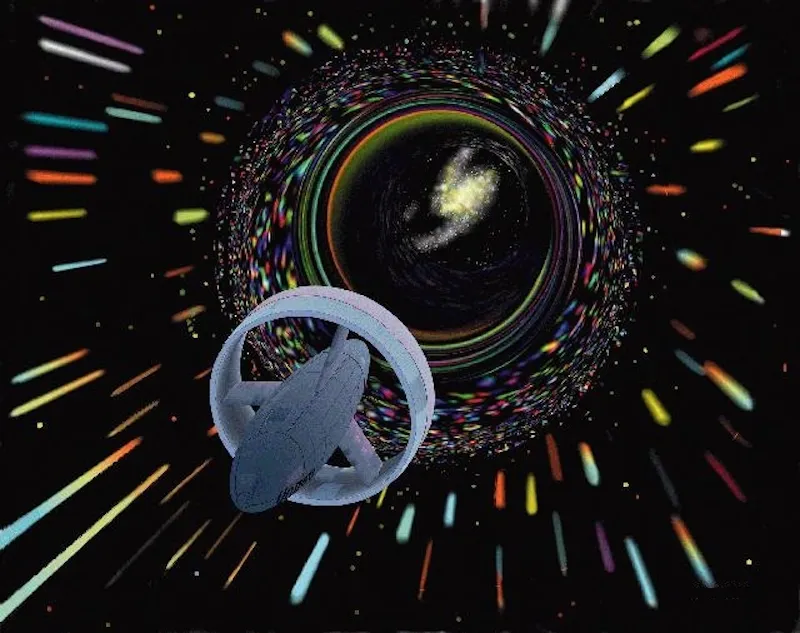
Kip Thorne, the physicist who brought real science to the movie "Interstellar," has a history of coming up with ideas that sound like they are straight out of science fiction. We've rounded up three of Thorne's most mind-bending theories — at least one of which may have recently been confirmed.
Interstellar travel through wormholes
Looking to travel from one star to another, but don't want the trip to take tens of thousands of years? How about using a wormhole?
Wormholes were first theorized in 1916 (although they weren't called that at the time), derived from Einstein's equations for relativity. A wormhole connects two points in space via a sort of tunnel through a higher dimension. An object entering one end of a wormhole would emerge almost instantly on the other end, even if the openings were separated by trillions of miles.
In the 1980's, Thorne, who is the Feynman Professor of Theoretical Physics, Emeritus, at the California institute of Technology, kicked off a serious discussion among physicists about whether or not an object (like a spaceship) could physically travel through a wormhole. In other words, do the laws of physics forbid it? Or, with unlimited resources and knowledge, could a civilization build a wormhole and use it as a cosmic highway?
Physicists, including Thorne, have made some progress on this question. Scientists knew prior to the 1980s that if wormholes existed, they would evaporate before anything (even light) could pass from one opening to another. So sending something through a wormhole would require a kind of scaffolding made from "exotic matter" to hold the wormhole open.
In addition, wormholes for travel would likely need to be artificially constructed, because there is no solid evidence that they exist naturally.
"We see no objects in our universe that could become wormholes as they age," Thorne writes in his new book "The Science of Interstellar" (W.W. Norton & Co. 2014). By contrast, scientists see huge numbers of stars that will eventually collapse to form black holes. There is a possibility that very, very small wormholes exist in the universe in something called "quantum foam," which may or may not exist in the universe.
Thorne's question on the possibility of interstellar travel through wormholes remains unanswered. But at the moment, he told Space.com, wormhole travel will likely only ever exist in science fiction. [Star Trek's Warp Drive: Are We There Yet? | Video]
Wormholes for time travel

When Thorne began to consider the likelihood that wormholes could be used for space travel, he realized that they could also be used for time travel.
In his 1994 book "Black Holes and Time Warps" (W.W. Norton & Co. 1994), Thorne proposes a thought experiment: Say he obtains a small wormhole, which connects two points in space as if they were not separated by any distance at all. [What's New in Black Holes? A conversation with Kip Thorne]
Thorne takes his wormhole and puts one end in his living room, and the other aboard a spaceship parked in his front yard. Thorne's wife, Carolee, hops aboard the spaceship to prepare for a trip. The two don't have to say goodbye, though, because no matter how far away Coralee travels, they can see each other through the wormhole. They can even hold hands, as if through an open doorway.
Carolee starts up the spaceship, heads into space and travels for six hours at the speed of light. She then turns around and comes back home traveling at the same speed — a round trip of 12 hours. Thorne watches through the wormhole and sees this trip occur. He sees Coralee return from her trip, land on the front lawn, get out of the spaceship and head into the house.
But when Thorne looks out the window in his own world, his front lawn is empty. Coralee has not returned. Because she traveled at the speed of light, time slowed down for her: What was 12 hours for her was 10 years for Thorne back on Earth.
Now, as Thorne and Coralee hold hands through the wormhole, they are each traveling in time. Coralee has landed on Earth 10 years after she left, and there she will meet Thorne, 10 years older. But she can still reach through the wormhole and find Thorne, who is only 12 hours older. Thorne can step through the wormhole and find himself 10 years in the future, or his future self can step back 10 years into the past.
Thorne's idea is a thought experiment, intended to answer a larger question: Is time travel forbidden by the laws of the universe? Scientists know that time moves more slowly at high speeds (although traveling at the speed of light would actually kill a person) or in areas with very high gravity. (This was portrayed in the movie "Interstellar," when time moves more slowly on a planet orbiting a black hole.) Hence, traveling "into the future" is not forbidden.
But backward time travel is still unresolved. Stephen Hawking has stated adamantly that the laws of physics will prevent backward time travel. Thorne writes in "The Science of Interstellar" that the answer lies with more advanced physics than scientists currently understand.
A star within a star
Scientists may prove at least one of Thorne's wild theories in the near future: that one star can take up residence inside another star.
In 1975, Thorne and his colleague Anna Zytkow proposed that a very small, dense star could fall into a very large, diffuse star and go on living (rather than ending in the destruction or merger of the two). In October, other researchers announced that they had found what they believe to be the first Thorne-Zytkow Object (ZTO) ever detected.
The large, diffuse star would be a red giant: a star nearing the end of its fuel supply, which, as a result, has begun to inflate. (A red giant large enough to form a TZO would have a diameter the size of Saturn's orbit, according to scientists.)
A TZO would look very much like a normal red giant, but at its core would be a neutron star: an incredibly dense object (a teaspoon of neutron star material would weigh 1 billion tons) created when a massive star stops burning and explodes, and the remaining material collapses. A neutron star cannot form inside a red giant, so it would have to form outside and then fall in.
Thorne and Zytkow showed that if this odd merger actually occurred, it would create a unique kind of stellar oven. [The Strangest Alien Planets (Gallery)]
"It would have a shell of burning material around the neutron core, a shell that would generate new elements as it burned," Thorne said in an interview. "Convection, the circulation of hot gas inside the star, would reach right into the burning shell and carry the products of burning all the way to the surface of the star long before the burning was complete."
Subsequent work by Thorne's graduate student Garrett Biehle showed that ZTOs produce high levels of the elements rubidium, molybdenum and lithium. This activity differs from that of normal red giants, giving astronomers a way of identifying a ZTO based on its chemical profile.
In June, researchers from the University of Colorado Boulder and colleagues announced that they'd identified a red giant that fit the profile of a TZO. The star, HV 2112, is located in the Small Magellanic Cloud, a dwarf galaxy about 20,000 light-years away from Earth.
"The evidence is compelling but by no means ironclad," Thorne told Space.com. "We need to get additional observational data before victory can really be declared. So I think it's premature to say that a Thorne-Zytkow Object has been discovered."
Follow Calla Cofield @callacofield. Follow us @Spacedotcom, Facebook and Google+. Original article on Space.com.
