





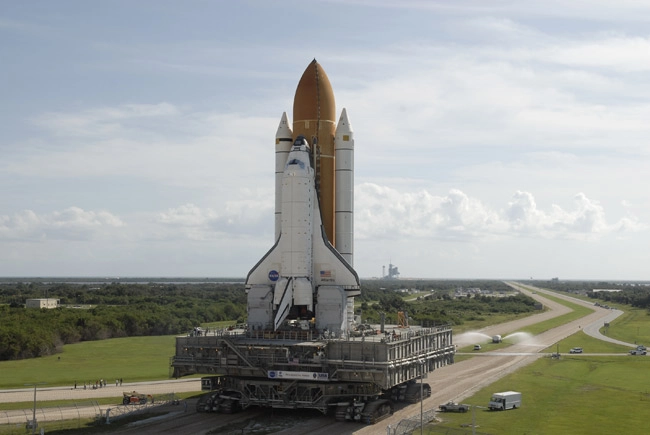
NASA?sspace shuttle Atlantis moved out to its Florida launch pad Thursday to preparefor one last flight to the Hubble Space Telescope next month after weather concernsrelated to Tropical Storm Hanna eased at the seaside spaceport.
Rollingslow and steady atop an Apollo-era carrier vehicle, Atlantis headed forits Pad 39A launch site at NASA?s Kennedy Space Center (KSC) in Cape Canaveral, Fla.,following several days of delay due to Hanna. But by early this morning, thestorm?s predicted path carried it far enough off shore to allow the shuttle?smove.
?It?s goingvery well,? NASA spokesperson Candrea Thomas told SPACE.com from thespaceport.
NASAofficials delayedAtlantis? move this week to avoid the possibility of high winds and rainfrom Tropical Storm Hanna. But while that storm is expected to have littleimpact on the Atlantis? launch preparations, NASA is tracking two other stormscurrently making their way east across the Atlantic Ocean.
Thomas saidKSC officials are watching the development of Hurricane Ike and, farther out,Tropical Storm Josephine to understand what impacts both storms might have ifthey stray too close to the coastal spaceport.
?What weare doing is watching it extremely closely to find out where it?s going to go,?Thomas said of the closer Hurricane Ike, a Category 4 storm currently about 525miles (845 km) northeast of the Leeward Islands. ?We?ll just watch Ike andJosephine and see what happens.?
Atlantis iscurrently slated to launch toward Hubble on Oct. 8 carrying seven astronauts onan 11-day mission to overhaulthe orbital observatory for the fifth and final time. Commanded by veteranspaceflyer Scott Altman, Atlantis astronauts plan to stage five back-to-backspacewalks to replace Hubble?s batteries, gyroscopes and thermal shielding,install new cameras, upgrade the telescope?s guidance system, attach dockingequipment and make unprecedented repairs.
NASA initiallycancelled the mission due to safety concerns after the tragic 2003 loss of theshuttle Columbia and its astronaut crew, but later reinstated it followingdissent from scientists and the public, as well as the development of heat shieldinspection and repair tools.
The spaceagency also plans to have a second space shuttle — the Endeavour orbiter —ready to serveas a rescue ship in case Atlantis suffered critical damage. Unlike recentshuttle missions, Atlantis will not be able to ferry its crew to theInternational Space Station to await rescue in an emergency because Hubbleorbits the Earth at a higher altitude and different inclination than the station.
Instead, Atlantisastronauts will carry supplies for an extra 25 days to allow time for Endeavourand a four-person rescue crew to launch and rendezvous with their spacecraft,Altman has said. Atlantis? crew would then transfer to Endeavour during aseries of spacewalks, but the actual likelihood such a rescue would ever berequired is very low, he added.
Atlantis? STS-125mission to Hubble will mark the fourth of up to five space shuttle missionsplanned for 2008.
Despiteweather delays, shuttle workers still have about four days of padding to theircurrent schedule to ready Atlantis for its planned Oct. 8 launch, Thomas said.
- Video - Hubble Service Mission 4 Countdown
- New Hubble Images - When Galaxies Collide
- Video - Flame Trench Repair
