





CAPECANAVERAL, Fla. - Astronauts from Germany and France will make the InternationalSpace Station (ISS) a bit more international when they help ferry a newEuropean module to the orbital laboratory this week.
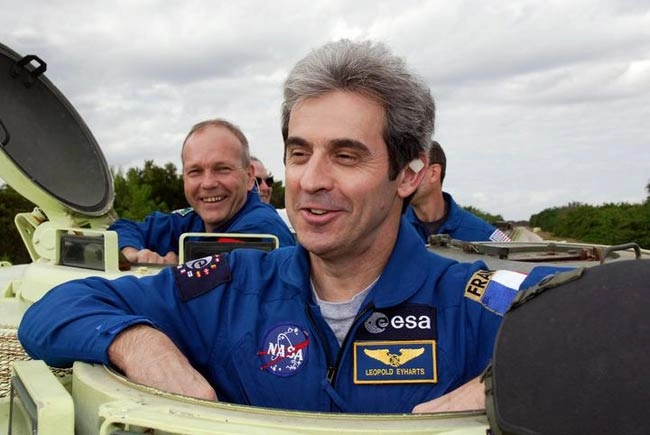
Veteran spaceflyers Hans Schlegel and L?opold Eyharts will haul the European Space Agency?s (ESA) Columbus laboratory intoorbit with the help of five crewmates when NASA?s shuttle Atlantis launches onThursday.
?Columbus is the biggest contribution from Europe for theInternational Space Station,? Schlegel, of Germany, told reporters Monday."By doing this, Europe will become a seniorpartner in human spaceflight and I?m very glad."
Schlegel, Eyharts and their STS-122 crewmates will deliver the 13-tonColumbus moduleduring a planned 11-day mission that is setto launch Dec. 6 at 4:31 p.m. EST (2131 GMT).
Returnto space
Hailingfrom Aachen, Germany, Schlegel is a former Federal Armed Forces paratrooper who is returning to space more than 14 years after launching on his first mission in 1993.
?The firstburning question for me is, how much will I remember?? Schlegel, 56, said in aninterview. ?How much will my body still remember and will it be functioning asI would like it to function??
Schlegel, ascientist-turned-astronaut, first flew as a mission specialist for the SpacelabD-2 research expedition during NASA?s STS-55 flight aboard Columbia, where he participated in some 88experiments over the course of 10 days. On STS-122, he will serve as MissionSpecialist-3 and participate in two of the flight?s threeplanned spacewalks.
?The mostjoy will be when the first laughter comes over through the space-to-ground [comm],? said Schlegel, adding that, as the fifth of ninechildren with eight children of his own, he?s learned the value of teamwork.?That means we know our mission is going well, we are doing as expected andeverything is going to be good so we can continue building up and working toour common goal.?
It wasscience that led Schlegel to Germany?s astronaut corps. While studying the properties of semiconductor materials, the trained physicist had the chance to work with substances made in orbit, which galvanized his interest in spaceflight. He gladly applied when his country madea new call for astronauts.
?I neverthought I would have had a chance, but I was lucky enough to be selected,? saidSchlegel, who joined Germany?s astronaut ranks in 1988 before shifting into the ESA?s spaceflying corps in 1998. He served as backup to fellow German astronaut Reinhold Ewald during the joint German-Russian Mir-?97 mission to the Mir Space Station.
?I think the International Space Station is a role model ofhow in the future we, as humankind, have to tackle our big problems and solvethem,? Schlegel said. ?Only in cooperation, in taking advantages of thecapability of other nations, other people, other cultures, this is the way togo.?
ISS orbust
LikeSchlegel, Eyharts is also making a return to spaceafter a years-long hiatus. But this time, the veteran French astronaut isheading for a very different space station.
Eyharts,50, first flew in space in February 1998, when he launched to the Mir SpaceStation aboard a Russian Soyuz spacecraft on France?s 20-day P?gasescience expedition. On STS-122, Eyharts will serve asMission Specialist-5 aboard Atlantis until the shuttle reaches the ISS, wherehe will replace NASA astronaut Dan Tani as anExpedition 16 crew flight engineer for the next three months.
?As I?llprobably be gone for awhile, I?d like to wish you Merry Christmas and a HappyNew Year,? Eyharts told reporters Monday. ?See you in2008.?
A generalin the French Air Force, Eyharts flew fighter jets,conducted parachute jumps and served as a test pilot, but spaceflight hasalways been his main goal.
?I decidedthat I would like to be an astronaut when I was about 12 years old and I sawthe first U.S. astronauts stepping on the moon and walking on the moon,? he said in a NASAinterview. France selected Eyharts to join its astronaut corps in 1990.
Eyharts will be the first astronaut to enter the ESA?s Columbus lab once it isfinally attached to the ISS, and he hopes to savor the moment once therequisite safety checks are complete.
?I thinkthere will be some emotion, even though that?s just a partial ingress,? hesaid, adding that many people on Earth have worked for up to 25 years to see Columbus fly.
Eyharts is married and has a nine-year-old child, and said he will definitely miss his familyduring the months he will spend in orbit. The long duration of his spaceflight,and the months of training and travel that preceded it, cannot help but causesome stress to those he will leave behind, he added.
He has alsosteeled himself to forgo the traditionally French glass of wine while in space.
?I willmiss it actually,? Eyharts said with a laugh. ?I amvery French.?
NASAwill broadcast Atlantis' STS-122 mission live on NASA TV. Click here for SPACE.com's STS-122 mission coverage and NASA TV feed.
- VIDEO: ISS Commander Peggy Whitson Takes Charge
- NEW IMAGES: Discovery's STS-120 Mission in Pictures
- The Orbital Chef: The Top 10 Space Foods
