





HOUSTON -- Astronauts aboard the International SpaceStation (ISS) partially tucked away one of the orbital laboratory's solarwings Wednesday and started up a power-producing paddlewheel on the outpost'sport side.
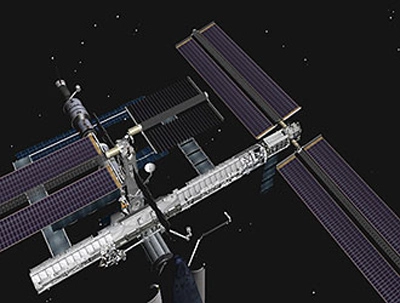
After morethan 40 attempts and six hours of work to stow a six-year-old solar array onthe station's mast-like Port6 (P6) truss, the joint ISS and Discoveryshuttle crews settled for a semi-retracted state that was enough to allow anewerset of solar wings to begin tracking the Sun[image].
"It justwasn't going to work for us today, but that stuff happens and I'm sure we'llget through it," said Expedition14 commander MichaelLopez-Alegria told flight controllers, apparentlydisappointed in the partial arrayretraction.
"Well Mike,actually, we consider it a success," NASA astronaut SteveRobinson, serving as spacecraft communicator, replied adding that the P6array was hauled in enough to activate the station's massive port Solar AlphaRotary Joint (SARJ) [image]."We're looking at the SARJ rotating on the big screen and up there and we'requite happy about it."
Theportside SARJ joint allows the station's Port 3/Port4 (P3/P4) solar arrays to rotate like a paddlewheel and efficientlygenerate power by tracking the Sun whilethe ISS orbits the Earth [image].That rotation is vital for the space station's future, since the P3/P4 solararrays will serve as the prime source of power after two planned spacewalks setfor Thursday and Saturday of this week.
Robinsonadded that mission controllers are now discussing whether to add additionaltasks to the planned Saturday spacewalk for Discovery's STS-116 crew, add afourth spacewalk altogether to the mission, or reserve the remaining P6 arrayretraction for a later ISS crew-only extravehicular activity (EVA) [image].
Stop andgo retraction
Wednesday'sretraction work marked the first time astronauts attempted to furl the 115-foot(35-meter) P6 array, known as P6-4B, since the solar wing's initialdeployment in December2000.
Retractionbegan in earnest at about 1:28 p.m. EST (1828 GMT), but astronauts quicklyfound that the array, which originally stretched out over the P3/P4 truss, wasprone to errant folds [image].Slack in some array guide wires also caused some strife.
"It'skind of like folding a map up," said Discovery's STS-116commander Mark Polansky said as he watched theprocess. "You have the folds in the paper, and if youstart folding it and the fold is going the wrong way, you can try a little bitbut there gets a point where it just bows out and there's nothing you can doother than to pop it back in place or unfold it and try again."
Thatprompted astronauts aboard the ISS to retract the P6-4B array until an errantfold occurred, then extend the solar wing back out and try again, a technique thatnewly arrived ISSastronaut Sunita "Suni"Williams said produced favorable results.
"Okay Suni, that's good news to hear. You've got a bunch of guysabout to turn blue here," astronaut Terry Virts told the ISS crew, promptinglaughs at NASA's Mission Control here since flight controllers said the samething to NeilArmstrong and Buzz Aldrin after their 1969 Moon landing.
Solararray rotation begins
In order tobegin rotating the P3/P4 truss, astronauts had to retract at least 40-percentof the P6-4B array into its storage boxes.
EachU.S.-built solar array aboard the ISS is made up of two "blankets" connected toa pop-up mast divided into 31 ? sections known as bays. To rotate the P3/P4arrays, ISS and Discovery astronauts could leave a maximum of 19 mast bays ofthe P6 array still deployed.
After hoursof back and forth motion, the astronauts managed to retract the array enough toleave about 17 ? bays exposed.
That gave ISSflight controller the room they needed to commence rotation of P3/P4, whichbegan at about 8:00 p.m. EST (0100 Dec. 14 GMT). They also began filling an ISScooling system with its ammonia coolant.
Today'sarray rotation and retraction work, along with the remaining STS-116spacewalkers, are vital steps building up the ISS for the arrival of futuremodules and laboratories, NASA officials said.
"Thestation, for all this time, has been in this infant stage," John Curry, NASA'sISS flight director for the STS-116 mission. "We need to go to the permanentsystem so that we can add the Japanesemodule Kibo and the [European Space Agency's] Columbuslater."
Thosemodules are due to arrive at the ISS in 2007 and 2008, he added.
- Images: Discovery's STS-116 Launch Day Gallery
- STS-116 Video: Power is Everything
- STS-116 Video: Building Blocks
- Mission Discovery: The ISS Rewiring Job of NASA's STS-116
- Complete Space Shuttle Mission Coverage
- The Great Space Quiz: Space Shuttle Countdown
- All About the Space Shuttle
