NASA wants to dump the ISS in the sea. Experts say the plan 'raises serious concerns for ocean health'

NASA's plan to deorbit the International Space Station in coming years has fallen under the scrutiny of a government watchdog group and stirred up a wave of reaction by a leading ocean conservation organization.
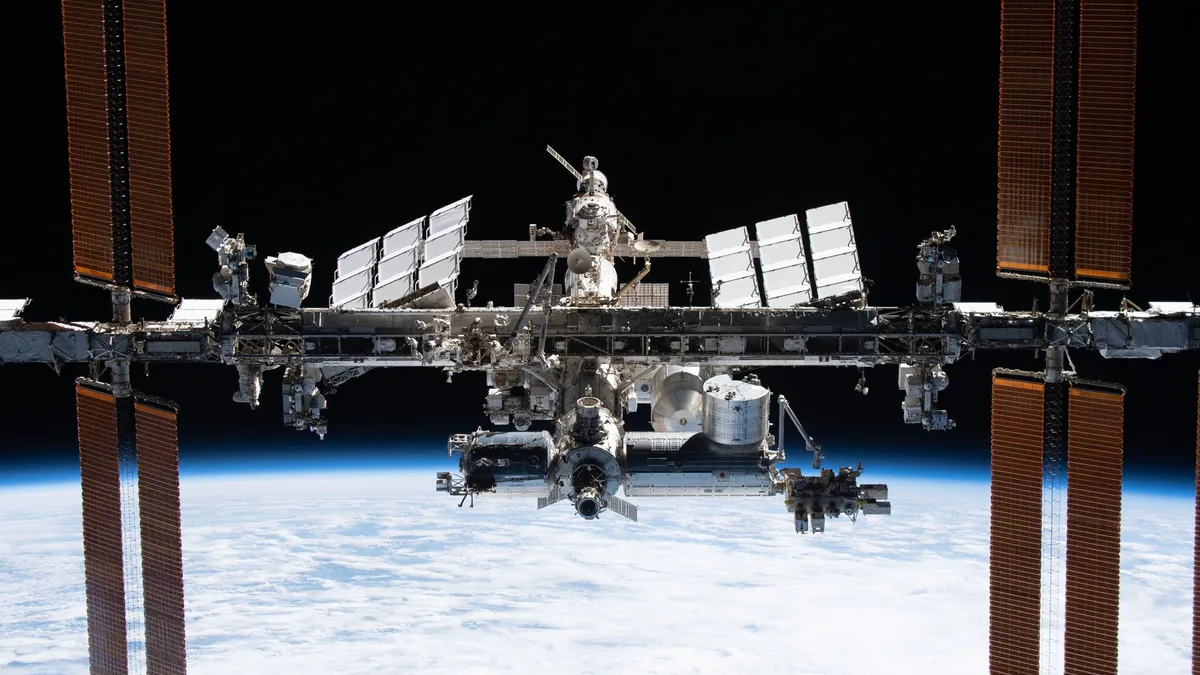
As presently blueprinted by NASA, the International Space Station will be de-orbited via a series of actions. Firstly, in early to mid-2028, the ISS will start to be lowered through a combination of Earth's natural atmospheric drag and the execution of re-entry maneuvers by the ISS's Russian segment. Then, in mid-2029, NASA plans to launch a SpaceX-supplied, government paid for, U.S. Deorbit Vehicle (USDV) and attach that craft to the ISS, which will fire its 46 Draco thrusters and push the station down to a watery grave.
But there's one issue that has ecology experts concerned. The Ocean Foundation, a Washington, D.C.-headquartered group with a mission to improve global ocean health and the human relationship with the sea via carefully chosen strategies and projects, says the planned deorbit of the International Space Station "raises serious concerns for ocean health that the space community has not adequately grappled with," according to Mark Spalding, president of the foundation.
A troubling gap
A just-issued U.S. Government Accountability Office (GAO) report has focused on issues related to NASA's plan to bring down the International Space Station (ISS) and transition from the ISS to commercial space stations, namely NASA's concern about having a "gap" in continuous human presence in low Earth orbit.
The GAO report explains that, at the end of 2030 or early 2031, the USDV is to perform a re-entry burn. That would push the ISS through the Earth's atmosphere and into a pre-determined spot – an ocean zone called Point Nemo.
"As part of the reentry process, NASA expects portions of the ISS and deorbit vehicle to break up and fall into the remote part of the ocean to minimize the risk to populated areas," states the GAO report.

But as for using Point Nemo or any part of the ocean as a convenient dumping ground, Spalding told Space.com that "there is a troubling structural gap in international law that the ISS de-orbit throws into sharp relief."
Under the Space Liability Convention of 1972, if space debris falls on another nation's territory or damages property, Spalding said, the launching nation owes compensation - absolutely and without needing to prove fault. "But no equivalent protection exists for the ocean," he said.
"As a result, when space agencies have control over where debris falls, they aim for the high seas, and in doing so, they incur no legal obligation to pay for cleanup or environmental remediation," said Spalding.
The Ocean Foundation leader said he understood the legitimate safety rationale for targeting Point Nemo, the point on Earth farthest from any populated area. "But the ocean's remoteness from human infrastructure should not be mistaken for a lack of value or vulnerability," Spalding said. "The ocean and its creatures deserve the same protection that international law affords to national territories."
Concerning the ocean's ecosystems, Spalding asks what happens to the marine ecosystems and creatures on the seafloor where the ISS leftovers land?
"The honest answer is, we don't fully know. That is deeply troubling for a structure the size of a football field. We do know that not everything burns up on reentry. Denser components will survive and reach the seafloor," Spalding added.

The problem: uncertainty
What denser, specific materials from the ISS re-entry will be, and what harm they may cause to marine life, Spalding said, "has not been adequately studied or disclosed. That uncertainty is itself the problem."
Additionally, what environmental harm may begin before the debris hits the water is worrisome. As the largest reentry in history, the cumulative atmospheric impact of down-falling ISS hardware deserves serious study, he said.
For one, Spalding flagged a newly negotiated High Seas Treaty (BBNJ Agreement) that is relevant to downing the ISS. It requires parties to conduct environmental impact assessments for activities that may affect the marine environment beyond national jurisdiction when effects are unknown or poorly understood.
"It is fair to ask whether the ISS deorbit — the largest such reentry in history, targeting the high seas — should trigger that obligation," Spalding said.
Position statement
As for the Ocean Foundation's position on the ISS deliberate crashing into the Pacific Ocean, the group believes that discussion points prior to the ISS downing include:
- A full environmental impact assessment of the anticipated seafloor debris field and atmospheric effects;
- Public disclosure of all materials that will survive reentry and reach the ocean floor;
- A rigorous legal analysis of obligations under the UN Convention on the Law of the Sea (UNCLOS,) the London Protocol of 1996 that provides an international standard and framework for countries to individually and collectively protect and preserve our oceans from pollution caused by the dumping of wastes and other matter into the ocean, along with the BBNJ Agreement.
The high seas have no sovereign who can demand accountability, concluded Spalding. "We believe this gap in international law needs to be closed, and the ISS de-orbit is a vivid illustration of why."