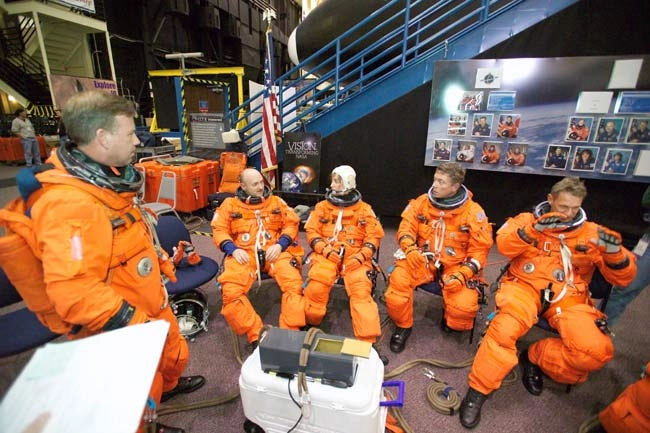
WhileNASA's Discovery astronauts prepare for the agency's first shuttle flight inmore than two years, another orbiter crew is also training hard for its ownlaunch - now less than three months away.
"We'reworking really hard, and it's getting busier," said Mark Kelly, pilot forNASA's STS-121 mission, in a telephone interview. "You would think that atwo-month launch slip would give you a lot of extra time, but it doesn't."
Kelly andhis STS-121 crewmates are set to ride the space shuttle Atlantis into orbitbetween Sept. 9-24 in what NASA hopes will be its second orbiter launch sincethe 2003 Columbia disaster. The spaceflight's earlier launch window, whichstretched from July 13-31, is now reservedfor NASA's first return to flight mission, STS-114 aboard Discovery.

Bothshuttle missions are test flights to demonstrate new safetytools and procedures put in place after the loss of seven STS-107 astronautsaboard the Columbiaorbiter, which broke apart during reentry on Feb. 1, 2003. Wing damagesustained from external tank foam debris at launch was later identified byinvestigators as the accident's cause.
"To me,professionally, it's just about getting the space shuttle program back to wherewe were before the accident," Kelly said of the STS-121 spaceflight. "The factis we learned from Columbia and will hopefully operate [the shuttle] safer thanbefore."
Kelly, anexperienced pilot and U.S. Navy commander, said that while he is aware of therisks posed by human spaceflight, he believes space exploration is a worthyendeavor.
"I,personally, would not take a lot of risk with something that has little benefitto me or the country as a whole," he said. "And spaceflight has given ourcountry and the rest of the world a lot of technology we might not have hadotherwise."
Morereturn to flight tasks
Many of thereturn to flight tasks during STS-121, such as external tank photography, willbe simple repeats of STS-114 experiments. But Atlantis' mission is expected totake some tasks, especially orbital repair tests, to the next level.
"Ourflights work together," STS-121 commander Steven Lindsey said of the twoupcoming shuttle missions in an earlier interview. "The [return-to-flight]objectives the STS-114 crew don't get to, we'll do...that's where we fit in."
LikeDiscovery's STS-114 spaceflight, the STS-121 crew will test a 50-foot(15-meter) orbital boomdesigned to scan sensitive shuttle areas for damage using a laser and camerasensor package. But while the STS-114 mission will test new instrument'sutility, the STS-121 crew will put one its spacewalking astronauts at the tipof boom for additional tests.
STS-121astronauts said the manned orbital boom test is slated for the mission's firstextravehicular activity (EVA) with the boom attached to the end of Atlantis'robotic arm.
"We want totest the feasibility of the structural loads," Lindsey said. "We need todetermine if the arm and boom together is a stable enough platform for orbitalrepair...with a crewmember attached."
All threeof the STS-121 mission's 6.5-hour spacewalks, to be executed by Fossum andSellers, will test some facet of return-to-flight hardware, ranging from themanned orbital boom test to repairmethods for Atlantis' protective thermal tiles and reinforced carbon carbon(RCC) panels.
The secondspacewalk includes space station support activities, in which Fossum andSellers will attach spare parts to an exterior platform.
"In themiddle of that we'll test the CIPAA tile repair goo gun," Kelly said. "And EVA3 will be dedicated to RCC repair tests."
Short forCure in Place Ablator Applicator, the backpack-mounted CIPAA device is designedto mix and deliver a pink, ablative goop known as STA-54 into damaged shuttletiles.
DuringSTS-121's third spacewalk, RCC plug experiments and additional tests of ablack, heat-resistant substance called non-oxide adhesive experimental (NOAX)are scheduled, Kelly added.
Oneastronaut short
UnlikeDiscovery's upcoming flight, which will rely on its entire seven-astronaut crewto accomplish NASA's return-to-flight goals, the STS-121 crew must make do withsix astronauts.
The finalseat aboard Atlantis is currently reserved for European Space Agency (ESA)astronaut Thomas Reiter, who will jointhe two astronauts aboard the ISS for a long-duration mission instead ofreturning home with the STS-121 crew.
"We've gotthe same amount of work [as STS-114] with one less person," Kelly said, addingthat Reiter will help with some standard shuttle tasks in the three days beforeISS docking. "So we're going to be pretty busy, but we're ready."
In additionto Kelly and Lindsey, STS-121's crew complement includes mission specialistsLisa Nowak, Stephanie Wilson, Michael Fossum and Piers Sellers.
As shuttleengineers ready Atlantis for launch - the orbiter and its crew must be preparedto launch to the ISS within about 35 days after Discovery as part of an emergencyrescue plan - the STS-121 crew is preparing for a July 19thcheck on their Italian-built Leonardo cargopod, Kelly said. A launch countdowndress rehearsal is slated for mid-August, he added.
Spacestation or bust
Theinevitable target of the STS-121 spaceflight is the orbiting space station,where Expedition 11 commander Sergei Krikalev and flight engineer John Phillipswill be awaiting the arrival of both Reiter and the cargo aboard the Leonardomodule.
"The shuttleis a capable workhorse not only to conduct a lot of science on its own, butalso to build the space station," Lindsey said.
NASAgrounded its three remaining shuttles after the Columbia accident, leaving onlyRussian Soyuz spacecraft available to launch fresh crews to the ISS, andRussian unmanned Progress vehicle to deliver vital food and other supplies.Additional ISS construction has been delayed because many of the new trussesand modules can only be launched via NASA's shuttles.
"I was originallytraining for the STS-119 mission, with Commander Steven Lindsey and MichaelFossum, and we were going to deliver a big piece of truss to the station,"Kelly said. "We need the space shuttle to complete the space station."
- Fixing NASA: Complete Coverage of Space Shuttle Return to Flight
