A newly released NASA timelapse offers a rare look at a solar eclipse observed from deep space during the Artemis 2 mission, when astronauts aboard the Orion spacecraft watched the moon fully obscure the sun during their far-side lunar flyby.
The video compresses nearly an hour of totality into a short sequence, showing the precise alignment of the sun, moon and spacecraft, as the Artemis 2 crew flew around the far side of the moon on April 6.
"As the sun disappears behind the moon, it reveals a glowing halo around the lunar disk," NASA officials said in a post on Instagram, sharing the new timelapse video. "Science team members are investigating whether this effect is due to the corona, zodiacal light or a combination of the two."
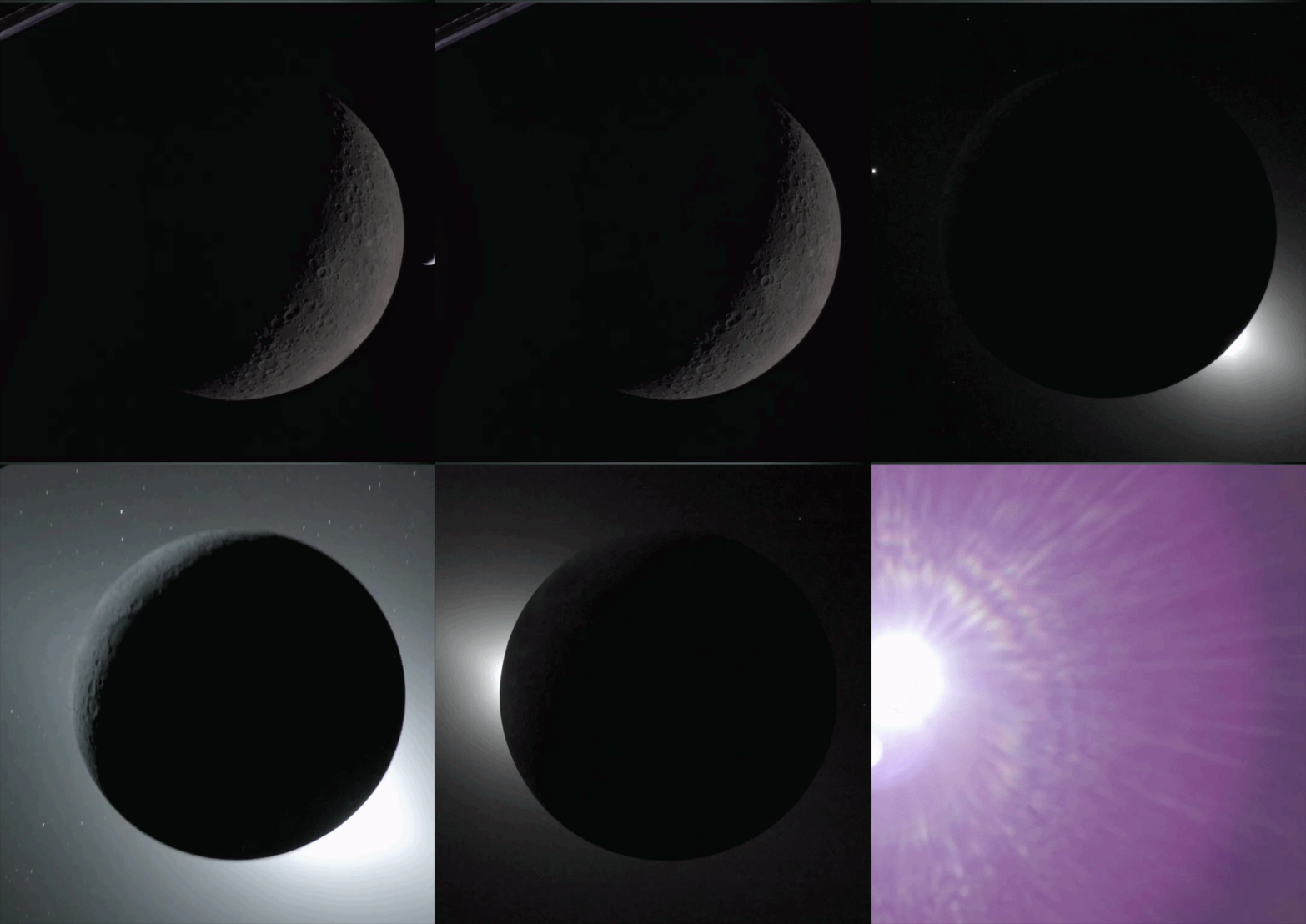
As Orion moved behind the moon, the lunar disk gradually covered the sun until only the solar corona — the sun's outer atmosphere — remained visible as a bright halo. The timelapse highlights changes in brightness and structure within the corona, which become easier to observe when the sun's photosphere is completely blocked.
Unlike solar eclipses viewed from Earth, which typically last only a few minutes, the geometry of Artemis 2's trajectory allowed for an extended period of totality lasting about 53 minutes. This longer duration provided sustained observing conditions for both the crew and onboard instruments, enabling clearer visibility of faint coronal features and background stars. The footage was captured using Orion's solar array wing cameras, showing the progression of the eclipse as seen from the capsule, according to the statement released on Instagram.
Because the observation occurred beyond Earth's atmosphere, the view was not affected by atmospheric scattering or distortion, offering higher contrast and sharper detail. As totality progressed, the reduction in scattered sunlight revealed additional phenomena, including stars and planets in the background sky and faint illumination of the lunar surface from sunlight reflected off Earth, also known as earthshine.
The eclipse took place as Orion passed behind the moon, a phase of the mission that also involved a temporary communications blackout with Earth. During this time, the spacecraft entered the moon's shadow, creating ideal conditions for observing the sun's corona over an extended period.
For the Artemis 2 crew — which includes commander Reid Wiseman, pilot Victor Glover and mission specialists Christina Koch and Jeremy Hansen — the event provided a direct view of solar and lunar alignment from a vantage point rarely experienced by humans. While astronauts during the Apollo program also observed solar eclipses near the moon, those events were typically shorter because the spacecraft were in lunar orbit and moved quickly through the moon's shadow, whereas Artemis 2 follows a trajectory that allows for a longer observing window.
NASA's timelapse documents the solar eclipse from deep space, capturing the sun's corona during totality and highlighting how missions beyond low Earth orbit can provide observational opportunities for otherwise short-lived events. Now, as the mission comes to a close, the Artemis 2 crew is heading back to Earth and is expected to splash down today (April 10) off the coast of San Diego.