





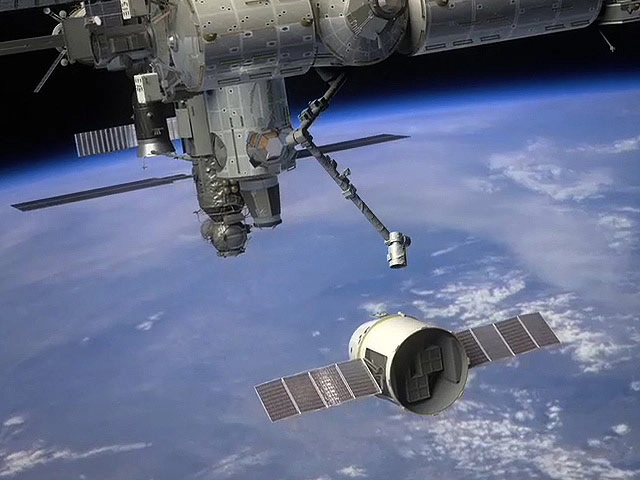
A private spaceship is preparing to link up with the International Space Station for the first time Friday (May 25) in a historic step for commercial spaceflight.
The unmanned Dragon capsule, built by Space Exploration Technologies Corp. (SpaceX) is due to arrive at the station early tomorrow and be attached to an open docking port, becoming the first spacecraft built by a company — and not a national space program — ever to do so.
A series of orbital tests Thursday (May 24), including a practice flyby of the space station by Dragon, cleared the way for the capsule to attempt the groundbreaking berthing tomorrow.
At around 5 a.m. EDT (0900 GMT), NASA is due to give Dragon the go-ahead to move within about a mile (1.4 km) of the orbiting laboratory. After about an hour, the capsule will move to roughly 820 feet (250 meters) below the station.
A few more checkouts later, NASA will decide whether Dragon can make its final approach to the station, where it will move into position to be grabbed by the outpost's robotic arm, which will be controlled by astronauts inside. Dragon will then be attached to the lab's Earth-facing Harmony node.
"Sort of like a cowboy ropin’ a steer we fly in the robotic arm and lasso the vehicle and then we bring it up to one of the docking ports on station," NASA astronaut Don Pettit, who will control the arm for tomorrow's maneuver, said in a preflight NASA interview. [SpaceX's Historic Flight to Space Station (Photos)]
If all goes smoothly, the robotic arm is expected to grab hold of Dragon at 9 a.m. EDT (1300 GMT).
The rendezvous and docking plan was approved by NASA today after Dragon completed a near-flawless series of tests this morning, including checkout of its navigation and communications systems, during a flyby of the station.
"Certainly this is a demonstration flight, a test flight, and to get through the first piece of it, obviously makes you feel positive, but in terms of the activity tomorrow there's still a lot of new things that the teams need to perform and the vehicle needs to perform," NASA flight director Holly Ridings said during a briefing today.
There are further checks in place tomorrow to make sure the untested Dragon is cleared to safely approach the $100 billion International Space Station, a collaboration between the United States, Russia, Europe, Canada and Japan. The rendezvous activities will be punctuated with a series of "go-no go" queries in Mission Control in Houston, starting when Dragon is 1.5 miles (2.5 kilometers) from the station and again at various points closer in.
Finally, Dragon will approach to 656 feet (200 meters), and then 98 feet (30 meters), and ultimately to 32 feet (10 meters), the point where it will be captured by the robotic arm.
The capsule is a 14.4 foot-tall (4.4 meter) and 12 foot-wide (3.7 m) gumdrop shape, packed with student-designed science experiments as well as crew food rations and clothing for the six spaceflyers living on the orbiting laboratory.
"Dragon is go for berthing day tomorrow and right now we're looking good across the board," Dragon Mission Director John Couluris said today from SpaceX headquarters in Hawthore, Calif.
Dragon launched atop a SpaceX Falcon 9 rocket from Cape Canaveral, Fla. on Tuesday (May 22). It was the second-ever flight to orbit for the new capsule.

The vehicle is due to spend just under a week docked at the space station being unpacked. On May 31, the capsule will be loaded with its return cargo, completed science experiments and equipment no longer needed on the station, and sent back to Earth. The spacecraft is equipped with a heat shield to survive the temperatures of re-entry; Dragon is intended to be recovered by ship crews after it splashes down in the Pacific Ocean.
Dragon is one of two commercial vehicles being nurtured by NASA to replace the cargo-carrying duties of the retired space shuttles (the other spacecraft is the Cygnus built by Orbital Sciences Corp., of Dulles, Va.). This flight is a test mission sponsored by the agency's COTS program (Commercial Orbital Transportation Services).
If the current mission goes smoothly, SpaceX will be cleared to begin flying delivery missions to the space station starting this fall. The company is contracted for at least 12 of these flights for a total of $1.6 billion.
You can follow SPACE.com assistant managing editor Clara Moskowitz on Twitter @ClaraMoskowitz. Follow SPACE.com for the latest in space science and exploration news on Twitter @Spacedotcom and on Facebook.
