


NASA's 17 Apollo Moon Missions in Pictures
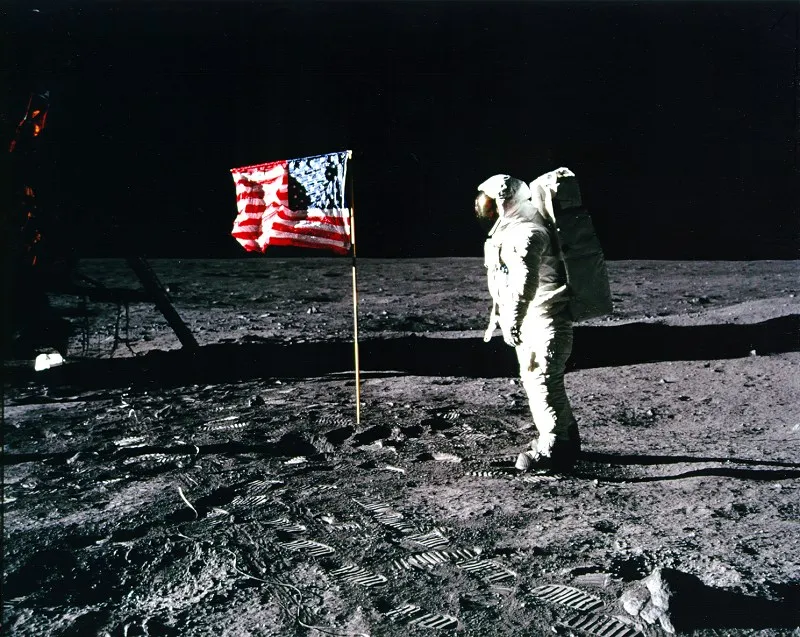
The Apollo program placed humans on the moon for the first time.
The effort famously began with President John F. Kennedy's speech on May 25, 1961, announcing the goal of sending astronauts to the moon.
The rocket technology necessary for such a feat underwent testing during 1961-1966. In 1966, the uncrewed flights of Apollo-Saturn AS-201, AS-203 and AS-202 (in order of launch) showed the readiness of the Saturn IB launch vehicle to carry astronauts into space.

Apollo 1 — Disaster on the Pad
From left, Apollo 1 astronauts Gus Grissom, Ed White and Roger Chaffee pose in front of their Saturn 1 launch vehicle at Launch Complex 34 at the Kennedy Space Center in Florida.
The astronauts were in training for AS-204, the first crewed test of the Apollo Command/Service Module. However, on Jan. 27, 1967, a fire on the launch pad claimed the lives of the three astronauts during a preflight test.
NASA retroactively named the unflown mission Apollo 1, as the agency redesigned the Apollo command module and returned to unmanned test flights.

Initial Uncrewed Test Flights
Prior to the Apollo 1 disaster, three unmanned test flights of Apollo-Saturn rockets took place. AS-201 (seen here), AS-203 and AS-202 missions took place in 1966, testing the Saturn 1B launch vehicle.
These missions set the stage for AS-204, planned to have been the first crewed mission, but which ended with fire killing three astronauts during training. That mission was later renamed Apollo 1. Apollo 4 then continued the uncrewed test flights as NASA redesigned the command module.

Apollo 4 — "All-Up" Test
The giant Saturn V rocket for the Apollo 4 mission at the Kennedy Space Center's launch complex 39A stands at the dawn of Nov. 8, 1967, during the pre-launch alert.
The uncrewed Apollo 4 (AS-501) mission was the first "all-up" test of the three-stage Saturn V rocket, meaning all stages were functioning.
The seemingly confusing Apollo 4 designation followed from the first three uncrewed launches, AS-201, AS-203 and AS-202.

Apollo 5 — The Lunar Module Checks Out
The rocket for Apollo 5 (AS-204), the fourth Saturn IB launch vehicle, sits on the launch pad before its Jan. 22, 1968 liftoff from Cape Canaveral, Florida of the uncrewed Apollo 5 mission.
This mission successfully tested the Lunar Module in a space environment. It marked the first test flight of the lunar module that would eventually carry astronauts to the moon.

Apollo 6 — The Final Unmanned Test
The Apollo 6 mission provided the final test of the Saturn V launch vehicle and Apollo spacecraft for use in crewed Apollo missions.
It launched on April 4, 1968, but was overshadowed by the assassination of Martin Luther King, Jr. the same day.

Apollo 7 — First Crewed Apollo Mission
Walter Schirra, Apollo 7 commander, sports nine days of space beard while looking out the rendezvous window during the Earth orbital mission.
Apollo 7 was also crewed by Donn Eisele and Walter Cunningham.
The mission launched on Oct. 11, 1968, and was an engineering flight to test space vehicle and mission support facilities performance during a crewed mission.
Apollo 8 — Lunar Orbit and Return
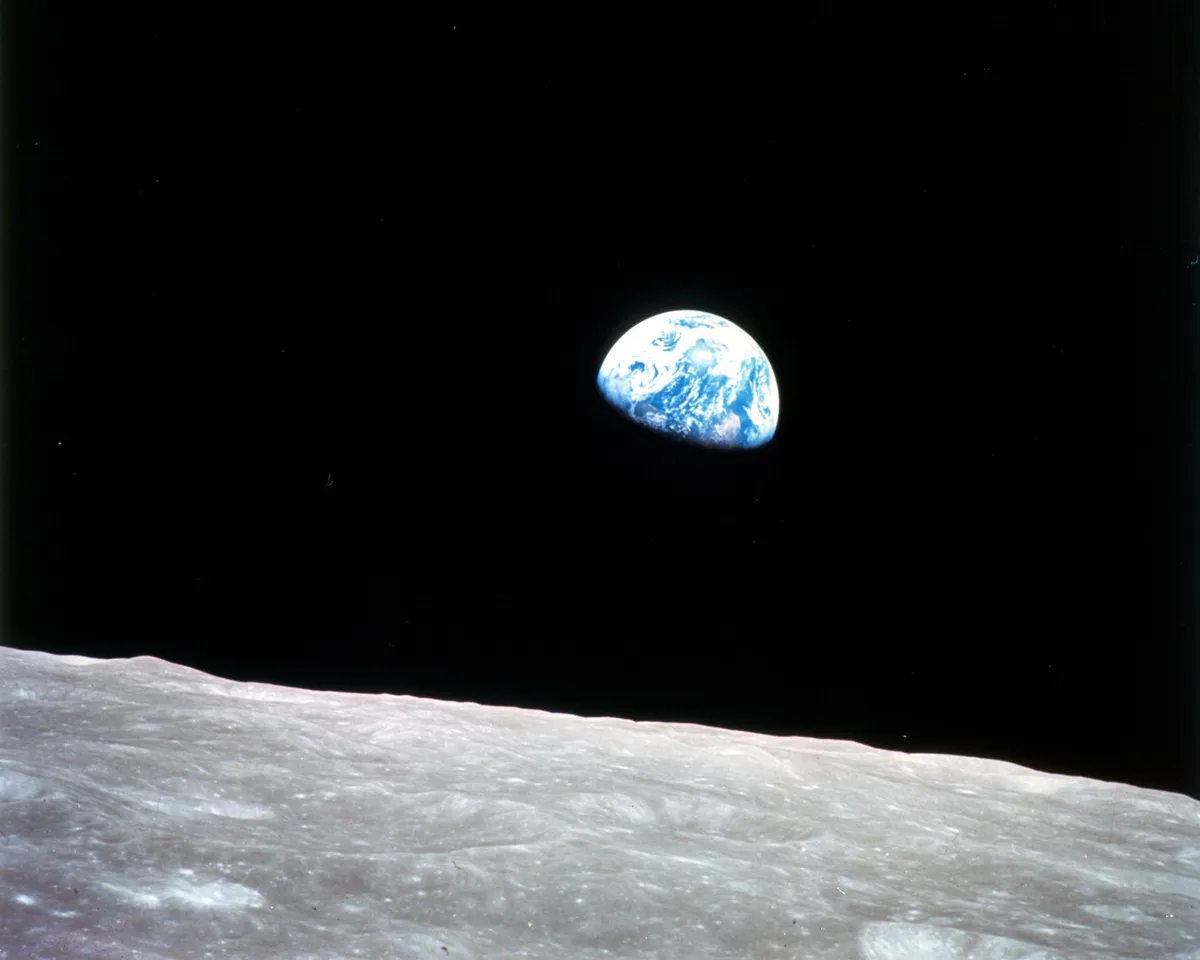
This picture of the Earth from near the moon was taken by Apollo 8 astronauts in December 1968.
Apollo 8 launched from Cape Kennedy on Dec. 21, 1968, carrying astronauts Frank Borman, Jim Lovell and Bill Anders. The three astronauts gained the distinction of seeing the moon's far side for the first time in human history.

Apollo 9 — First Crewed Lunar Module Test
Astronaut Russell Schweickart stands on the module's deck during his spacewalk on the fourth day of the Apollo 9 mission. This photo was taken from inside the lunar module "Spider" by mission commander James McDivitt.
Apollo 9 was the first crewed flight of the command/service module along with the lunar module. The mission's three-person crew, which also included command module pilot Dave Scott, tested several aspects critical to landing on the moon.

Apollo 10 — Lunar Orbit and Return
The Apollo 10 Command and Service Modules (CSM) are photographed from the Lunar Module (LM) after CSM/LM separation in lunar orbit.
Apollo 10 launched from Cape Kennedy on May 18, 1969 with astronauts Thomas Stafford, John Young and Eugene Cernan. The mission served as a "dress rehearsal" for the actual moon landing.
Apollo 11 — First Men on the Moon
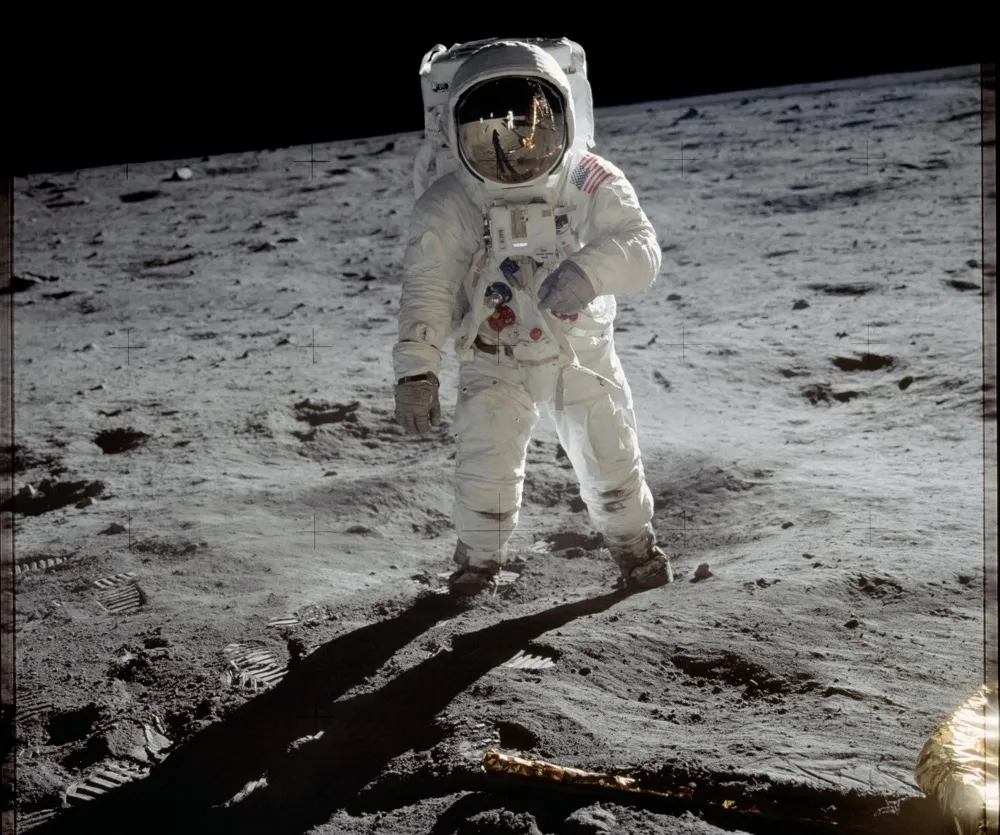
Buzz Aldrin stands near the leg of the Lunar Module (LM) "Eagle" during the Apollo 11 extravehicular activity (EVA).
Apollo 11 launched from Cape Kennedy on July 16, 1969, carrying Neil Armstrong, Buzz Aldrin, and command module pilot Michael Collins. Armstrong and Aldrin forever changed the course of history by walking on the face of the moon.
Apollo 12 — Ocean of Storms
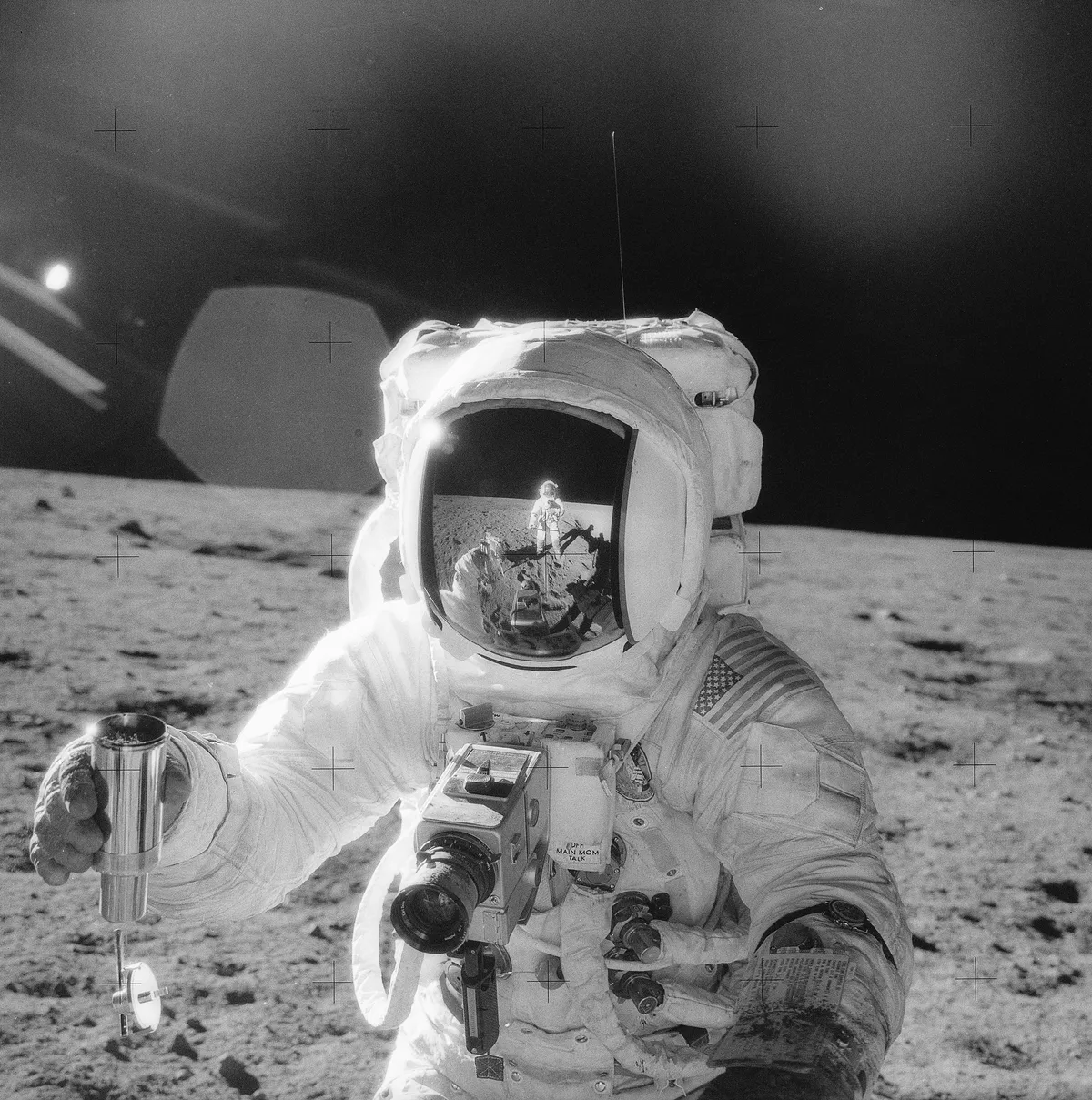
A television camera and other pieces of unmanned robotic lander Surveyor 3 were brought back from the moon for scientific examination. Here, Apollo 12 moonwalker Pete Conrad examines the Surveyor's TV camera.
Apollo 12 launched from Cape Kennedy on Nov. 14, 1969 crewed by Charles Conrad, Jr., Alan L. Bean and Richard F. Gordon Jr.

Apollo 13 — "Houston, we've had a problem."
On April 11, 1970, Apollo 13 lifted off for the moon with Commander Jim Lovell, Command Module Pilot Jack Swigert and Lunar Module Pilot Fred Haise aboard. Two days later, with the spacecraft well on its way to the moon, an oxygen tank exploded, scrubbing the lunar landing and putting the crew in jeopardy.
Working with Mission Control in Houston, the crew used their lunar module as a "lifeboat," and even rigged an adapter so that a command module "air scrubber" would work in the lunar module, preventing a dangerous buildup of carbon dioxide. The mission ended safely when the crew splashed down on April 17, 1970.

Apollo 14 — Fra Mauro
On Feb. 5, 1971, the Apollo 14 Lunar Module touched down on the moon's Fra Mauro highlands, with Alan Shepard and Edgar Mitchell onboard. Stuart Roosa piloted the command module. Liftoff occurred 33 hours later.
Famously, Alan Shepard hit two golf balls on the moon at the end of the last EVA.

Apollo 15 — Hadley Rille
Apollo 15 launched on July 26, 1971. In this photograph, Apollo 15 lunar module pilot Jim Irwin loads the first lunar rover in preparation for the first lunar spacewalk at the Hadley-Apennine landing site. The lunar module "Falcon" stands at the left in this image. The undeployed Laser Ranging Retro-Reflector lies on top of Falcon's Modular Equipment Stowage Assembly. David R. Scott and Alfred M. Worden made up the remainder of the crew.

Apollo 16 — Descartes
During the Apollo 16 mission, Charles M. Duke, Jr. collects rock samples at the Descartes landing site on the moon.
Apollo 16 lifted off on April 16, 1972, from Kennedy Space Center in Florida. John W. Young and Thomas K. Mattingly II also flew on the mission.

Apollo 17 — The Final Moon Landing
Apollo 17 mission commander Eugene A. Cernan makes a short checkout of the Lunar Roving Vehicle during the early part of the first Apollo 17 extravehicular activity at the Taurus-Littrow landing site in 1972. Harrison H. Schmitt and Ronald E. Evans rounded out the crew, the last humans to set foot on the moon (to date).
Following Apollo 17, three more missions, 18, 19 and 20, were planned, but cancelled owing to budget constraints. Apollo-Saturn technology was used for four Skylab missions and the Apollo-Soyuz Test Project in 1975 before NASA ended the program.
View Original
View Original

View Original
View Original
View Original
View Original
View Original

View Original

View Original
View Original
View Original
View Original

View Original
View Original
View Original

View Original

View Original

Space.com is the premier source of space exploration, innovation and astronomy news, chronicling (and celebrating) humanity's ongoing expansion across the final frontier. Originally founded in 1999, Space.com is, and always has been, the passion of writers and editors who are space fans and also trained journalists. Our current news team consists of Editor-in-Chief Tariq Malik; Editor Hanneke Weitering, Senior Space Writer Mike Wall; Senior Writer Meghan Bartels; Senior Writer Chelsea Gohd, Senior Writer Tereza Pultarova and Staff Writer Alexander Cox, focusing on e-commerce. Senior Producer Steve Spaleta oversees our space videos, with Diana Whitcroft as our Social Media Editor.