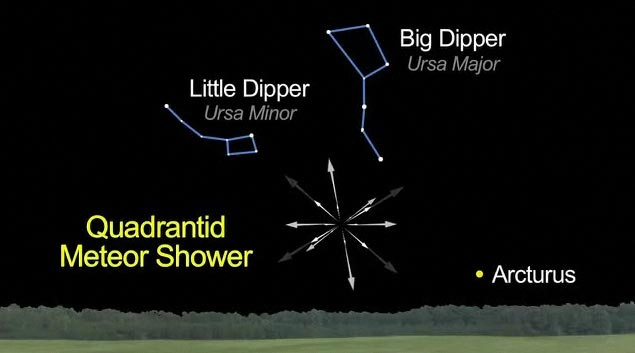
The year 2011 will begin with an eye-catching skyshow for well-placed observers when the annual Quadrantidmeteor shower hits its peak next week. The new yearpromises to be a great one to see the Quadrantidssince the moon, which can sometimes outshine the display, will be completelyout of the picture.
The Quadrantid meteor shower is due to reach maximum late Monday (Jan. 3) or early Tuesday (Jan. 4). Themoon will be in its "new" phase ? when it?s dark ? and poses noconcern of interfering with the meteor display.

Very few meteors are likely to be seen in thesouthern United States, since they would be streaking from below the horizonduring the early hours of darkness.
The peak of the "Quads" lasts only a few hours.But under ideal, dark-sky conditions, this can be one of the year?s best meteordisplays. (Any light pollution would cut down the numbers greatly.)
Give your eyes at least 15 to 20 minutes to adapt to thedark before starting a serious meteor count. No matter what time thepeak, you?d have to get up before dawn to see the best display.
This is because the shower's radiant ? from where themeteors appear to fan out or emanate ? is in QuadransMuralis, the Mural Quadrant, theobsolete constellation halfway between the head of Draco and the end of the BigDipper's handle.
According to British meteor astronomer Alastair McBeath, the peak of the 2011 Quadrantidsmight occur roughly between 4 p.m. EST (2100 GMT) on Jan. 3 and 1 a.m. EST(0600 GMT) on Jan. 4. Most almanacs are highlighting 8 p.m. EST Jan. 3(0100 GMT Jan. 4) as the "most likely" time, because that is aboutwhen Earth is expected to pass through the densest part of this meteor stream,based on observations dating back to 1992.
As a bonus, a partial solar eclipse will also be visibleat, or soon after sunrise.
For those living in North America, try looking for the Quadrantid meteors as soon as the sky gets dark on theevening of Monday, Jan. 3. The radiant will be low in the northwestduring the early evening. But even if you have excellent weather, the radiant will be very near the horizon.
If, however, the peak comes several hours later (asMcBeath suggests), viewers in eastern Canada and thenortheastern United States also might try looking toward the northeast part ofthe sky during the predawn hours of Jan. 4.
- Video ? Meteor Shower Kicks Off 2011 Skywatching Season
- Skywatchers Capture Gorgeous Photos of Geminid Meteor Shower
- The Best Leonid Meteor Shower Photos 1, 2, 3, 4
Joe Rao serves as aninstructor and guest lecturer at New York's Hayden Planetarium. He writes aboutastronomy for The New York Times and other publications, and he is also anon-camera meteorologist for News 12 Westchester, New York.