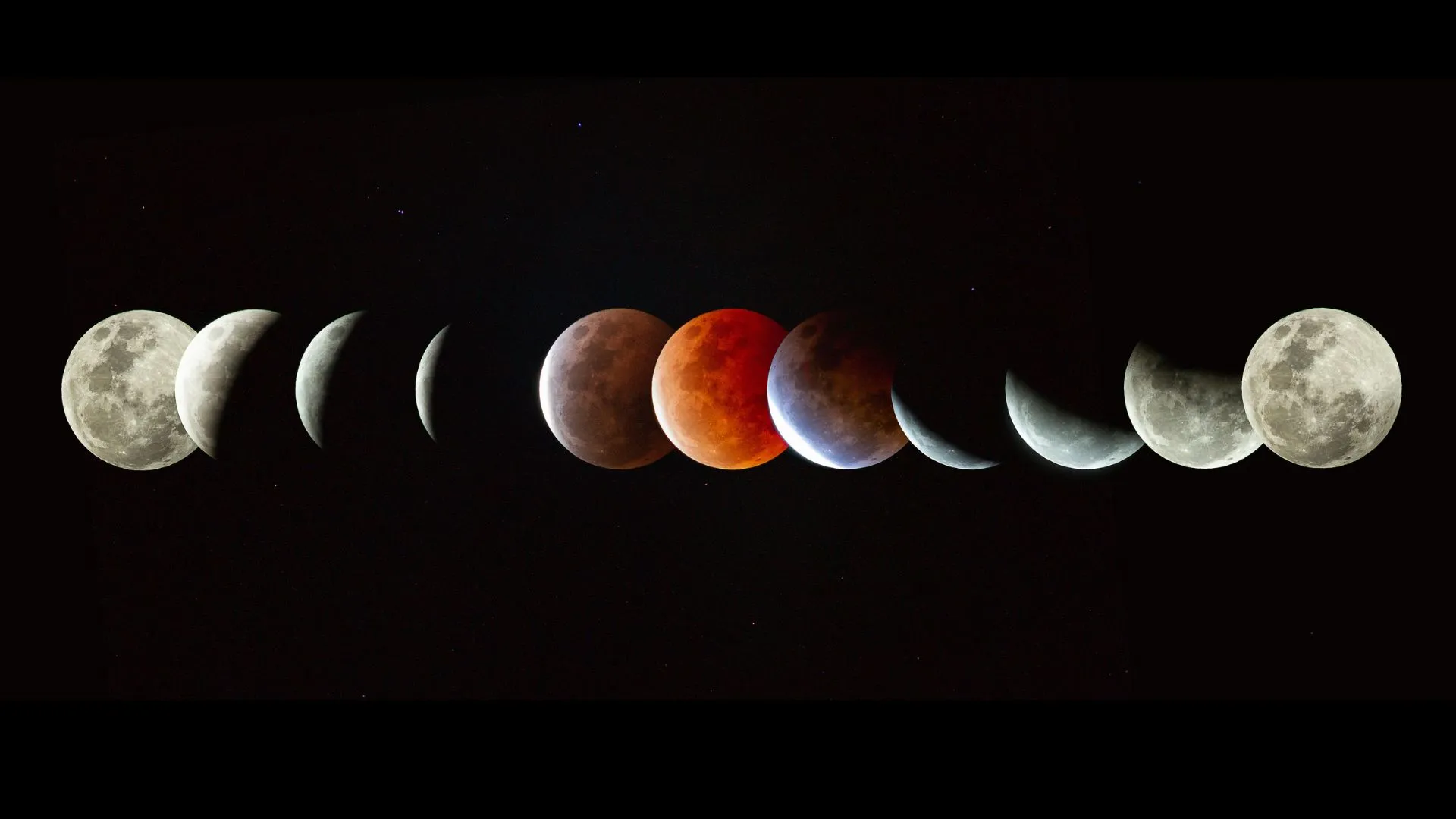
Should the weather be clear early on Tuesday morning, March 3, sky watchers across most of the Americas will have an opportunity to view one of nature's most beautiful spectacles: A total eclipse of the moon.
Unlike a total eclipse of the sun, which often requires a long journey to the path of totality, those of the moon can usually be observed from one's own backyard. The passage of the moon through the Earth's shadow is equally visible from all places within the hemisphere where the moon is above the horizon. This event favors locations near and around the Pacific Rim. For North America, places within the Eastern Time Zone will see the moon set during dawn's early light during the total phase; places farther west will be able to catch the moon emerging from the Earth's shadow as it sets, while for sites out in the Far West, the eclipse will be visible from start to finish. Hawaiians will see the moon almost overhead as totality takes place in the hours after midnight. Meanwhile, during local evening hours, Central Asia and western Australia will see the moon rise as it emerges from the Earth's dark shadow. Eastern Australia, Papua New Guinea, as well as much of Japan and eastern Siberia, will see it all during convenient evening hours.
There is nothing complicated about how to view this celestial spectacle. Unlike an eclipse of the sun, which necessitates special viewing precautions to avoid eye damage, an eclipse of the moon is perfectly safe to watch. All you'll need to watch is your eyes, but binoculars or a telescope will give a much nicer view.
Where will the moon be?
It's not too early to begin preparing for viewing next month's total lunar eclipse. One of the things to consider is the moon's location in the sky during the eclipse. As we have noted, for those who live in the eastern U.S. and Canada, this will be an important factor, since the moon will be moving into totality as it approaches its setting. Will tall trees or nearby buildings block your view of the moon?

You can get a very good idea about where the moon will be in the sky during the eclipse by looking for it on Wednesday, Feb. 4. Early that morning, the moon — 2½ days past full — will be very near to that region of the sky where it will be on March 3 for the eclipse. But on Feb. 4, rather than looking for the moon at the prescribed times given for March 3, you will need to look two hours and 8 minutes later.
For example, on March 3, for an observer in Salt Lake City, the moon will begin to enter the dark central shadow of Earth (called the umbra) at 2:49 a.m. Mountain Time. At that moment, the moon will stand 44° above the southwest horizon; that's roughly halfway up in the sky.
Now, on Wednesday, Feb. 4, if you add 2 hours 8 minutes to 2:49 a.m., you'll come up with 4:57 a.m. At that hour, on that morning, you'll be able to get a very good approximation of where the moon will be in the sky at the start of the eclipse as seen from Salt Lake City.
This method will be especially helpful for easterners who might want to determine roughly where the moon will be relative to their western horizon (and local landmarks) as it sets during the total phase of the eclipse. The table below provides details on the corresponding positions of the moon on Feb. 4, relative to where it will appear in the sky for various stages of the eclipse on March 3.
| Header Cell - Column 0 | EST |
CST |
MST |
PST |
|---|---|---|---|---|
Eclipse Starts |
6:57 a.m. |
5:57 a.m. |
4:57 a.m. |
3:57 a.m. |
Totality Starts |
8:11 a.m. |
7:11 a.m. |
6:11 a.m. |
5:11 a.m. |
Mid-Eclipse |
8:41 a.m. |
7:41 a.m. |
6:41 a.m. |
5:41 a.m. |
Totality Ends |
9:10 a.m. |
8:10 a.m. |
7:10 a.m. |
6:10 a.m. |
Eclipse Ends |
Not visible |
9:25 a.m. |
8:25 a.m. |
7:25 a.m. |
Take note that if you live in the Eastern Time Zone, the farther to the west you go, the higher in the sky the moon will appear and the longer you will be able to prolong your view of the totally eclipsed moon before it sets. As an example, from Portland, Maine, the moon will set only one minute after the start of totality. However, as seen from Indianapolis, Indiana — which also observes Eastern Time, but is positioned 860 miles (1,380 km) to the west — the entire total phase will be visible, with the moon not setting until five minutes after totality ends.
Space.com will provide more details about the lunar eclipse in the weeks to come, so stay tuned!