Jeremy Hansen grew up in a world with no Canadian astronauts. Soon, he'll become the first person from his country to fly around the moon.
Jeremy Hansen, then a Royal Canadian Air Force fighter pilot with NORAD flight experience, was selected to be an astronaut by the Canadian Space Agency (CSA) in 2009. He didn't get a seat on a mission until Artemis 2, whose crew was announced in 2023. That 14-year gap sounds long, but Hansen was busy. On top of normal support for other missions, he helped develop tools to fix a dark-matter detector on the International Space Station, he advised Canadian space policy-makers, and he was the first Canadian to manage the training schedule for all astronauts (American and Canadian) selected in the 2017 astronaut class.
Hansen is so well-respected that, after his selection for the Artemis 2 crew, then-Canadian Prime Minister Justin Trudeau gave him a "geeking-out" congratulations call. Hansen had to wait so long to fly in large part because the CSA contributes a less-than-3% share to ISS activities, which results in an astronaut mission roughly every six years for the agency at current flight rates. Hansen's seat on Artemis 2 came from Canada's contribution of the Canadarm3 robotic arm, which was expected to fly to NASA's planned Gateway moon-orbiting space station later this decade. (NASA recently "paused" Gateway and is instead focusing on building a moon base.)

The most detailed Artemis SLS Lego set, this adult-aimed model has 3,601 pieces and stands 28-inches (71 cm) tall. We thought "Lego has knocked it out of the park" in our full build review. Don't forget about the newer, more compact and much cheaper Lego Technic SLS set, only $60, also 'launches' with some clever Technic moving parts.
Flying alongside Hansen will be three NASA astronauts: Reid Wiseman (the Artemis 2 commander), pilot Victor Glover (who will become the first Black person to leave low Earth orbit) and mission specialist Christina Koch (the first woman to do so). The mission could launch as soon as April 1.
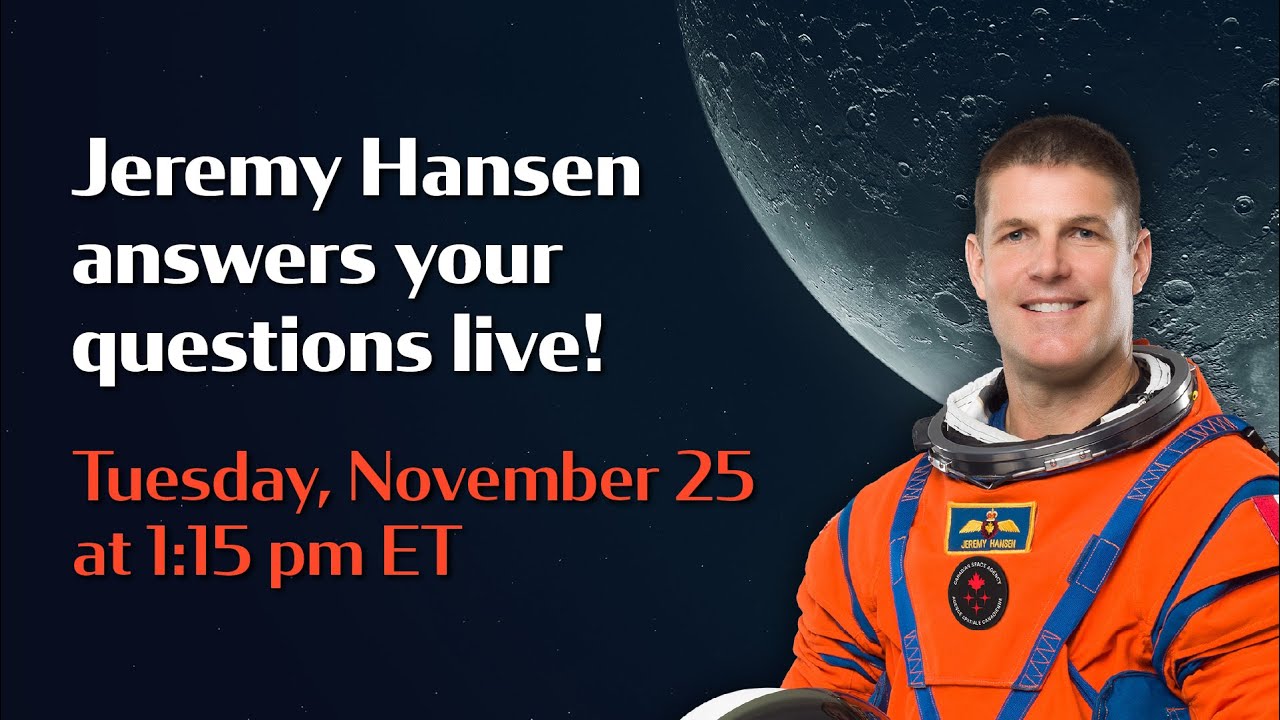
While Hansen was not available for a Space.com interview due his training schedule, he recently did a livestreamed Q&A with entrepreneur Fred Bastien on the CSA's YouTube channel. Below are excerpts from the interview, edited for length and clarity. Hansen spoke not only about his mission but also about helping set the table for Artemis 4, which will land astronauts on the moon in 2028, if all goes to plan.
One "of the things I love to reflect on about the mission is what it represents and says about Canada, to be the second country in the world to send a human into deep space. And this is not a gift, but something we earned over decades. We've worked to create technologies and innovate, and now we are an important partner on the world stage with respect to space, and we earned our spot here. And that's the reason that a Canadian will fly next year around the moon. And if we can do that right now, imagine what we can do next.
"A lot of colleagues say that, you know, [the moon] wasn't a childhood dream for them. But for me, it certainly was. I simply saw an image of a human standing on the moon [when I] was a child, and it changed my perspective, and I started looking at the moon differently. I wanted to go there. I changed my tree house into a spaceship with like, dials and controls, and I was exploring space in my imagination, and so it pushed me.
"And I told other people about it. That's what's kind of neat, is I was telling teachers who were guiding me to do things that would help me along that path, and they used that to motivate me. That led me to an interest in aviation, which led me to Air Cadets, which prepared me for the military.
"I think it [being in space for the first time] will be fun. There is pressure, of course. But I have a lot of trust in the team, when we face challenges together, because we are capable of doing what we're supposed to do, and it's really fun to work together. We will have moments with a lot of pressure, that's certain, but it will be fun.
"I've had the privilege, just in my travels across Canada, I've been invited by numerous [Indigenous] elders to sit with them. Sometimes I participate in traditional ceremonies, sweat lodges, pipe ceremonies, and then just sitting and chatting with elders. Anybody who's had more time on this planet, the wiser you are.
"That also led to the creation of my mission patch. Henry [Guimond], an Anishinaabe artist, incorporated one Indigenous perspective about the seven sacred laws, which are represented in the animals. Just quickly, the buffalo represents respect. The eagle, love. The bear is courage. The sasquatch is honesty. The beaver is wisdom. The wolf is humility and the turtle is truth. None of us are perfect. We're not always able to walk in that integrity, but if we strive to, they will bring a rich life for each of us.
"Through those connections [I was] led to being invited on a vision quest by an elder named Sabe [David Courchene III] from the Turtle Lodge [on the lands of Sagkeeng First Nation in Manitoba]. It's a four-day fast. No food and water. You do some preparation before, and then you go off by yourself and you just commune with nature for that time frame.
"My takeaways [from the vision quest] are, I'm a pretty driven person. Obviously, I like to be part of big teams doing big things. That really fuels me. I also am a member in the military. The reason I'm interested in the military is because of its deterrence. But I feel the weight of problems in the world, like when I see wars going on in other countries. It makes me sad. I really struggled with [that]. The purpose of life is to be happy. So if we're meant to be happy, how do we do that and have all these other things going on? I spent a lot of time thinking about that, and the teaching that I received was, you can be happy so long as you use your energy to try and make the world better. You can't do it as an individual. You can't fix those wars or those problems. But you can make sure that your energy doesn't contribute to the negativity.
"The south pole of the moon is very special, in that there are craters there that have never seen sunlight. We think there's frozen water ice in there, and that's a major objective of the Artemis missions, is to go figure this out, because that's a neat resource in space. If you can plan on water, now you've got water to drink. You can break it down into oxygen to breathe.
"In space exploration, we're going to plan as best we can. And then, at the end of the day, we're just going to do the best we can with what we have, and we're going to accept a lot of risk to do it. But we're also not silly about that. You know, we're professionals. Through practice, we test over and over again to put ourselves in the best position to overcome some pretty extreme challenges. Going to the moon is crazy. It's nuts. I mean, it's 400,000 kilometers [250,000 miles] away. When you start to really look at how difficult this is, and like, how precise your trajectory has to be? This stuff is crazy. But it's super-cool that we can do it, and we can, by working through it."