






ILS Proton Successfully Launches Eutelsat 9B Telecom/Data-Relay Satellite
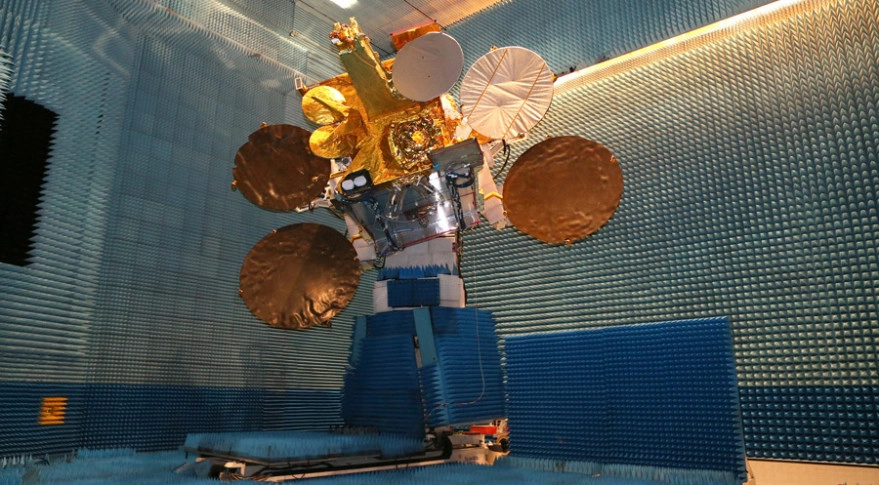
PARIS— An International Launch Services (ILS) Russian Proton rocket on Jan. 30 successfully placed the Eutelsat 9B commercial telecommunications satellite into orbit, with Proton's Breeze-M upper stage separating the satellite nine hours and 12 minutes after liftoff from Russia's Baikonur Cosmodrome in Kazahkstan.
Paris-based Eutelsat said the satellite was healthy in orbit and sending signals, and that the solar panels had deployed as planned.
Built by Airbus Defence and Space of Europe, Eutelsat 9B weighed 5,162 kilograms at launch and carries 47 36-megahertz-equivalent transponders in Ku-band for video coverage mainly in Europe through five beams – one pan-European and four regional beams. It will operate from 9 degrees east in geostationary orbit, where it will replace the Eutelsat 9A satellite launched a decade ago.
Eutelsat 9A will be moved this year to another orbital slot that Eutelsat has not yet announced.
Eutelsat 9B also carries a laser communications payload for Airbus Defence and Space as part of European Data Relay System of speeding transfer of Earth observation satellite data to users via satellites in higher, geostationary orbit.
With the European Space Agency and the European Commission as anchor customers, Airbus has invested in the data-relay technology, developed in Germany, and is pioneering it as a commercial service to civil and government agencies.
Eutelsat said 9B, once in operations by March, would add a net 12 transponders to its capacity from the 9 degrees east slot, where as of January the company said it was carrying 375 television channels, including 100 in high-definition format.
While the size of the West European television market is not growing much in terms of households, the region is still supports the highest-price transponders in the world. Growth for Eutelsat is expected as current broadcasters move from standard- to high-definition format.
Eutelsat calculates that a 36-megahertz transponder using MPEG-4 signal compression technology can be loaded with 26 standard-definition channels, but just 6-8 high-definition channels.
Compression standards are improving as fast as image quality, and the latest Highly Efficient Video Compression (HEVC) standard can squeeze 12-15 high-definition channels onto a single transponder.
Less than 25 percent of Western European satellite television is now beamed in high-definition format, a figure expected to rise to more than 60 percent in a decade. Next up for satellite broadcasters: ultra-high-definition television, which industry officials expect will become a significant force in the market by the end of the decade.
The Eutelsat 9A satellite's launch had been delayed for months as Russia's Proton rocket worked through a 2015 failure and then began chipping away at its commercial and Russian Federal government backlog.
Eutelsat's growth plans for 2015 were also slowed by bottlenecks with launch-service provider SpaceX of Hawthorne, California, which is scheduled to launch Eutelsat's 117 West B satellite. Eutelsat is hoping for an April launch.
Eutelsat renewed its endorsement of Reston, Virginia-based ILS and of the Proton rocket in 2015 with a multi-launch agreement that, beyond Eutelsat 9B, both companies expect to convert to firm contracts of future satellites.
Eutelsat, the world's third-largest commercial satellite fleet operator when measured by revenue, has capacity on 40 satellites, including more than 30 that it owns itself. It can be expected to launch at least two satellites per year on average just to maintain its current in-orbit capacity.
ILS owner Khrunichev State Research and Production Space Center of Moscow has said it would give ILS leeway to reduce prices to work its way back into the regular commercial-launch rotation alongside SpaceX and Europe's Arianespace. The decline of the Russian ruble against the U.S. dollar has made that task easier as most commercial launch contracts are priced in dollars.
ILS President Kirk Pysher, in a post-launch statement, noted the international nature of the mission: a European-built satellite with a European government/commercial payload launched by a U.S. company on a Russian rocket.
Pysher said ILS looks forward "to launching future satellites in the Multi-Launch Agreement, designed to provide Eutelsat additional schedule flexibility and assured access to space at cost-effective prices."
This story was provided by SpaceNews, dedicated to covering all aspects of the space industry.