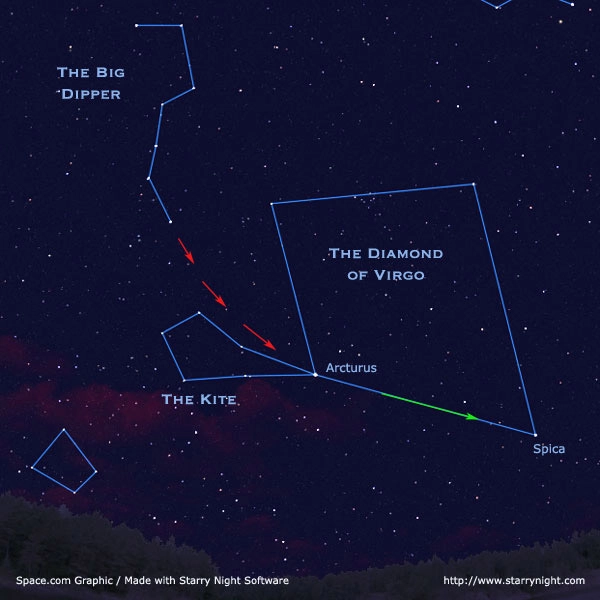
There is a brilliant star that sparkles with a golden yellow or topaz hue, roughly halfway up in the eastern sky as darkness falls this week. This is Arcturus in the constellation of Boötes, the Herdsman.
Arcturus ranks as the fourth brightest star in the night sky overall, behind Sirius, Canopus and Alpha Centauri. In older astronomy books, it is actually ranked sixth behind Vega and Capella, but modern measurements have shown it to be a trifle brighter than those two stars.
As if it weren't already easy enough to find, there is another way of locating it. Simply remember the following mnemonic phrase, "Follow the arc to Arcturus." That means just this: look at the Big Dipper. Its handle is bent. Imagine extending a curve from the handle, a curve that is readily translated into a smooth arc. Continue that imaginary arc about the length of the Big Dipper and you will ultimately come to Arcturus.

Some folks may add an additional line to the mnemonic: "Then speed to Spica," for that same arc, continued past Arcturus for roughly the same distance, will come to the bright bluish star Spica in the constellation of Virgo.
Fast for a big star
An interesting fact about Arcturus is that it appears to shift its "fixed" position in the sky much more rapidly than most of the other bright stars (the sole exception being Alpha Centauri).
Sir Edmund Halley was the first to discover this motion back in 1718. Arcturus appears to be whizzing through space at a speed of nearly 90 miles per second in the direction of the constellation Virgo. It appears to move toward Virgo by about one-degree (which is about twice the apparent width of a full moon) over a time span of about 1,500 years. We are thus very fortunate to live at a time when the distance separating Arcturus and our solar system is nearly at its minimum.
It will continue to approach the Earth for several thousand years more, but then it will pass us as it continues to move toward Virgo and its distance from us will begin to steadily increase. Computations show that in approximately 500,000 years, it will probably have moved out as far as 800 light years away from us and likely will have faded completely from naked-eye visibility.
Arcturus has been estimated to be roughly 25 times the diameter of the sun — about 20 million miles. If we could shrink our sun down to the size of a baseball, Arcturus would be a ball just over 6 feet across. Its luminosity is about 115 times that of the Sun.
In his definitive three volume work "Burnham's Celestial Handbook," the late Robert Burnham, Jr. points out that with modern infrared recording devices, the heat received from Arcturus can be measured, and is found to " ... equal the heat of a single candle at a distance of about 5 miles."
Herdsman ... Kite ... or Ice Cream Cone?
The dots over the second o in Boötes mean that you should pronounce the vowels separately: Boo-OH-tes, not (as many people say), Boo-ties! It is a Greek word meaning a man who tends to a herd of cows, so why not refer to Bootes as the cowboy of the sky? Boötes was the son of the goddess Demeter. It is written that he was rewarded with a place in the sky for inventing the plow.
In the allegorical sky pictures of star atlases of a few hundred years ago, Boötes is usually pictured holding a large rod or staff. Boötes is supposedly chasing after Ursa Major, the Great Bear. This is why some legends refer to Boötes as "The Bear-guard." On our sky map Boötes resembles a narrow kite; Arcturus would be where the tail is attached. But it might also be envisioned as an ice-cream cone.
At the bottom of the cone shines Arcturus. Since it has an orange hue, we might say that the cone was holding orange sherbet, and perhaps somebody bit off the bottom of the cone allowing the last little glob (Arcturus) to dribble out.
Joe Rao serves as an instructor and guest lecturer at New York's Hayden Planetarium. He writes about astronomy for The New York Times and other publications, and he is also an on-camera meteorologist for News 12 Westchester, New York.