Asteroids are the rocky remnants of material leftover from the formation of the solar system and its planets approximately 4.6 billion years ago.
The majority of asteroids originate from the main asteroid belt located between Mars and Jupiter, according to NASA. NASA's current asteroid count is over 1 million.
Asteroids orbit the sun in highly flattened, or "elliptical" circles, often rotating erratically, tumbling and falling through space.
Related: Smashin' asteroids, Hollywood style: could nuking an asteroid save the Earth?
Many large asteroids have one or more small companion moons. An example of this is Didymos, a half-mile (780 meters) wide asteroid that is orbited by the moonlet Dimorphos which measures just 525 feet (160 m) across.
Asteroids are also often referred to as "minor planets" and can range in size from the largest known example, Vesta, which has a diameter of around 326 miles (525 kilometers), to bodies that are less than 33 feet (10 meters) across.
Vesta recently snatched the "largest asteroid title" from Ceres, which NASA now classifies as a dwarf planet. Ceres is the largest object in the main asteroid belt while Vesta is the second largest.
As well as coming in a range of sizes, asteroids come in a variety of shapes from near spheres to irregular double-lobed peanut-shaped asteroids like Itokawa. Most asteroid surfaces are pitted with impact craters from collisions with other space rocks.
Though a majority of asteroids lurk in the asteroid belt, NASA says, the massive gravitational influence of Jupiter, the solar system's largest planet, can send them hurtling through in random directions, including through the inner solar system and thus towards Earth. But don't worry, NASA's Planetary Defense Coordination Office is keeping a watchful eye on near-Earth objects (NEOs), including asteroids, to assess the impact hazard and aid the U.S. government in planning for a response to a possible impact threat.
Asteroid definition
What is an asteroid?
Using NASA definitions, an asteroid is "A relatively small, inactive, rocky body orbiting the sun," while a comet is a "relatively small, at times active, object whose ices can vaporize in sunlight forming an atmosphere (coma) of dust and gas and, sometimes, a tail of dust and/or gas."
Additionally, a meteorite is a "meteoroid that survives its passage through the Earth's atmosphere and lands upon the Earth's surface" and a meteor is defined as a "light phenomenon which results when a meteoroid enters the Earth's atmosphere and vaporizes; a shooting star."
What are asteroids made of?
Before the formation of the planets of the solar system, the infant sun was surrounded by a disk of dust and gas, called a protoplanetary disk. While most of this disk collapsed to form the planets some material was left over.
"Simply put, asteroids are leftovers rocky material from the time of the solar system formation. They are the initial bricks that built the planets," Fred Jourdan, a planetary scientist at Curtin University told Space.com in an email "So all the material that formed all those asteroids is about 4.55 billion years old."

Fred Jourdan is a geochronologist and geochemist at Curtin University. Jourdan's research interests include investigating impact craters on Earth and using geochronology to age rocks and minerals found at the impact site.
In the chaotic conditions of the early solar system, this material repeatedly clashed together with small grains clustering to form small rocks, which clustered to form larger rocks and eventually planetesimals — bodies that don't grow large enough to form planets. Further collisions shattered apart these planetesimals, with these fragments and rocks forming the asteroids we see today.
"All that happened 4.5 billion years ago but the solar system has remained a very dynamic place since then," Jourdan added. "During the next few billions of years until the present, some asteroids smashed into each other and destroyed each other, and the debris recombined and formed what we call rubble pile asteroids."
This means asteroids can also differ by how solid they are. Some asteroids are one solid monolithic body, while others like Bennu are essentially floating rubble piles, made of smaller bodies loosely bound together gravitationally.

"I would say there are three types of asteroids. The first one is the monolith chondritic asteroid, so that's the real brick of the solar system," Jourdan explained. "These asteroids remained relatively unchanged since their formation. Some of them are rich in silicates, and some of them are rich in carbon with different tales to tell."
The second type is the differentiated asteroids which for a while behaved like they were tiny planets forming a metallic core, a mantle, and a volcanic crust. Jourdan said these asteroids would look layered like an egg if cut from the side, with the best example of this being Vesta, which he calls his "favorite asteroid."
"The last type is the rubble pile asteroids so it's just when asteroids smashed into each other and the fragment that is ejected reassemble together," Jourdan continued. These asteroids are made of boulders, rocks, pebbles, dust, and a lot of void spacing which makes them so resistant to any further impacts. In that regard, rubble piles are a bit like giant space cushions."
| Classification | Composition |
|---|---|
| C-type 'chondrite' | Clay and silicate |
| S-type 'stony' | silicate and nickel-iron |
| M-type 'metallic' | nickel-iron |
The differences in asteroid composition are related to how far away from the sun the asteroid formed. Proximity to the sun and high temperatures after formation caused asteroids to melt, with iron sinking to the center and forcing basaltic (volcanic) lava to the surface.
Asteroid FAQs answered by an expert
Paul Chodas is an expert on asteroid dynamics and impact probabilities. He is the principal architect for orbit determination and ephemeris software use by NASA's JPL Near Earth Object Program Office.
We asked Paul Chodas, the director of NASA Jet Propulsion Laboratory's Center for Near Earth Object Studies (CNEOS), a few frequently asked questions about asteroids.
How often do asteroids hit Earth?
Asteroids large enough to cause damage on the ground hit Earth about once per century, as you go to larger and larger asteroids, the impacts are increasingly infrequent. At the extremely small end, desk-sized asteroids hit Earth about once a month, but they just produce bright fireballs as they burn up in the atmosphere. As you go to larger and larger asteroids, the impacts are increasingly infrequent.
What's the difference between asteroids, meteorites and comets?
Asteroids are the rocky/dusty small bodies orbiting the sun. Meteorites are pieces on the ground left over after an asteroid breaks up in the atmosphere. Most asteroids are not strong, and when they disintegrate in the atmosphere they often produce a shower of meteorites on the ground.
Comets are also small bodies orbiting the sun, but they also contain ices that produce a gas and dust atmosphere and tail when they get near the sun and heat up.
How do we know if a potentially dangerous asteroid is heading our way?
Once an asteroid is discovered it is tracked for as long as possible to be seen in Earth-based telescopes. Position measurements are fed into orbit determination software that calculates the asteroid's trajectory and projects it into the future. The tracking data spans many days, weeks, months, or years, with dozens, hundreds, or even thousands of measurements.
Most asteroid orbits can be predicted with remarkable precision, considering how far away many of these objects are, and the possibility of any potential impacts can be predicted years or decades in advance. The Jet Propulsion Lab's CNEOS calculates high-precision orbits for all asteroids and maintains a list of all that have even the slightest possibility of impacting Earth over the next century called the Sentry Risk table.
So far, there are no known asteroids large enough to cause damage that have any significant chance of impacting Earth over the next century.
What are Near Earth Objects and Potentially Hazardous Asteroids?
Asteroids are also classified by their size and their location in relation to Earth. According to the Centre for Near Earth Object Studies (CNEOS) asteroids estimate the size of asteroids using their brightness or "absolute magnitude" and how well they reflect sunlight back into space.
"A NEO is a Near-Earth Object is an asteroid or comet whose orbit brings it into the Earth's region of the Solar System," Chodas said. "Most asteroids are on fairly circular orbits that stay in the asteroid belt between Mars and Jupiter. NEOs are on orbits that bring them closer to the sun and in the general vicinity of Earth."
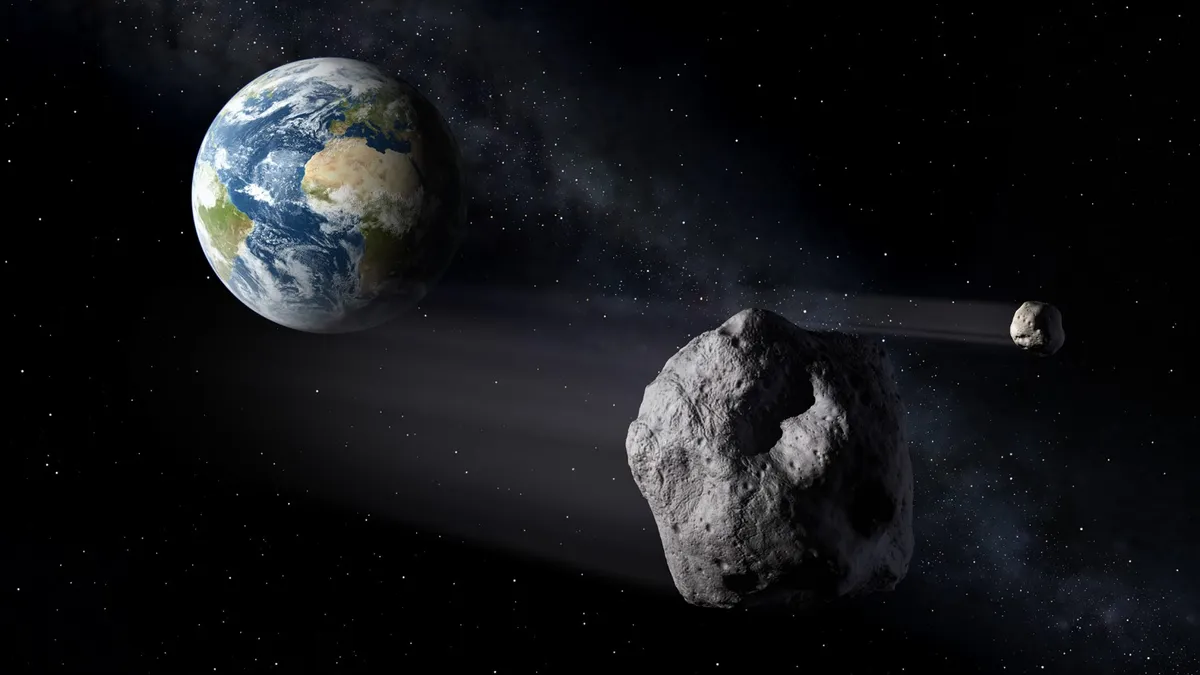
In terms of their orbits, NASA defines a NEO as coming to distances less than 1.3 AU from Earth, where 1 AU is the distance between Earth and the sun. The majority of NEOs are "Near Earth Asteroids" (NEA) and these are divided into three sub-categories.
Athens, are NEAs that cross Earth's orbit with an orbit possessing a semi-major axis smaller than that of the orbit of our planet. They take their name from 2062 Aten. Apollos also cross Earth's orbit, but have a semi-major axis larger than our planet's and take their name from 1862 Apollo. The final group, the Armors, are Earth approaching NEAs with orbits outside our planet's, but inside the orbit of Mars.
There is a further group of asteroids, however. Ones that could potentially pose a threat to Earth.
"A PHO is a Potentially Hazardous Object, which is large enough to be hazardous if it should hit Earth, larger than about 140 meters, or about 500 feet, AND is on an orbit that brings it quite close to Earth's orbit, to within about 5 million miles," Chodas explained. "As the PHO and the Earth orbit the sun, there is a potential for them to come very close to each other, but that doesn't mean that an impact is inevitable any time soon."
NASA currently reports 586 known potentially hazardous asteroids.
Do asteroids hit Earth and how often?
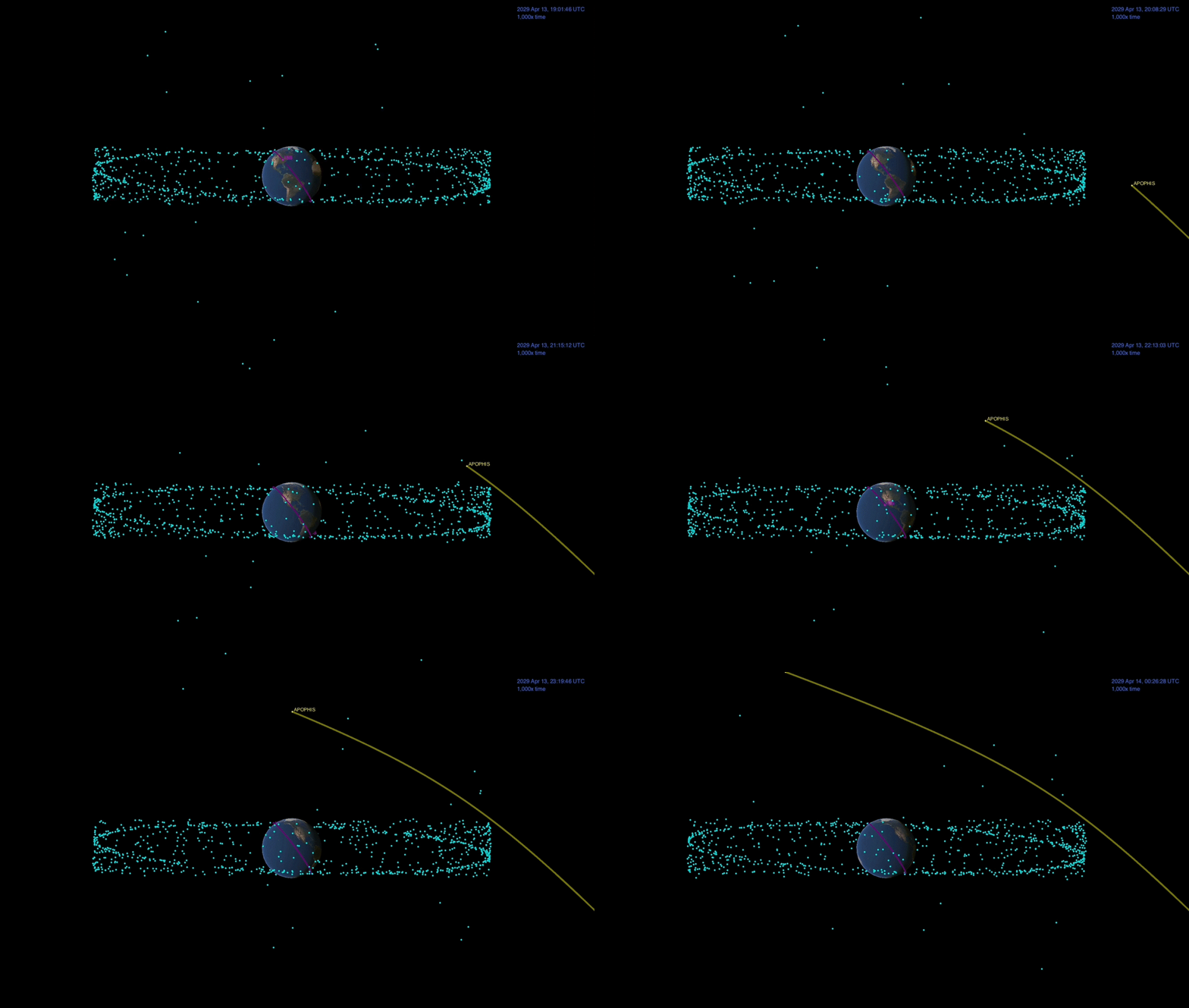
NASA estimates that every year over 100 tons of material falls to Earth from space, but just how much of this material is in the form of asteroids?
Asteroid impacts are less frequent today than they were in the early solar system, especially between 7.8 million and 11.7 million years ago when conditions were far more chaotic.
This early bombardment of our planet by asteroids may have been vital to the development of life on Earth. As Harvard University points out analysis of asteroids indicates they could have been important in seeding water to the planet's surface.
Of course, occasionally Earth is hit by larger and more devastating asteroids. One striking (if you'll excuse the pun) example is found in the Chicxulub region of the Yucatán Peninsula. Mexico, where an asteroid thought to be between 6.2 to 9.3 miles (10 and 15 kilometers) wide struck the Earth slicing a 6.2 mile-wide (10 kilometer-wide) scar into the surface of the planet 6.5 million years ago.
Known as the Chicxulub impactor, the asteroid wiped out 75% of Earth's species, including the dinosaurs, according to the Natural History Museum. Chodas points out that impacts from such large asteroids are rare.
NASA says a space rock larger between 25 meters and just over half a mile wide (1 kilometer) would cause local damage if it hits Earth, while an asteroid between around half a mile and a mile (1 and 2 kilometers) could have global ramifications.
Related: This Asteroid Launcher simulator lets you destroy your hometown — or anywhere else
"Asteroids large enough to cause a global catastrophe impact Earth [larger than 1 kilometer or 0.62 miles] only once in a million years, and they are of much less concern because we've already discovered 95% of them," Chodas said. "We know that none of them are headed for impact over at least the next century."
The reason we know this is thanks to the impressive tracking efforts of NASA and other space agencies and observatories.
Could we save Earth from an asteroid impact?
To date, only about 40 percent of 460-foot-plus (140-meter-plus) sized asteroids have been found, according to NASA. That means it makes sense to be prepared for such an event. While many concepts exist to divert asteroids, only one has made it to practical testing away from the surface of Earth.
"The Double Asteroid Redirection Test (DART) mission demonstrated NASA's capability to slightly change the trajectory of a small asteroid using a concept called a Kinetic Impactor," Chodas concluded. "With this technique, a spacecraft rams into the target and imparts a small change in its velocity. If an asteroid were headed towards Earth, and we knew about the possibility of collision with many years of warning, and the asteroid was not too large, a spacecraft like DART could be used to divert the asteroid so that it would miss the Earth many years later."
DART reached its target Dimorphos on September 2022, successfully altering the asteroid's orbit. The mission represented the first time humanity has altered the course of a celestial object, but the tiny alteration demonstrates that to successfully deploy such a mission to save Earth, a long advance notice, or "lead time" is needed.
"For planetary defense, it's vital to know what asteroids are made of if we want to attempt to push them away," Jourdan said. "It's not the same pushing a chunk from a differentiated asteroid completely made of metal compared to an asteroid made of rocky rubble. Each type of asteroid would require different techniques, different approaches, and different amounts of energy to push the asteroid away.
"By studying those asteroids and meteorites we can start to think about those questions early, before the time arise when we will need precise and accurate answers to act. Hopefully not too soon, if at all!"
Thus, agencies like CNEOS must continue monitoring the heavens for asteroids tracking their orbits, and projecting them in the future. Not only could this ensure humanity won't experience the same fate as dinosaurs but studying these fossilized remnants from the early solar system could teach us more about the origins of our planet and its neighbors.
Additional resources
The DART mission was humanity's first attempt to redirect an asteroid in preparation for the possibility such an object could one day approach Earth and pose a threat to the planet. Read more about the mission here on NASA's mission page
The CNEOS database contains a list of known NEOs about to make a close approach to Earth including their velocities and distances from the planet.
Arguably the most famous asteroid in Earth's history is the one that impacted our planet over 65 million years ago wiping out around 75% of its species including the dinosaurs. You can read more about this asteroid, the Chicxulub impactor in these resources from the Natural History Museum.
Bibliography
NASA Confirms DART Mission Impact Changed Asteroid's Motion in Space, NASA,
Asteroids, NASA, [Accessed 02/05/23], [https://solarsystem.nasa.gov/asteroids-comets-and-meteors/asteroids/in-depth/]
Asteroids, Cosmos Swinburne, [Accessed 02/05/23], [https://astronomy.swin.edu.au/cosmos/m/main+asteroid+belt]
Origin of water on Earth, Harvard University, [Accessed 02/05/23], [https://courses.seas.harvard.edu/climate/eli/Courses/EPS281r/Sources/Origin-of-oceans/1-Wikipedia-Origin-of-water-on-Earth.pdf]
Discovery, CNEOS, [Accessed 02/05/23], [https://cneos.jpl.nasa.gov/stats/]
Vesta, NASA, [Accessed 02/05/23], [https://solarsystem.nasa.gov/missions/dawn/science/vesta/]
Ceres, NASA, [Acessed 02/05/23], [https://solarsystem.nasa.gov/planets/dwarf-planets/ceres/overview/]