


The Laser Interferometer Gravitational-Wave Observatory (LIGO) is a pair of enormous research facilities in the United States dedicated to detecting ripples in the fabric of space-time known as gravitational waves. Such signals come from massive objects in the universe, such as black holes and neutron stars, and provide astronomers with an entirely new window to observe cosmic phenomena.
LIGO's underlying mechanisms rely on the work of the famous physicist Albert Einstein, who in his theory of relativity predicted the existence of gravitational waves, analogous to electromagnetic waves, more than a century ago. Einstein believed that such waves were too weak to ever be feasibly detected, according to a history of the project from the California Institute of Technology (Caltech) in Pasadena.
How LIGO detected gravitational waves
Beginning in the 1960s and 70s, researchers built prototype gravitational wave detectors using free-hanging mirrors that bounced a laser between them. If a gravitational wave passed through the apparatus, it would wiggle the fabric of space-time and cause the mirrors to move ever so slightly. This device, known as an interferometer, is still the basic unit inside today's gravitational wave detectors.
Though those early models didn't have the sensitivity necessary to capture a gravitational wave signal, progress continued for several decades and, in 1990, the National Science Foundation approved the assembly of two LIGO detectors; one in Hanford, Washington and another in Livingston, Louisiana.
Construction of both detectors was completed in 1999 and the search for gravitational waves began a few years later. For more than a decade, the detectors continued to come up empty, as physicists learned how to handle the highly sensitive instruments and all the things that could go wrong. Any number of things can mess with the facilities, including something as trivial as ravens pecking on the pipes leading into them.
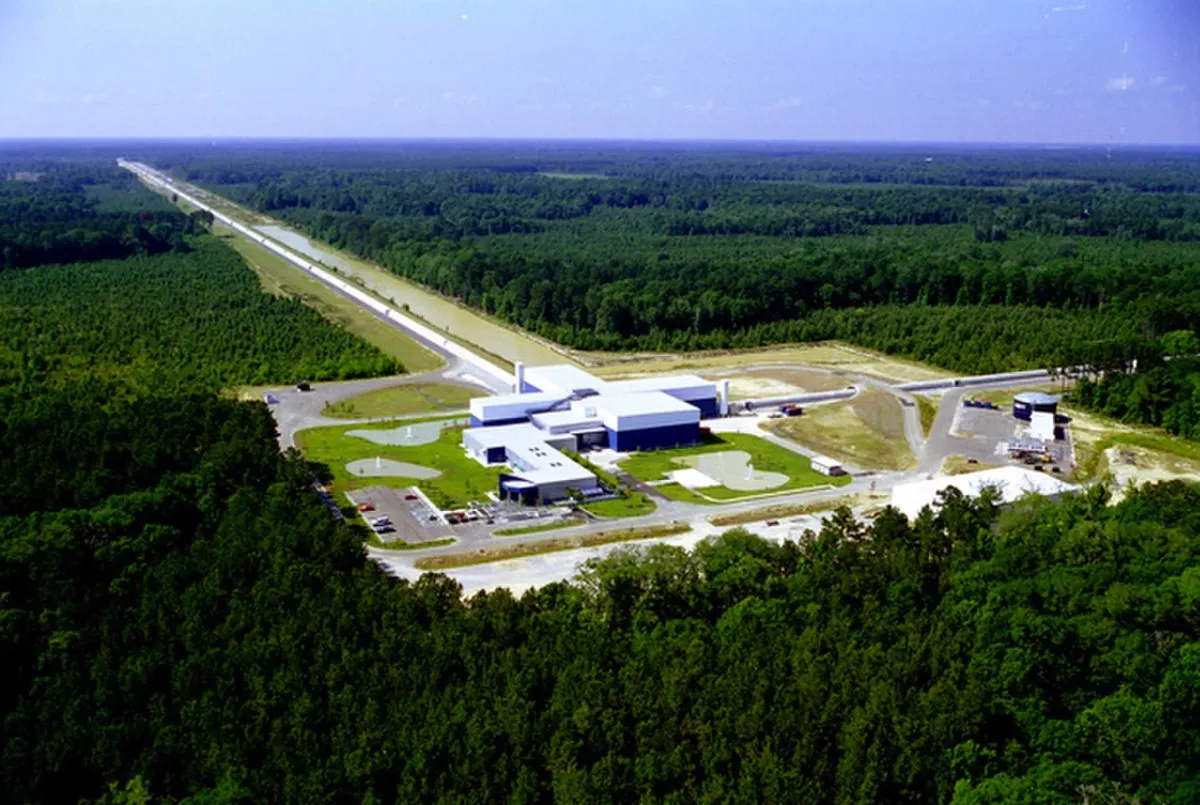
LIGO was completely redesigned for greater sensitivity between 2010 and 2014. The hard work paid off. Within days of the instruments being turned on in September 2015, the observatory began picking up the signature of its first gravitational waves, according to a LIGO fact page from Caltech.
This historic signal was kept secret for months as scientists worked to understand its details. On Feb. 11, 2016, the finding was made public, with physicists announcing that they had detected the collision of two black holes 29 and 36 times more massive than the sun, respectively, that occurred nearly 1.3 billion years ago.
The results were greeted with joy from the physics community and received widespread attention in the media. The observation not only confirmed Einstein's century-old prediction but also provided researchers with a brand new way to peer out into the universe. A year later, astrophysicists Kip Thorne and Barry Barish of Caltech, and Rainer Weiss of MIT shared the Nobel Prize in Physics for their pioneering work on gravitational wave detection.
Related: Gravitational waves: What their discovery means for science and humanity
The LIGO collaboration currently consists of the two U.S.-based detectors as well as a third instrument that came online in 2017 called Virgo. It sits near Pisa, Italy and is run by a European group. Each facility includes an L-shaped vacuum chamber with legs 2.5 miles (4 kilometers) long containing an interferometer. The detectors' lasers can discern movements between their mirrors with a mind-boggling accuracy of 1/10,000th the width of a proton.
Working in tandem, the three facilities help confirm that any signal one facility picks up is a true gravitational wave detection and not random noise. Researchers have created some of the quietest spots in the world around the gravitational wave detectors, slowing down nearby traffic, monitoring every tiny tremor in the ground, and even suspending the detection equipment from a pendulum system that minimizes vibrations.
LIGO's other greatest hits
Some of LIGO and Virgo's most spectacular results include the first detection of two neutron stars — extremely dense stellar corpses — crashing into one another. The finding, announced in October 2017, was accompanied by observations of the same event using radio, infrared, optical, gamma ray, and X-ray telescopes, allowing scientists to draw information from multiple channels — an endeavor known as multi-messenger astrophysics. The data helped prove that such collisions are the source of much of the universe's gold, platinum and other heavy elements.
In January 2020, LIGO detected a second neutron star smashup that involved colossal objects with a combined mass 3.4 times that of the sun. Such weighty neutron stars have never before been seen in telescopes and push the size limit of what should theoretically be possible for such entities, leaving scientists to scratch their heads over how those stars could have been created.
Related: Gravitational waves from neutron star crashes: The discovery explained
Later that year, researchers announced that LIGO and Virgo had detected the signal of two behemoth black holes merging. The entities, which had masses 66 and 85 times that of the sun, respectively, formed a single black hole with a total mass of 142 times the sun. This was the first unambiguous evidence for what are known as intermediate mass black holes, weighing between 50 and 100,000 times the sun, which scientists knew must exist but had never before seen.
In 2020, LIGO and Virgo were joined by a Japanese instrument named the Kamioka Gravitational Wave Detector (KAGRA), though all the facilities had to be temporarily shut down due to the worldwide COVID-19 pandemic. An Indian detector is expected to join the network sometime in the mid-2020s. With these additional facilities and upgrades to the current facilities, physicists will be able to observe gravitational waves from farther away and with greater frequency, allowing them to make even more discoveries in the future.
Additional links:
- Find more information about the international LIGO collaboration on the LIGO Scientific Collaboration website.
- Learn more about gravitational waves from NASA Science.
- Read about the sources and types of gravitational waves LIGO has discovered, from the LIGO-CalTech website.
