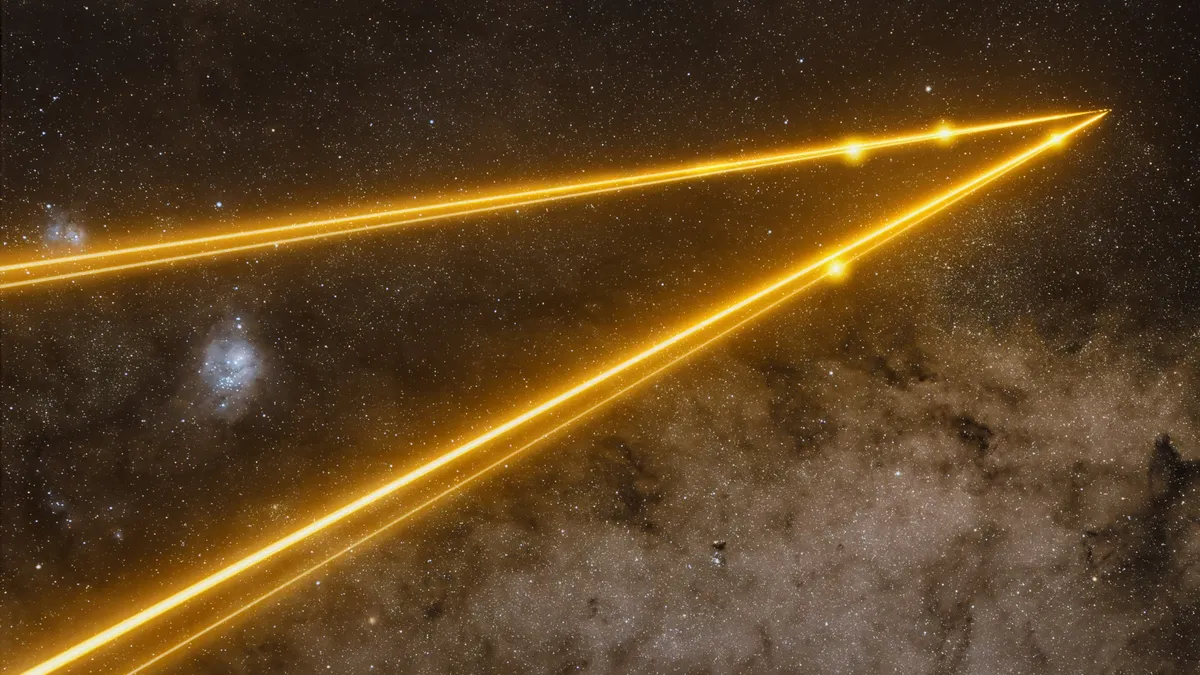
Four glowing laser beams blasting through open space converge at the center of our galaxy. But this isn't Star Wars, it's real science.
What is it?
The European Space Observatory's Very Large Telescope in Chile has four giant Unit Telescopes (UTs), which emitted lasers pointed to the center of the Milky Way galaxy.
The UTs create what ESO refers to as "artificial stars" in our atmosphere, about 56 miles (90 kilometers) above Earth's surface.
These beams of light allow scientists to see how our planet's ever-changing atmosphere might be distorting incoming light, which is critical for accurately analyzing telescope observations.
This information allows the VLT to make real-time changes in response to Earth's atmosphere, making sure that it can see through the cosmos clearly.
Why is it incredible?
This image shows four lasers appearing as if they are piercing space itself as they seem to meet in the galaxy's center, or the area surrounding the Milky Way's supermassive black hole. But this spectacular view hides some interesting details.
Four blowing dots appear on these lasers toward the point where they converge. These strange, glowing orbs in the lasers path are actually the result of clouds that the lasers are traveling through clouds that just happened to be in the way. However, if you look even closer at the image at the point where the beams seem to connect, you will see four even tinier dots.
"For me, this image is an accomplishment," the photographer behind this cosmic view, ESO astronomer Anthony Berdeu, said in a statement, reflecting on the moment. "The first night the lasers were shined to point at the galactic center, I had to be on the VLT platform to take a picture."