Exoplanets are planets that orbit stars other than the sun and thus exist outside the solar system. The word "exoplanet" derives from the term "extrasolar planet," which hints at its existence beyond the influence of our star.
Prior to the 1990s, humanity had never observed a planet beyond the solar system and thus could not confirm such worlds existed. In the more than three decades since the first discovery of an exoplanet, NASA's exoplanet catalog has burgeoned. As of 2023, the exoplanet catalog contains over 5,500 confirmed exoplanets and almost 10,000 additional candidate exoplanets.
Exoplanets that orbit in the so-called habitable zone — the region around their star where it's not too hot or too cold to sustain liquid water — are targets for the search for life outside the solar system.
Related: The 10 most Earth-like exoplanets
Exoplanets FAQ
Can life survive on exoplanets?
That depends on the exoplanet. The chances of life existing on an exoplanet are significantly greater if that planet exists in the habitable zone of its star. Astronomers are also currently becoming aware of the possibility of "Hycean worlds." These planets are dominated by liquid oceans and could hang on to liquid water outside standard habitable zones, thus widening the potential area around a star in which life could exist.
Can humans go to exoplanets?
Currently, the closest exoplanet to Earth is Proxima Centauri b, which orbits the star Proxima Centauri, located 4 light-years away. The crew-carrying module of the Artemis missions is Orion, which, according to its maker, Lockheed Martin, has a top speed of 24,000 mph (39,000 km/h).
That means that traveling constantly at this top speed and assuming no diversions, it would take Orion over 1 billion hours to reach Proxima Centauri. That's more than 114,000 years, so until the invention of light-speed travel or suspended animation , it is not possible to travel to an exoplanet.
Types of exoplanets

One thing that has become abundantly clear in humanity's exploration of exoplanets is that planets come in a much wider range of categories than can be seen in the solar system.
While our planetary system hosts a relatively ordered system of terrestrial planets, like Earth; gas giants, like Jupiter; ice giants, like Neptune; and dwarf planets, like Pluto, exoplanets are more diverse and more disordered.
Hot Jupiters
Hot Jupiters are gas giant exoplanets that orbit close to their stars and complete a full orbit in just a few Earth days.
The "hot" in "hot Jupiter" refers to the proximity of these planets to their star, which can lead to searing surface temperatures. The "Jupiter" in the name refers to the fact that these worlds have sizes and masses that are most comparable to Jupiter's, though they can be many times more massive or just a fraction of its mass and size.
The proximity to their star can cause hot Jupiters to "puff out' to huge diameters while making them incredibly light in terms of density. Some of the lightest exoplanets ever found are hot Jupiters.
Hot Jupiters' size and proximity to their stars also create greater effects on these stars, meaning they are easily seen using the radial velocity and transit methods. This means the exoplanet catalog is heavily and disproportionately weighted in favor of hot Jupiters.
There is nothing like a hot Jupiter in the solar system, and some evidence suggests that these planets may form farther out, like Jupiter and Saturn are in our solar system, and then migrate closer to their stars.
Hot Jupiters overlap with the following categories of exoplanets when examples of these worlds are found close to their stars.
Terrestrial exoplanets
Terrestrial exoplanets are roughly Earth-size worlds outside the solar system that are composed of rock, silicate, water and carbon. The bulk composition of these worlds is dominated by rock or iron, and they can have either a solid or liquid surface, according to NASA. A deeper investigation of these exoplanets is required to determine if they have atmospheres or oceans.
Perhaps unsurprisingly, as Earth is the only planet we are aware of that hosts life, these worlds are the major targets in our hunt for life beyond the solar system.
Super-Earths or mini Neptunes
Super-Earths, alternatively known as mini-Neptunes, are planets that are up to twice the size of Earth and have up to 10 times the mass of our planet — meaning they're larger than terrestrial planets but smaller than ice giants and gas giants. Super-Earths don't necessarily have to be terrestrial planets; they can be gas giants.
Neptunian exoplanets
Neptune-like exoplanets (or Neptunian exoplanets) are worlds similar in size to Neptune and Uranus — around four times the size of Earth and around 17 times its mass. Neptunian worlds are thought to have mixed interiors but heavy metals at their cores.
The missing planets
Neptune-size worlds are a mystery for astronomers because so few are discovered close to their stars. This lack of "hot Neptunes" with orbits of around four days or less has come to be known as the "hot Neptunian desert." One suggested reason for this could be that if planets don't have a lot of mass, the radiation from their stars easily strips their atmospheres, thus quickly turning potential hot Neptunes into super-Earths.
Rogue exoplanets

Rogue planets, also known as isolated planetary-mass objects and free-floating planets, are worlds outside the solar system that are not gravitationally bound to stars. That means that they wander the Milky Way alone without a parent star.
One possible explanation for rogue planets is that they form in planetary systems and are then flung away by gravitational interactions with other planets in the same system or by encounters with another star system. A less plausible, but still viable, formation mechanism is that rogue planets form on their own, outside planetary systems.
According to NASA, a study suggested that when NASA's Nancy Grace Roman Space Telescope comes online, it could spot as many as 400 Earth-mass rogue exoplanets using microlensing.
How do astronomers discover exoplanets?
Discovering exoplanets is tricky because, unlike stars, they don't emit their own light — or at least not enough to help locate them. This means that most techniques exoplanet hunters use to discover exoplanets are related to spotting the effects a planet has on its parent star.
Here are the five main methods astronomers use to spot exoplanets.
Radial velocity method
Historically, the first method used to detect exoplanets was the radial velocity method. According to the European Space Agency (ESA), this technique works because when a planet orbits a star, that planetary system's center of mass is located within the star, as it has considerably more mass than its planet.
This center of gravity is located off-center within the star, causing the star to "wobble" back and forth ever so slightly. Because wavelengths of sound or light are squashed as a source moves toward an observer and are stretched as the source moves away — known as the Doppler effect — astronomers can observe and measure this wobble.
Transit method
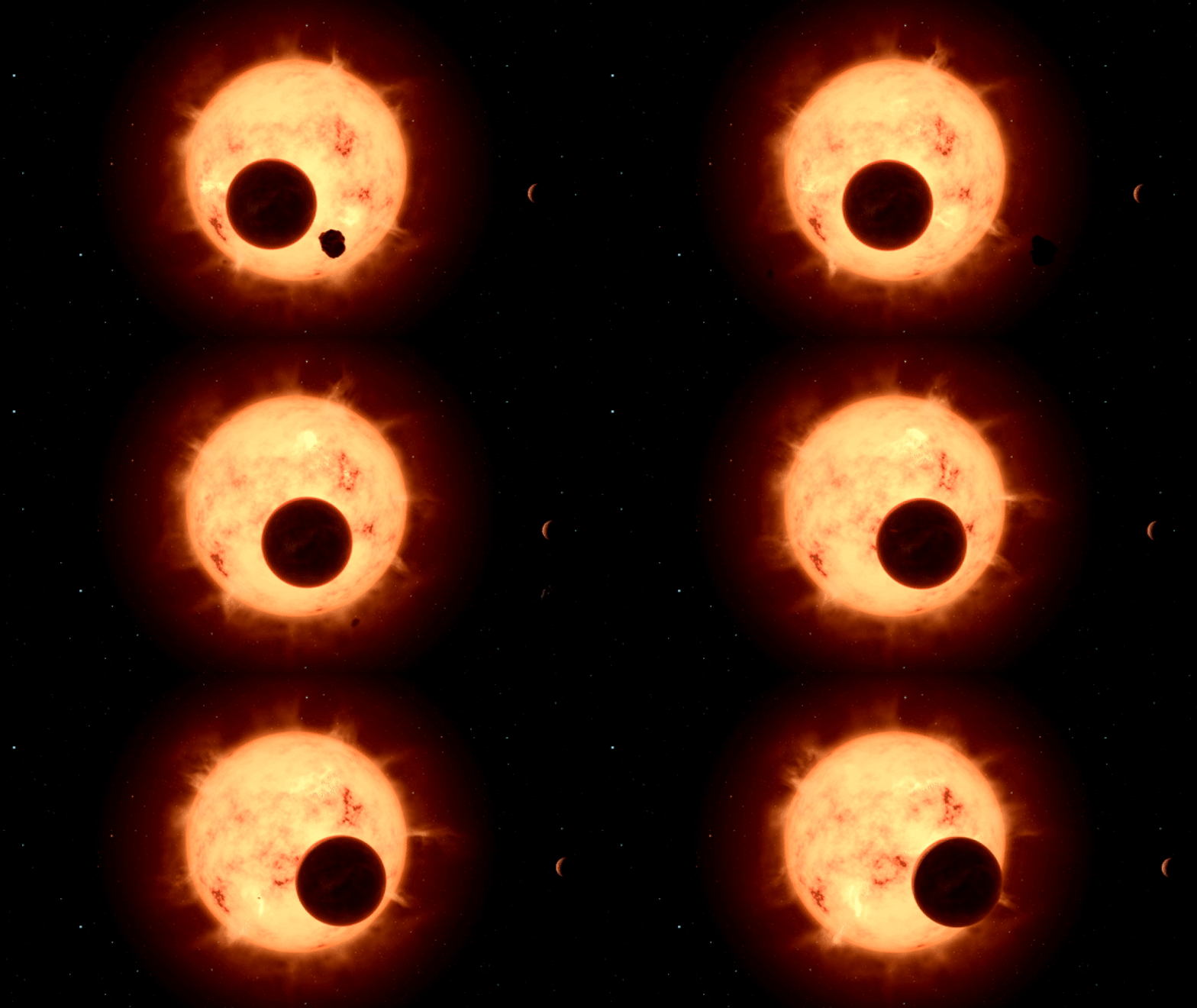
The unquestioned monarch of exoplanet detection is currently the transit method, which works by measuring tiny dips in light from a star caused as a planet moves across its face — or transits the star — between that star and Earth.
Data detected during transits can be used to determine the exoplanet's orbit and size. Plus, by looking at the light passing through the planet's atmosphere, astronomers can investigate the composition of gases around it.
That means that, in the modern era of exoplanet investigation, during which scientists are delving deeper into exoplanet atmospheres than ever before, hunting for biosignatures — elements that are vital to life and traces of living processes — the transit technique has unparalleled utility.
Gravitational lensing
Few phenomena are more useful to astronomers than gravitational lensing. First predicted in Einstein's 1915 theory of general relativity, gravitational lensing happens when a path of light curves as it travels past a warp in space-time .
When light from a background object passes a massive object — a lensing body — between it and Earth, its path is diverted, resulting in the brightening of the background source, a shift in the apparent position of that source or, in extreme cases, the appearance of the background source in multiple places in the same image.
This applies to an exoplanet because, if it comes between Earth and a distant background source, it will act as a lens for that source's light. Because the mass of intervening planets is small, this effect is tiny — so the method is known as microlensing.
This method can be really useful for the discovery of rogue exoplanets, which lack parent stars but can be sighted when they warp the light of other background stars.
Direct imaging
As of November 2023, just 69 exoplanets have been spotted the old-fashioned way: with direct imaging. Why is this so tough? ESA explains that the light from a planet's parent star overwhelms that planet by a factor of over a million.
Astrometry
Remember the wobble that helps inform the radial velocity technique? It also forms the basis of another exoplanet detection method, albeit one that is much less successful.
Astrometry takes repeated measurements of the positions of stars in the sky and uses them to infer motion, including the kind of wobbling caused by an exoplanet in orbit, according to ESA. This is extremely difficult to do, so astrometry has uncovered only three exoplanets so far, according to NASA.
Don't rule out astrometry just yet, though. ESA's Gaia mission is currently making highly detailed, precise observations of star positions across a vast swath of the sky over Earth. ESA predicts that eventually, Gaia could use astrometry to reveal tens of thousands of exoplanets at distances as great as 1,600 light-years from the sun.
Major exoplanet discoveries
Although astronomers have found thousands of exoplanets, a few stand out as major discoveries.
51 Pegasi b
51 Pegasi b was the first exoplanet discovered orbiting a sunlike star. It was found in 1995 by astronomers Michel Mayor and Didier Queloz, with the duo sharing the 2019 Nobel Prize in physics for the breakthrough (along with James Peebles "for theoretical discoveries in physical cosmology.")
Found by the radial velocity method, 51 Pegasi b is a hot Jupiter that orbits its parent star at a distance of around 0.0527 times the distance between Earth and the sun, completing an orbit in just 4.2 Earth days, according to NASA. It has around 0.46 times Jupiter's mass and 1.27 times its diameter.
Poltergeist and Phobetor
Although 51 Pegasi b was the first exoplanet found around a sunlike star, it wasn't the first exoplanet ever discovered. That honor goes to a duo of planets called "Poltergeist and Phobetor," discovered in 1992 by Aleksander Wolszczan and Dale Frail. Poltergeist and Phobetor are also known as PSR B1257+12 b and PSR B1257+12 c, respectively.
The TRAPPIST-1 system

Located around 40 light-years from Earth, the TRAPPIST-1 system comprises seven planets orbiting a relatively cool red dwarf star; the first two of these planets were discovered in 2016, and the remaining five were found in 2017, according to NASA.
What makes this system extraordinary is that all seven planets seem to be similar to Earth in terms of their size and rocky composition, and at least three orbit their star in the habitable zone, making them prime targets in the search for life outside the solar system.
As soon as it came online, the James Webb Space Telescope (JWST) began observing the TRAPPIST-1 system and has already measured the temperature of TRAPPIST-1b using its thermal emissions — the first time light emitted by an exoplanet has been measured — and determined that the exoplanet seems to lack an atmosphere.
WASP-76 b
Another hot Jupiter, WASP-76 b, discovered in 2016 using the transit method, is an extraordinary exoplanet.
WASP-76 b orbits its star at a distance of just 0.033 times the distance between Earth and the sun and completes an orbit in 1.8 Earth days. The planet, which is 1.83 times the width of Jupiter and 0.92 times its mass, is tidally locked, meaning one side permanently faces its parent star while the other perpetually faces space.
This sends the temperature of the dayside soaring to 4,350 degrees Fahrenheit (2,400 degrees Celsius), while the nightside is a relatively cooler 2,730 F (1,500 C). This means that iron is vaporized on the planet's dayside and is then blown across to the nightside, where it cools and falls as iron rain. As such, WASP-76 b is a stark reminder of how truly alien exoplanets can be.
Additional resources
Stay up to date with exoplanet discoveries by visiting NASA's exoplanet catalog. NASA also has a fantastic set of travel posters that beautifully illustrate what travel to such a world would be like. Many exoplanets can be described as "strange new worlds," and no television show has capitalized on the sense of wonder that the exploration of such worlds invokes as the original "Star Trek," which ran from 1966 to 1969. You can read about it here and select episodes to explore yourself.

Robert Lea is a science journalist in the U.K. whose articles have been published in Physics World, New Scientist, Astronomy Magazine, All About Space, Newsweek and ZME Science.
Latest about Exoplanets

Most exoplanets might be 'soot factories,' scientists say: 'Like you have a natural diesel engine'
A chemical engineer noticed that the spectra of the hazy atmosphere of mini-Neptune planets looked like the soot produced by combustion engines.

'Hot Jupiter' winds blasting at over 15,000 mph reveal 1st evidence of exoplanets with magnetic fields
Astronomers have discovered the first evidence of magnetic worlds beyond the solar system thanks to their high-speed, violent winds, representing a major step forward in exoplanet research.

How do you study an invisible exoplanet? Astronomers discover planetary 'fingerprints' in the rings around stars
How do you weigh a planet you can't see? Astronomers may have the answer and it involves "reading between the rings," the bright beautiful structures exoplanets create.

The most common type of planet in the galaxy may not look anything like Earth on the inside
The familiar concept of a planetary core, a small, dense metallic heart we take for granted, may be the exception rather than the rule for exoplanets.

NASA exoplanet-hunting spacecraft TESS reveals its most complete look at the night sky yet
TESS has released its most complete view of the sky over Earth, revealing the location of 6,000 potential worlds beyond the solar system.

How an exoplanet odd couple survived by traveling in from the cold together
The TOI-1130 system features a rare example of a hot Jupiter exoplanet joined by another world rather than being on its own.

Is Tatooine the norm? Planets may prefer living with two suns instead of one
New simulations suggest binary star systems may be ideal for planet formation, and may produce more gas giants than single-star systems.

NASA's TESS spacecraft discovers a weird system of exoplanets unlike anything seen before
"Most planetary systems appear as 'peas in a pod.' This is not the case in the TOI-201 system."

