


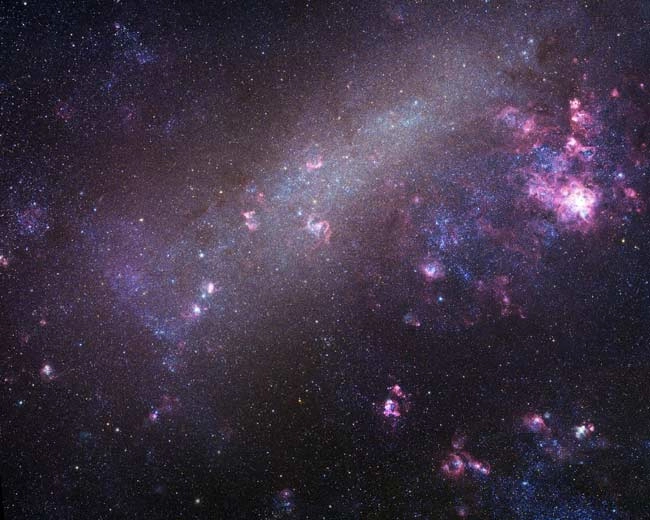
Two dwarfgalaxies thought to be our Milky Way's longtime companions are actually relativenewcomers to our neighborhood that are just passing through, according to a newstudy.
Thesurprising finding is a celestial curveball of sorts, sending astronomers backto the clubhouse in order to rework theories that were based on long-lastinginteractions between the Milky Way and the dwarf galaxies, called the Large andSmallMagellanic Clouds.
?Wehave known about the Clouds since the time of Magellan, and a single measurementhas thrown out everything we thought we understood about their history andevolution,? said the study's lead author, Gurtina Besla of the Harvard-Smithsonian Center for Astrophysics in Massachusetts.
Forinstance, some astronomers thought a blazing trail of hydrogen gas extendingfrom the Clouds, called the Magellanic Stream, formed due to tidal interactionsbetween the Clouds and the Milky Way. Others explained the gas trail as theresult of hydrogen being stripped from the Cloudsby gas pressure as they plunged through the gas halo around our galaxy. Bothscenarios are false if the galaxies are indeed just passing through.
Glowingclouds
Locatedabout 160,000 light-years from Earth, the Large Magellanic Cloud (LMC) is onlyone-twentieth the diameter of our galaxy and contains one-tenth as many stars.The Small Magellanic Cloud resides 200,000 light-years from Earth and is about100 times smaller than the Milky Way.
Earlierthis year, astronomers making the most detailed measurements yet of the 3-dimensionalvelocities of the Magellanic Clouds found they are flying through spacetwice as fast as previously thought.
Besla'steam incorporated the new estimates into computer models, finding that bothgalaxies had extremely parabolic orbits and indicated they had entered ourneighborhood for the first time between 1 billion and 3 billion years ago.
?Theproblem is [the LMC] is moving at a velocity that would correspond to aparabolic orbit,? Besla explained. ?It's just moving too fast. Ifthere were no other effects involved, it would just slingshot away.? Sheadded that friction forces from the Milky Way's gas halo and an observed lossof mass in the form of the Magellanic Stream slow down the galaxies.
Even still,with such elongated orbits, the galaxies are unlikely to boomerang back towardthe MilkyWay any time soon. ?It will go out really far before it comes backaround again and it will take an extremely long time ... on the order of like 8billion years and beyond,? Besla told SPACE.com.
Oneanswer, many questions
The resultshave implications for at least two astrophysicalphenomena.
Theoriesput forward to explain the Magellanic Stream involved a lengthy interactionbetween the Clouds and our galaxy. An alternative mechanism must be at work,Besla said.
Theresearchers suggest a type of stellar feedback. ?As stars form they startlosing a lot of material through stellar winds and they also explode and thatblows out material,? Besla said. ?It's possible some of that materialgets puffed out and then other effects like 'ram pressure' and tidal effectscan then remove this really loosely bound stuff.?
Tidaleffects between large objects (such as the moon and Earth, or two galaxies)cause one side of an object to be tugged more than the other side, stretchingit.
Inaddition, the LMC and SMC have served as laboratories for understanding howstars evolve. Unlike the Milky Way, which is continually churning out stars, theMagellanic Clouds have undergone several bursts of star formation followed byquiet periods.
?Thosebursts had typically been linked to multiple passages around the MilkyWay,? Besla said. ?Now that doesn't fly.?
- Image Gallery: Amazing Galaxies
- VIDEO: Fly Through the Milky Way and Beyond
- The Strangest Things in Space
