


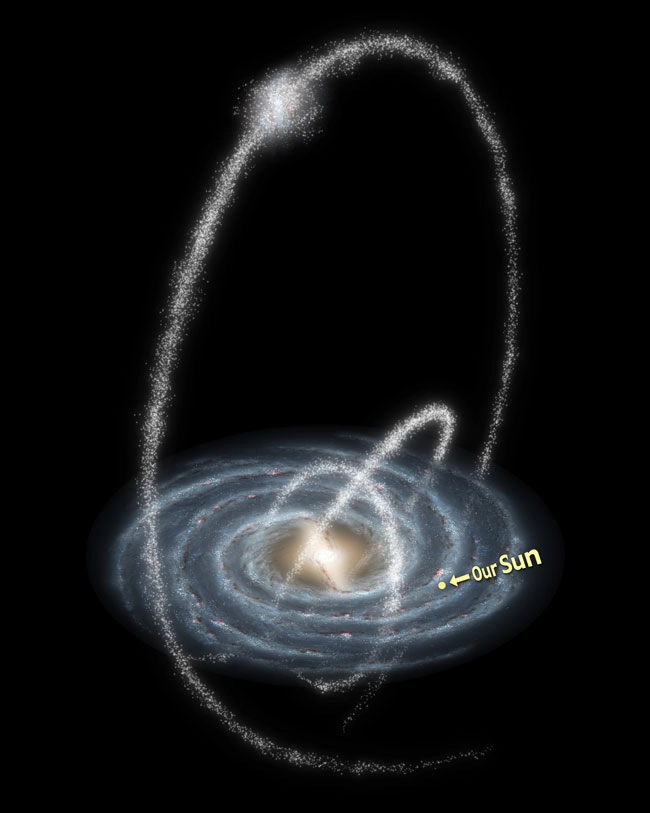
HONOLULU?Newlydiscovered stellar streams that arc around our galaxy might be the remnants ofcannibalized star clusters and galaxies, scientists announced today.
The stellar streams findings, described by Caltech's Carl Grillmair here at a meeting of the American Astronomical Society, reveal our galaxy can be a dangerous place for passersby. .
Stellarstreams are thought to form over billions of years as our galaxy?s gravityslowly tears apart globular clusters and even dwarfgalaxies. The stars, which were once packed tightly together, are nowseparated by light-years, trailing one another as they jet at high speedsthrough the galactic halo.
Grillmairand his colleagues analyzed data from the Sloan Digital Sky Survey (SDSS),comparing the colors and luminosities of stars and grouping similar starstogether.
Two of thediscovered streamsare about 13,000 light-years from Earth and are likely the remains of ancientglobular clusters, spherical collections of hundreds of thousands of old stars. Astronomers have identified onlyabout 150 globular clusters orbiting the MilkyWay, though they think thousands may have existed in the past.
The thirdstream is about 130,000 light-years from Earth and could be the closest dwarfgalaxy to our Milky Way ever discovered. To date about 20 dwarf galaxies havebeen identified in the Milky Way and astronomers have wondered why they haven?tfound more.?
?It mighttell us why we don?t see them, because they all get ripped up like this,?Grillmair told SPACE.com. He added that perhaps there is a safe distancefrom the Milky Way, and any closer dwarf galaxies would be ?toast.?
Containingup to 100 million stars, dwarf galaxies are also thought to be chock-full ofdark matter, the glue thought to hold our galaxy together.
Grillmairsuspects stellarstreams will garner loads of scientific attention for years to come, asthey are windows into our galaxy?s past, present and future and likely holdevidence of dark matter.
One theoryfor how our galaxy formed says that lots and lots of dwarf galaxies merged, andare continuing to merge, and ultimately gave rise to the Milky Way. Thedwarf-galaxy stream could be one such merger that?s slowly succumbing to theMilky Way?s gravitational lure.
?This is avery exciting time for galactic archaeology, and finding more of these ancientstreams will really help us to piece together the structure of our galaxy andhow it evolved over time,? Grillmair said.
- Top 10 Star Mysteries
- Images: Amazing Galaxies
