If you're a space lover and wondering about the best space books you should be reading, we've rounded up our favorites right here.
Our guide to the best space books includes investigations into the wonder of our galaxy and beyond. You'll also find deep dives into physics and astronomy as well as accounts from astronauts about life in space. Others are more grounded, telling the stories of the people who helped launch space programs with their feet firmly placed on Earth.
But these aren't all non-fiction books for education purposes: We've also included our favorite science fiction books that offer a different perspective of space. No matter what type of space book you're after, we're confident you'll find something to suit in our selection.
If you're looking for something more specific, take a look at our guide to the best astrophysics books or the best space photography books. And if you're shopping for kids, our guide to the best space books for pre-teens might come in handy.
The quick list

An engaging, enjoyable and accessible book about the history of our own galaxy.

An intriguing memoir about the Psyche mission, a mission to study an asteroid three times further away from Earth than the sun.

A fascinating look at the history of science, revealing popular theories don't always come from where we expect.

Scharmen puts forward a very interesting history of space travel, with a slant on sci-fi rather than stark realism.

Stott uses her time aboard the ISS to reflect on the Earth, and the ways we can protect it.

Hadfield draws upon his experience as an astronaut to write a terrifying and realistic thriller about the space race.
Load the next 15 books ↴

A fantastic account of Yuri Gagarin's first trip into space aboard Vostok 1.

A fascinating dive into all areas of physics that also deals with issues of racism and sexism in science.

A thrilling fiction book that tells the story of an Earth on the brink of collapse and a colonized Moon.

Johnson's work searching for life on Mars, along with her personal obsession with the Red Planet.

This is an in-depth and interesting history of spaceflight, as well as an investigation into how space travel will change in the future.

Masters poses the question: What if UFOs aren't aliens, but in fact ourselves from the future?

An intriguing deep dive into UFO culture, and where it comes from.

A sequel, some 50 years later, to Michael Crichton's essential novel, The Andromeda Strain.

A touching spiritual journey into what it means to be human from the daughter of Carl Sagan.

Written by an archaeologist, this book investigates the 'junk' left behind by space travel and how it might affect the future.

Smolin posits that Einstein's theories might not be complete or correct.

A rich dive into the moon landings, told from multiple different perspectives.

Courtois' personal journey through discovering Laniakea, the home of the Milky Way.

A delightfully illustrated children's book telling the story of Venetia Burney.

A technological thriller set in the near future, when deep-space mining is a reality.
The best space books to read in 2025
Why you can trust Space.com Our expert reviewers spend hours testing and comparing products and services so you can choose the best for you. Find out more about how we test and review products.
Books about NASA and space exploration

The books in this section all deal with human stories of real space missions, the realities of living and working in space, and the people on the ground making space missions come to life.
Some books (Dr Space Junk vs The Universe) take a more broader look at humans in space, and the impact we have, and others (See You in Orbit?) take a look at what the future of space travel might hold.
Jump to a specific space exploration title using the links below:
- A Portrait of The Scientist as a Young Woman by Lindy Elkins-Tanton
- Space Forces: A Critical History of Life in Outer Space by Fred Scharmen
- Back to Earth by Nicole Stott
- Beyond by Stephen Walker
- See You in Orbit? by Alan Ladwig
- Dr Space Junk vs The Universe by Alice Gorman
- Apollo's Legacy by Roger D. Launius
A Portrait of the Scientist as a Young Woman

✅ You want to learn more about the Psyche mission: Elkins-Tatton provides a fantastic dive into the mission to study an asteroid.
❌ You're not interesting in a personal memoir: While there's plenty of science here, Elkins-Tatton weaves her own experiences into her writing.
🔎 A Portrait of the Scientist as a Young Woman: This is a fantastic overview of the Psyche mission, where Elkins-Tattor weaves together science and personal experience beautifully.
Lindy Elkins-Tanton of Arizona State University is the principal investigator of NASA's Psyche mission, a mission designed to explore an asteroid known as (16) Psyche. But since it's three times further from the Earth than the sun and it's made primarily of metal, it's no easy feat.
In A Portrait of the Scientist as a Young Woman, Elkins-Tatton discusses the ins-and-outs of the Psyche mission, the intriguing path she took to get her position, and how the mission went.
The book covers everything from her experience conducting field research in Siberia to her work supporting healthy culture in the ivory tower. Being only the the second woman ever to be awarded a major NASA space exploration contract, her point of view is an interesting one indeed.
You can find out more about the book and the author in our interview with Lindy Elkins-Tanton.
Space Forces

✅ You're open to radical ideas: Author Fred Scharmen blends together reality and science fiction.
❌ You want something easy going: This is quite dense at times, and deals with complex ideas.
🔎 Space Forces: There are some great ideas here, and Scharmen puts forward a very interesting history of space travel, with a slant on sci-fi rather than stark realism.
Like plenty of kids, Fred Scharmen was fascinated by the depictions he saw of what life in space might look like. But Scharmen grew up to be an architect and urban designer, which taught him to see all the silent assumptions, fears and hopes that were hidden in those images.
In Space Forces: A Critical History of Life in Outer Space, Scharmen examines seven different visions of life in space, exploring the cultural beliefs they betray and asking us to think more critically about why we want to go to space and how to translate our values into exploration. Mixing together reality and science fiction, this is a very interesting but dense read that might be very different from what you're expecting.
To learn more about the author and Space Forces, read our interview with Fred Scharmen. We have also published an excerpt from Space Forces to give you a taste of what to expect from the book.
Back to Earth

✅ You care about sustainability: This is primarily a book about caring for the Earth.
❌ You want a record of life on the ISS: While Stott's book comes from her time aboard the International Space Station, it's not the focus.
🔎 Back to Earth: Scott cares about the Earth, and it shows here. This is a nice mix of sustainability and activism, with a glimpse of life on the ISS.
Retired NASA astronaut Nicole Stott is one less than 600 people to have reached space, and she hopes the stories of that experience will inspire readers to take a planetary perspective on their daily lives.
In Back to Earth: What Life in Space Taught Me About Our Home Planet ― And Our Mission to Protect It, she offers new philosophies for living on Earth informed by her experience in orbit and melds her experiences in space with stories of people on Earth who act on the same value she sees as so crucial to spaceflight.
If you want to find out more about Back to Earth, you can read our interview with the author, Nicole Stott. We also have an excerpt from Back to Earth that you can read to get a taste of what to expect from the book.
See You in Orbit?

✅ You want to learn about space travel: This is a very comprehensive history of space travel, starting in the 1920s.
❌ You want something short and quick: At 500 pages, this is a book that deserves your time.
🔎 See You in Orbit?: Ladwig expertly uses his own experiences to present a very interesting history of spaceflight, filled with anecdotes, roadblocks and a surprising amount of humor.
Alan Ladwig is a former manager at NASA and in See You In Orbit? Our Dream of Spaceflight, he dives into the history and future of space flight.
Ladwig provides an in-depth history into space travel, dating all the way back to the theoretical ideas from the 1920s and 1930s, and moving through the decades to the present day, with the likes of Blue Origin, SpaceX, Virgin Galactic and more taking aim at private and commercial space travel.
This is a very comprehensive and in-depth read, and if you're any interest in space travel at all, it makes for essential reading. Ladwig's writing is both accessible and entertaining, with many humorous anecdotes sprinkled through, along with Ladwig drawing upon his own experiences during his time at NASA.
To find out more about Ladwig and See You in Orbit?, we'd recommend that you read Space.com's interview with the author.
Dr. Space Junk vs the Universe

✅ You're interested in space and archaeology: Author Alice Gorman is a traditional archaeologist who later became interested in space.
❌ You want to read accounts from actual NASA workers and astronauts: Gorman is an archaeologist first, space enthusiast second.
🔎 Dr Space Junk vs The Universe: An interesting look at what happens to "space junk", and how being human affects our relationship with space travel.
What happens to satellites when they die, and come to think of it, when do they die? Those are just some of the questions that Alice Gorman wants to answer in her book Dr Space Junk vs The Universe: Archaeology and the Future.
Alice Gorman is an Australian archaeologist who studies objects related to spaceflight, and what we can learn by thinking about space through the lens of archaeology. Dr Space Junk vs The Universe is an engaging story of the ways being human shapes how we go to space.
From Aboriginal songs tucked on the Voyagers' Golden Records to the importance of the size of a spacecraft, Gorman offers a new perspective on the history — and future — of space.
You can find out more about Dr Space Junk vs The Universe in our Q&A with Gorman, which covered the book as well as Gorman's experiences with the archaeology of space.
Beyond

✅ You want to learn more about Yuri Gagarin's mission: This is an in-depth account of his orbit aboard Vostok 1.
❌ You want a purely scientific read: While this is all based on fact, it often reads like a novel.
🔎Beyond: Rich and detailed, this is a fantastic account of the first human journey into space. A few inaccuracies don't ruin this well-written and important tale.
On April 12, 1961, Russian cosmonaut Yuri Gagarin became the first person to leave Earth's orbit and travel into space, marking a significant milestone in the space race between the United States and the Soviet Union.
In Beyond: The Astonishing Story of the First Human to Leave Our Planet and Journey into Space, author and documentary filmmaker Stephen Walker recounts intimate details of the months, and years, leading up to Gagarin’s historic flight, revealing the true stories of the Soviet space program as the agency prepared to launch the first human into space — only weeks before American astronaut Alan Shepard's suborbital flight on May 5, 1961.
Walker also discusses the historical impact of Gagarin's flight and how it set the stage for NASA's Apollo program.
Apollo's Legacy

✅ You're interested in the moon landings: Launius considers many viewpoints about the subject.
❌ You want to read about space travel in general: This book focuses solely on missions to the moon.
🔎 Apollo's Legacy: Launius has considered many different perspectives in exploring the moon landings, presenting an interesting and insightful narrative.
How do we understand a transformative event like the Apollo missions to the moon? Many present it as proof of American ingenuity and success, but there's much more to the story.
In Apollo's Legacy: Perspectives on the Moon Landings by space historian Roger D. Launius, he probes the impacts Apollo had technologically, scientifically and politically, as well as analyzing what we can draw from it to understand the country's modern space program.
The book is written as a scholarly text, but it's accessible to anybody with an interest in space history and the circumstances that spawned Apollo.
If you want to know more about Apollo's Legacy: Perspectives on the Moon Landings and its author, read our Q&A with Roger D. Launius.
Science and physics books

The books in this section delve into astrophysics and other scientific angles about our universe and space at large.
Some books here tell the story of a specific person and their impact on the world of astrophysics (The Girl Who Named Pluto) while others delve deeper into the laws of physics (Einstein's Unfinished Revolution) or provides a rich overview of everything that makes our galaxy what it is (The Milky Way).
You can find a bigger list of similar books in our guide to the best astrophysics books.
Jump to a specific book using the list below:
- The Milky Way by Moiya McTier
- Horizons: The Global Origins of Modern Science by James Poskett
- The Disordered Cosmos by Chanda Prescod-Weinstein
- For Small Creatures Such As We by Sasha Sagan
- Einstein's Unfinished Revolution by Lee Smolin
- Finding Our Place in the Universe by Helénè Courtois
- The Girl Who Named Pluto by Alice B. MicGinty
Finding Our Place in the Universe

✅ You're interested in Courtois' research: This is an interesting summary of the program she was involved in.
❌ You want a scientific deep-dive: This is a fairly short book, and lacks depth.
🔎 Finding Our Place in the Universe: A great read, and a worthwhile celebration of women in astrophysics.
In Finding Our Place in the Universe, French astrophysicist Helénè Courtois describes the invigorating quest to discover the Milky Way's home. In 2014 Courtois was part of a research team that discovered the galactic supercluster which contains the Milky Way, which they named Laniakea. This means "immeasurable heaven" in Hawaiian.
In this engaging and fast-paced book, Courtois describes her own journey in astrophysics and highlights the key contributions of numerous female astrophysicists. The reader is right there with her as Courtois travels to the world's leading observatories in pursuit of Laniakea, and it's easy to see why the challenge of discovering our galaxy's home became so seductive.
Readers who want them will learn all the scientific and technical details needed to understand the discovery of Laniakea, but it's also possible to enjoy this book as a pure tale of adventure.
To find out more about the book and the author, read our Q&A with Courtois about her hunt for Laniakea.
The Milky Way

✅ You want an easy to read overview about our galaxy: This is a great primer if you're not an expert on space.
❌ You want deep, scientific details: This is more of a book for beginners.
🔎 The Milky Way: A fun, accessible read that provides plenty of insight for those who don't already have deep scientific knowledge about our galaxy.
Astronomers have written the Milky Way's story many times over; scientists have traced violent collisions in its past and future and peered into the supermassive black hole lurking at its heart. But if our galaxy could tell us its story, what would it say?
Astrophysicist and folklorist Moiya McTier tells that story in her delightful book, The Milky Way: An Autobiography of Our Galaxy. McTier's Milky Way makes for a prickly narrator as the book zips through everything from the formation of the universe through the ways scientists think it might come to an end.
This isn't the most in-depth, rich scientific text, but if you're fairly new to learning about our galaxy, it makes for great reading.
To learn more about The Milky Way, read our interview with Moiya McTier. We've also previously published an excerpt from The Milky Way if you want a taste of what to expect.
Horizons

✅ You want a deep dive into the origins of science: Challenges our beliefs on where leading scientific research actually came from.
❌ You want something light: Don't go into this unless you already have a base understanding of scientific principles.
🔎 Horizons: This is a rich and fascinating history of science, challenging our beliefs as to where leading scientific theories actually came from.
What if everything we're taught about the history of astronomy and physics is wrong? That's what Horizons: The Global Origins of Modern Science posits to its reader.
In this book, James Poskett, a historian of science and technology, focuses on how science has always been a global endeavor and how that story was overshadowed by a biased Westernized version.
Astronomy and physics play key roles in the story he tells, with cameos from key figures such as Ptolemy and Isaac Newton, although the book spans several scientific fields, including natural history and evolution as well.
To find out more about Horizons: The Global Origins of Modern Science, read our interview with author James Poskett.
For Small Creatures Such As We

✅ You're open to philosophy and spirituality: This book by Sasha Sagan deals with more than just science.
❌ You want straight-up scientific fact: This is more of an exploration of life and the beauty of the world.
🔎 For Small Creatures Such As We: Coming from the daughter of Carl Sagan and Ann Druyan, this was written as a love letter to her parents. It's a touching and thought-provoking read.
Author Sasha Sagan is the daughter of Cosmos co-writer Ann Druyan and famed astronomer Carl Sagan. Before you know anything else about this book, then, that should give you something of an idea of what to expect.
Sasha Sagan describes her book, For Small Creatures Such as We: Rituals for Finding Meaning in Our Unlikely World, as a love letter to her parents. But rather than dealing solely with science, it dives into the secular side of spirituality.
Upon starting a family of her own, Sagan wanted to have rituals and traditions that would bond them together. But being non-religious, she re-evaluated what these traditions could be and this book explores how rituals like holidays can be inspired by the "magic" of nature, space and science rather than religion.
To find out more about For Small Creatures Such as We, read Space.com's interview with the author.
The Girl Who Named Pluto
✅ You want something for kids: This is aimed at elementary school-aged children.
❌ You want in-depth information: This picture book only deals with the basic story of Venetia Burney.
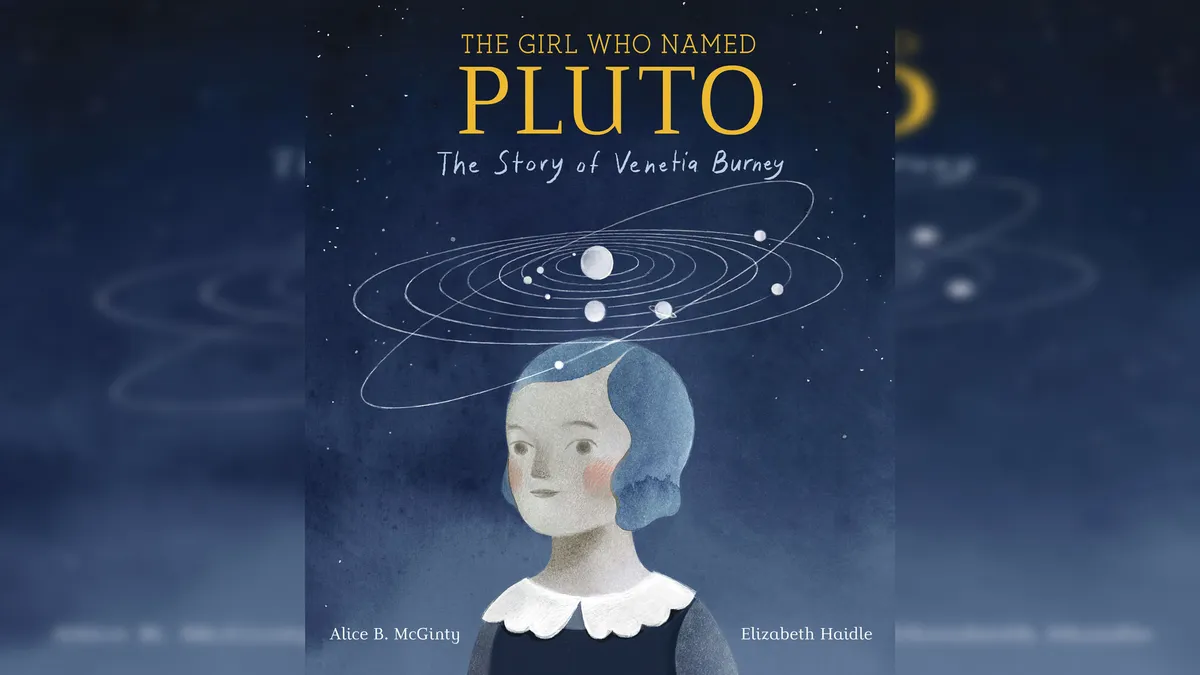
🔎 The Girl Who Named Pluto: A beautifully-illustrated picture book aimed at children that tells the story of an 11-year-old Venetia Burney.
How did an 11-year-old English schoolgirl come to name Pluto? In The Girl Who Named Pluto: The Story of Venetia Burney, Alice B. McGinty recounts one child's history-making turn on a fateful morning in 1930. Although the book is aimed at kids aged between 4 to 8, there's plenty for older children to connect with as well. And the vintage-flavored illustrations by Elizabeth Haidle make the experience a visual delight.
Venetia had connected her love of mythology with her knowledge of science to christen the new planet after the Roman god of the underworld, refusing to let her age or gender to hold her back.
McGinley says she hopes Venetia's tale inspires her readers — girls, in particular. "I hope girls read it and feel empowered to be part of the scientific process," she said. "I hope boys read it and feel empowered, too, and understand how important girls are to science."
To find out more about The Girl Who Named Pluto, read Space.com's interview with the author, Alice B. McGinty.
The Disordered Cosmos

✅ You want to read about physics in all forms: This goes far beyond astrophysics.
❌ You want a book purely about science: Prescod-Weinstein deals with issues about race and misogyny in her book.
🔎 The Disordered Cosmos: This journey into particle physics spans the breadth of the world, while also dealing with important issues such as race and sexism.
Theoretical physics is supposed to be about pure, crisp ideas. But physics is done by humans, and human society brings messiness to any endeavor. That reality means every aspect of physics is marked by the social constraints of who is allowed to do physics in harmony with their identity and who is not.
Chanda Prescod-Weinstein, a theoretical physicist at the University of New Hampshire, tackles the implications of that reality in her thought-provoking book, The Disordered Cosmos: A Journey into Dark Matter, Spacetime, and Dreams Deferred.
This deals with much more than just astrophysics, with Prescod-Weinstein dealing with the physics of just about everything. She also delves into issues relating to racism and sexism that affect the scientific medium, making this an interesting and thought-provoking read in many ways.
To learn more about The Disordered Cosmos, read our interview with the author.
Einstein's Unfinished Revolution

✅ You want a deeper understanding of quantum physics: Smolin argues that there's much more to quantum physics than Einstein's theory.
❌ You are new to science: The book is quite dense and requires some basic scientific knowledge.
🔎 Einstein's Unfinished Revolution: This is a well-researched and informative book, but its dense subject matter requires some scientific knowledge before you go in.
Although many believe that the quantum-mechanics revolution of the 1920s is settled science, Lee Smolin wants to disrupt that assumption.
Smolin, a theoretical physicist based at the Perimeter Institute in Toronto, argues that quantum mechanics is incomplete. The standard quantum model only allows us to know the position or trajectory of a subatomic particle — not both at the same time. Smolin has spent his career looking to "complete" quantum physics in a way that allows us to know both pieces of information.
Smolin's very engaging book, Einstein's Unfinished Revolution: The Search for What Lies Beyond the Quantum offers this unique perspective honed through four decades at the forefront of theoretical physics. ~Marcus Banks
Read a Q&A with Smolin about the new book and the state of quantum physics.
Books about UFOs and the search for life

This section of our favorite space books deals with UFOs and the search for life. We've chosen books that tackle the subject from a scientific point of view. Sarah Stewart Johnson's book takes us to Mars on an in-depth search for life, while They Are Already Here delves into the UFOs that have made the headlines.
Jump to a specific book about UFOs and space exploration using the links below:
- The Sirens of Mars by Sarah Stewart Johnson
- Identified Flying Objects by Dr. Michael P. Masters
- They are Already Here by Sarah Scoles
The Sirens of Mars

✅ You're interested in Mars: Elkins-Tatton provides a fantastic dive into the mission to study an asteroid.
❌ You want pure science: Stewart Johnson's book is very personal, with lots of life experiences drawn into her narrative.
🔎 The Sirens of Mars: A fascinating and in-depth look at Mars as a planet and as a personal obsession for author Sarah Stewart Johnson.
More than just a hunt for signs of life, The Sirens of Mars: Searching for Life on Another World is a love letter to the red planet. Author Sarah Stewart Johnson has been obsessed with Mars from a young age, and this book is both a look at the research she's carried out looking for life, and her lifelong obsession with the planet.
A planetary scientist, Stewart Johnson's book is the human story of the search for life on Mars. She shares a host of hidden moments about scientists' views of the Red Planet throughout the pages, and she also delves into how scientists have found and lost hope in the process of studying our nearest neighbor.
This is a surprisingly personal account, and a fascinating read throughout. It's filled with empathetic and evocative language, and it's very accessible to all readers even if you don't have a rich scientific background.
They Are Already Here

✅ You're interested in UFOs: This book delves into newspaper headlines, UFO culture and more.
❌ You're not interested in UFOs: This isn't the book for you.
🔎 They Are Already Here: A dive into the culture surrounding UFO sightings, rather than the sightings themselves. Interesting, entertaining and balanced.
Do you remember reading a New York Times story in 2017 that claimed to unveil a Pentagon program dedicated to investigating UFOs? Did you hear rumors about why the FBI closed a solar observatory the next year for then-undisclosed reasons? Are you confused about why there seem to be so many documentaries about alien sightings?
They Are Already Here: UFO Culture and Why We See Saucers, written by freelance journalist Sarah Scoles, tackles these questions and many more. Rather than delve into the investigations themselves, the book deals with the culture around UFO sightings, digging into where encounters come from and the emotional effects such a sighting can have on a person.
If you want to find out more about They Are Already Here: UFO Culture and Why We See Saucers read Space.com's interview with the author. We also have an excerpt from the book if you want a greater idea of what to expect.
Identified Flying Objects

✅ You want radical theories about UFOs: Are aliens simply 'us' from the future? That's one of many theories the author poses here.
❌ You like theories to be backed up by evidence: Some of Masters' ideas are just that: ideas.
🔎 Identified Flying Objects: A provocative look at different theories about where UFOs and 'little green men' might actually come from.
Unidentified flying objects (UFOs) have captured the public's attention over the decades. Rather than aliens, could those piloting UFOs be us — our future progeny that have mastered the landscape of time and space?
Perhaps those reports of people coming into contact with strange beings represent our distant human descendants, returning from the future to study us in their own evolutionary past.
That's the theory that Dr. Michael P Masters goes with in his self-published book, Identified Flying Objects: A Multidisciplinary Scientific Approach to the UFO Phenomenon. The idea of us being them has been advanced before, but this woek takes a fresh look at this prospect, offering some thought-provoking proposals.
If you want more information about the book, read our review of Identified Flying Objects.
Science fiction books

We're moving away from science and theory in our guide to the best space books now. This section focuses on our favorite sci-fi stories. These books draw on science to create new worlds, alternate timelines and thrilling situations for you to lose yourself in.
These books are sometimes scary, sometimes tense, but always engaging. Use the links below to jump to a specific sci-fi title featured in our guide.
- The Apollo Murders by Chris Hadfield
- The Relentless Moon by Mary Robinette Kowal
- The Andromeda Evolution by Daniel H. Wilson
- Delta-V by Daniel Suarez
The Apollo Murders

✅ You want authentic details: Author Chris Hadfield was an astronaut, so plenty of details are grounded in reality.
❌ You want a quick, easy to read thriller: There's a lot of technic detail buried in here.
🔎 The Apollo Murders: Grounded in reality thanks to Hadfield's own experiences, this is a fantastic take on the space race.
Not only is Canadian Chris Hadfield an astronaut, he's also a New York Times bestselling author, YouTube star, international speaker, and popular Twitter personality. It's a lot of bows under his belt, but in his first dive into fiction, he proves he can do just about anything he sets his mind to.
The Apollo Murders is a rousing adventure placed amid the tense days of the U.S.-Soviet Union space race in the 1970s following America's lunar landings.
The alternative history is set in 1973 when NASA launches a final top-secret mission to investigate a crewed Soviet space station called Almaz. The clandestine flight continues to the moon as both Russian and American crews target a huge bounty hidden on the lunar surface.
To find out more about the book, read our article where Chris Hadfield talks about writing the The Apollo Murders. We also have an excerpt from The Apollo Murders to give you a taste of what to expect.
The Relentless Moon

✅ You want a thrilling alternative timeline: It's set at a time where a major conflict breaks out on Earth.
❌ You haven't read the previous books in the series: This is the third book in the Lady Astronaut series.
🔎 Relentless Moon: People are being taken away from Earth for their own safety in this thrilling alternative future where a climate disaster is taking place.
Mary Robinette Kowal's Lady Astronaut series imagines what would have happened if Apollo-era spaceflight had continued at the same pace, pushed forward by the existential threat of meteor-caused climate change.
This third book in the series, Relentless Moon, follows astronaut Nicole Wargin on an investigation of threats to a lunar base, exploring how life on the ground continues amid ambitious space exploration. It's a thrilling read that speaks both of an Earth on the brink of destruction and a colonized Moon.
Being the third entry in the Lady Astronaut series, however, you might want to pick up the other two first: The Calculating Stars and The Fated Sky.
The Andromeda Evolution

✅ You're a Michael Crichton fan: This novel picks up from the Andromeda Strain some 50 years later.
❌ You've never read The Andromeda Strain: You probably should start there.
🔎 The Andromeda Evolution: A sequel to Crichton's 1969 classic, this terrifying tale is faithful to the original and a thrilling read.
The Andromeda Evolution from Daniel H. Wilson is actually a sequel to Michael Crichton's 1969 classic novel, The Andromeda Strain. Picking up some 50 years later, it continues to develop the terrifying world that Crichton lays out with immense and thrilling detail.
The story of The Andromeda Evolution deal with otherworldly matter that threatens the future of the Earth. A team of experts come together to investigate what becomes literally a life or death situation: if they can't reach the quarantine zone and enter the anomaly, life as we know it will end.
This is a thrilling read for start to finish, but you'll get much more out of it if you read Crichton's original novel, The Andromeda Strain first.
To find out more about the book, read our in-depth The Andromeda Evolution review, where we also interview author Daniel Wilson.
Delta-V

✅ You enjoy technological thrillers: Set in the near future, Delta-V is about space mining.
❌ You prefer your sci-fi to be unrealistic: Daniel Suarez's book might be a little too plausible (and terrifying) for some.
🔎 Delta-V: Fantastic world-building and an engaging plot make this sci-fi thriller a must-read.
In Delta-V by Daniel Suarez, an unpredictable billionaire recruits an adventurous cave diver to join the first-ever effort to mine an asteroid.
The crew's target is asteroid Ryugu, which Japan's Hayabusa2 spacecraft has really been exploring since June 2018. From the use of actual trajectories in space and scientific accuracy, to the title itself, Delta-V — the engineering term for exactly how much energy is expended performing a maneuver or reaching a target — Suarez pulls true-to-life details into describing the exciting and perilous mission.
The reward for successful asteroid mining is incredible, but the cost could be devastating.
To find out more about Delta-V, read our Q&A with the author.
More great space books to read
While our guide here includes a range of the best space books generally, we've also got several other lists all narrowing down into specific categories or catering for specific audiences. Browse those lists using the links below.
- Astrophysics
- Space photography
- Space books for kids
- Astronomy
- Spaceflight and space history
- Science fiction
- Space books for preteens
How we test
We typically don't publish full reviews of the space books we read and love, but everything on this list comes highly recommended from our staff, all of whom are space experts and enthusiasts.
We choose books for a number of reasons: Perhaps they give us a new glimpse into life working for NASA or living in space, or maybe they provide an in-depth understanding to the galaxies beyond our own. We've chosen books that suit all age ranges too, and in many cases we've spoken to the authors to get a better understanding of the work that's gone in to writing and compiling each of these entries.
Follow us on Twitter @Spacedotcom and on Facebook.