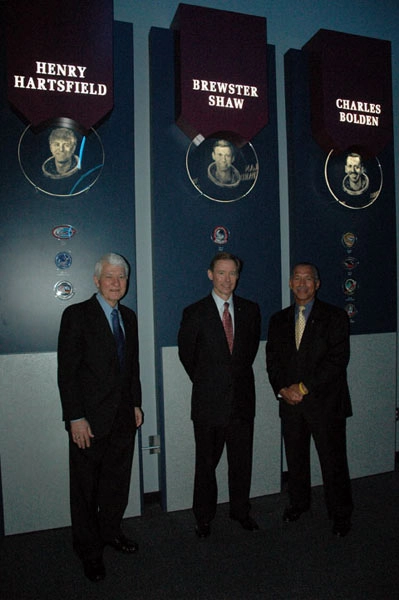
CAPE CANAVERAL -- Clad inbrown, blue and orange pressure suits, the 2006 class of Astronaut Hall of Fameinductees (as depicted in their official NASA portraits and reprinted onposters and programs given to their ceremony guests) visually emphasize thedifferent periods of space shuttle missions for which they were being honored.
The trio offormer shuttle commanders -- Henry "Hank" Hartsfield, Brewster Shawand Charles Bolden -- were welcomed into the Hall this past weekend by nearly 20of their fellow inductees out of the 60 that the Florida Hall honors to date.Addressing a crowd seated underneath a massive Saturn 5 Moon rocket and whichincluded their families, peers and the general public, this year's class washailed by the commanders of their first spaceflights.
Apollo 16 commandmodule pilot and Hartsfield's STS-4 crewmate Ken Mattingly reminisced about hispilot, who joined NASA's ranks in 1969 and who supported from the ground themission that would put Mattingly in lunar orbit. It would be nearly 13 yearsbefore Hartsfield would fly in space himself, on the shuttle's fourth and final"testflight," leading to it being deemed "operational" by NASA.He would go on to fly twice more and, after departing the space agency, serveas Vice President of Raytheon, one of its contractors until his recentretirement.

Shaw'sfirst flight came aboard Columbia in 1983, seated to the right of Gemini,Apollo and Space Shuttle veteran John Young. He followed that mission -- thefirst to carry Spacelab to orbit -- with a 1985 flight on Atlantis, during whichhis crewmates practiced space station construction techniques. Shaw's rarelyseen and never used in space blue spacesuit came after the Challenger accident,as a prototype of the more familiar orange launch and re-entry garments stillworn today. His last mission on a classified flight for the Department ofDefense was in 1989. Today, Shaw is the vice president and general manager of TheBoeing Company's NASA Systems division.
Robert"Hoot" Gibson praised his pilot Bolden for their flight together,STS-61C, which landed only 10 days prior to the loss of Challenger. Bolden nextpiloted the mission to deploy the Hubble Space Telescope, followed in 1992 byNASA's first Spacelab flight dedicated to studying our planet from orbit.Bolden last commanded the first shuttle mission to include a Russian cosmonautamong the crew. He now leads an aerospace consulting firm.
Hartsfield,Shaw and Bolden spoke with collectSPACE at the Astronaut Hall of Fame the daybefore their induction.
Tobegin, what does being inducted mean to you?
HankHartsfield (HH):"It's thrilling to me because it's recognition by peers, members of the[selection] board, people that I worked with a long time and that means a lotto me. I don't know how to explain it. I was thrilled when I got the call, Ididn't expect it, it was something out of the blue. I think anyone would feelgood about having their peers vote for them and recognize them as having madesome significant achievements in the areas we all chose to work."
CharlieBolden (CB):"I didn't know very much about the Hall of Fame except for the last fewyears and I had never been here before this weekend. One of the things I havelearned over the last few hours having met the [Astronaut ScholarshipFoundation] scholars is that the importance of being inducted is that it allowsme now to become a role model for kids that want to do what we've done. I thinkthat's really important because traveling around and visiting a lot of schools,I don't talk to a lot of kids that want to be astronauts any more. So it'sreally great to see some kids that are inspired by the thought of having anopportunity to be a human being in space."
BrewsterShaw (BS):"Well, I believe in using human beings to explore our universe, and Ithink the United States of America should be a leader in that endeavor, which Icall 'a great human adventure' because I think it is. So, anything like thisthat provides an avenue for people to learn more about our space program and tobe supportive of our space program I think is worthwhile and I am sure happy tosupport that."
The Hallof Fame prides itself as exhibiting the largest collection of astronautpersonal memorabilia. As new inductees, do you know yet what you will be loaning?
BS: "Actually, I wanted to seewhat the layout was going to be first before trying to select things. They haveasked for things like flown flight data files, those are checklists and cuecards and stuff like that, which most of us have. Once in a while you hang onto a flying suit or something like that, that might be appropriate. I wanted tosee the layout and evaluate what would be appropriate, so I don't know theanswer yet."
CB: "I thought about it and likeBrewster, I wanted to see what was here. The unfortunate thing for me is thatmost of the things that I think would be appropriate and that I would like tohave here, I don't own, I don't possess.
"Brewstermentioned flight data files, some of the flight data files that come from the flights,personal notes and things like that -- when I came out of the program, they wentto the National Archives. I had a big fight with the National Archives aboutretaining my own notes and the like. Those are things that would really beappropriate."
Forty-fiveyears ago today[May 5] another of the Hall of Fame astronauts, Alan Shepard became theUnited States' first man in space. Where will we be in space 45 years fromtoday?
CB: "I'll let these guys[referring to Hartsfield and Shaw] who just came out of the community answerbut I know where we would all like to be. I know where I thought we would betoday, prior to Challenger. I thought we would be beyond the Moon and on theway to Mars now. I know that may sound like folly to some people but I reallydid. The [space] program was robust, we were flying relatively regularly. Ithought we were on target to be well beyond where we are today.
"Ihave to admit to being somewhat discouraged when I look at funding that isgoing into the program. I mean, these guys live with it now, Hank did -- I'vebeen away from the program since 1994, so all my observations are from without.As a person from without, I just don't see the fiscal support that we need tobe where I know I'd like for us to be 45 years from today."
BS: "Forty-five years from now, Iwould think we have a global space program, that meaning an international spaceprogram. There are other countries that really have big ambitions relative tohuman spaceflight and human exploration. Of course we have our own as laid outby the President a couple of years ago. The Chinese, Russians, Japanese,Europeans, a lot of people want to be involved in human exploration of ouruniverse.
"Ithink in 45 years we will have figured out how to do that even better than wehave on the International Space Station. You remember the movies 2001 and 2010?We'll have something like that going 45 years from now. We should have alreadybeen to Mars and we will be thinking about where we want to go afterthat."
HH: "I would also think that wewould have a permanent station on the Moon..."
BS: "...ala Antarctica orsomething like that..."
HH: "Yes."
BS: "...if it makes sense once weget there and find out what's there. And I think Charlie's point is right on.It's going to take a national commitment, its going to take a globalcommitment, and with that commitment is going to have to come reasonablefunding levels each year or we won't make the kind of progress that people willbe looking for and then we won't make progress at all."
CB: "And I don't mean to be adoom and gloomer -- it probably sounded that way. I have two grandkids rightnow. I have six-year and three-year-old granddaughters -- we all have grandkids.I often wonder how I am going to sit down with my granddaughters ten years fromnow and explain to them why we didn't do some things that we should have doneby the time they reach 16 years of age and each of them is getting ready to gooff to college.
"So Iwork every day to try to make sure that I don't have to explain that to them.That we do what's right and it can be done but Brewster hit the nail on itshead, it's going to take a national commitment. And it's going to take anational commitment to open up to the other spacefaring nations and allow themto be a part of an international effort because for one thing, it's just tooexpensive. You can't do it solo any more, if we ever could.
"I amextremely happy to see that we may be getting ready to work with the Chinese. Ithink that's phenomenal, if we're really going to do it."
BS: "I think we ought to give[NASA Administrator] Mike Griffin a chance to go over [to China] to have a chatand follow his lead."
The endof the Space Shuttle Program is now in sight with Congress and NASA setting a2010 deadline for the orbiters to be decomissioned. Should the end be datedriven or by the completion of the space station and/or a last repair missionto the Hubble Telescope?
BS: "Those are not mutuallyexclusive. We are going to fly this summer and then we'll fly again this yearat least once, maybe twice.
"We'llget back up on the step because we'll have fixed the issues and we'll continueto improve the foam on the tank. So we can easily get back up to 4-5 flights ayear, so by the end of this decade we can have completed assembly on theInternational Space Station. So they are not mutually exclusive.
"Ithink we can do both of those. The President has said those are the first twosteps of his exploration initiative. If we can do that, we will be off andrunning."
Hank,your first mission was the last before NASA deemed the Space Shuttle'operational'. In hindsight, with the agency again considering the shuttle atest vehicle after the loss of Columbia in 2003, was it ever operational?
HH: "'Operational,' to me, is atough term to explain.
"Atthe time, it seemed to us, it was stretching a little bit to say it wasoperational. We had flown the vehicle four times. You'd never call an airlinerready for passengers [after four flights].
"In myview, the whole time we were flying it was a test vehicle, although we calledit operational. We used it and did a lot of great things with it. It is aunique vehicle. It does something that no other vehicle does; it's the onlyvehicle around that can carry big payloads back to Earth safely. So, in thatrespect it's unique. Unfortunately, it's expensive to operate but its still aunique vehicle. I don't get alarmed about someone saying it is a test vehiclebecause it really is -- or saying it's operational. It's not operational by theway I look at it, having been a test pilot and looking at airplanes."
CB: "Hank just talked about thefact that we are all test pilots. There are a lot of different kinds of testpilots. I have never been an experimental test pilot. I went to test pilotschool and trained to be an engineering test pilot. So what I have done all mylife after that is to do engineering tests or developmental tests. And that'swhat I always viewed the shuttle as: it was a developmental test vehicle thatwe were using as a test bed, if you will, for follow-on vehicles and systems.
"Ithink people who didn't understand the world of testing were probably ledastray into thinking that it should be called an operational vehicle. We havesome operational airplanes that, yeah, they are [operational] in one-respectbut when they are at Pax River [Patuxent River Naval Air Station Complex] orsomewhere, they are developmental test vehicles because we are changing theirconfiguration all the time. We're putting different airfoils or equipment onthem. So they are constantly in testing and that's how I always viewed theshuttle."
Finally,as visitors come to the Hall of Fame and view your displays, what message doyou hope they retain from the experience?
BS: "Some things are worth doingin life. Exploring our world is one of them and we haven't figured out how todo it better than have human beings involved yet. I think that keeping thatgoing, keeping our curiosity, maintaining programs that help us learn about ourworld and our existence so that we can extend our existence or protect ourexistence as a species for as long as possible is worth doing. I would hopethat people will support that."
HH: "I support exactly whatBrewster said. I think it's human nature, at least it's my nature to want toexplore and understand things and to understand what takes place on otherbodies away from Earth: Mars, the Moon, wherever. The more we can learn aboutthat, the more things we learn about ourselves, how to protect our ownenvironment and how to protect people and give them opportunities that wedidn't have before. So its essential that we do this. That's my view.
CB: "I am just fascinated by [theHall of Fame]. I would hope that we'd be able to bring school kids in here,have them walk down this wall and find something in common with everybody here.
"A kidcomes in from Wisconsin could say 'I've heard stories about Brewster Shaw abouthow he used to be a long haired hippy, playing a guitar, so there is hope for me,'(laughs) or some kid from Columbia, South Carolina and says 'Hey, I think I cando that.' I go back to what I said at the very beginning. I've enjoyed theweekend so far because I think I now understand a little bit better theintention of the Foundation and the scholarship program. I think that's reallyimportant."
Copyright 2006 collectSPACE.com. All rights reserved.