


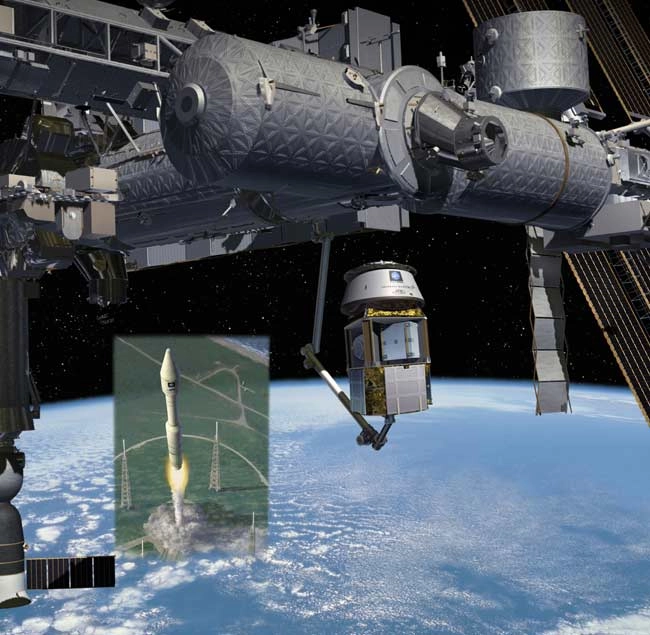
A privatespaceflight firm is developing a new unmanned spacecraft in hopes of deliveringcargo for NASA missions to the International Space Station (ISS).
TheChicago-based company PlanetSpace, Inc. is working with veteran aerospace firmsto build the Modular Cargo Carrier, an automated supply ship vying for fundingunder NASA's Commercial Orbital Transportation Services (COTS) program.
"We?revery comfortable and confident that NASA is going to have a low-cost, veryreliable cargo and crew transport to the space station," PlanetSpacechairman Chirinjeev Kathuria told SPACE.com.
PlanetSpaceteamed up with Lockheed Martin Space Systems to develop the orbital ModularCargo Carrier, with experienced rocket builder Alliant Techsystems (ATK) on boardto build the vehicle's booster. The firm, which is also developing a separatespace tourism and suborbitaltransportation vehicle, is building on an unfunded Space Act agreement withNASA that set out the requirements for its COTS bid.
NASA's COTSprogram is aimed at spurring the development of commercial cargo and crewlaunch services as the agency prepares to retire its three aging space shuttlesby September 2010.
While thespace agency is developing its own shuttle successor, the capsule-based OrionCrew Exploration Vehicle to be built by Lockheed Martin, it is alsoconsidering purchasing commercial launch services during the gap between the orbiterfleet's retirement and the first operational Orion flights in 2014.
PlanetSpaceand other private firms are vying for about $175 million in COTS seed money todevelop and demonstrate their own cargo-hauling spacecraft by 2010.
"Fromwhat we looked at in our experience base, that's something that's veryachievable," said Al Simpson, director of advanced programs for humanspaceflight at Lockheed.
The ModularCargo Carrier is currently designed to dock at the ISS using via a commonberthing port used to attach station modules and visiting NASA cargo pods,Simpson said.
Theavailable COTS funds were initially part of a $500 million NASA award to California'sSpaceExploration Technologies (SpaceX) and Oklahoma-based Rocketplane Kistler.When Rocketplane Kistler failedto meet key milestones earlier this year, NASA opted to re-compete thatfirm's allocation with a decision slated for February 2008.
In additionto PlanetSpace, the Houston-based firm SPACEHAB also announced intentions thisweek to compete for the COTS award using its ARCTUS spacecraft, which iscurrently envisioned to launch atop the expendable Atlas 5 and Delta 4 rocketsoperated by the United Launch Alliance.
IfPlanetSpace secures the COTS funds, the firm plans to launch its first ModularCargo Carrier demonstration flight from an established pad in Cape Canaveral,Fla., by the end of 2010, though the company will retain its previous plans tolaunch homegrown spacecraft from Cape Breton in Nova Scotia.
Kathuriasaid the Modular Cargo Carrier is being developed separately from PlanetSpace'splanned Silver Dart spacecraft, a reusable space plane based on the U.S. AirForce's Flight Dynamics Laboratory-7 (FDL-7) that is designed to fly cargo or upto eight astronauts through suborbital space for joy rides or point-to-point transportationon Earth.
"We'recontinuing down that development very strongly in terms of developing the FDL-7for what we call cargo express or space tourism," Kathuria said. "That'sthe commercial part of our business."
- VIDEO: A New Era of Exploration with NASA's Orion and Ares
- IMAGES: NASA's Next Spaceship
- Future of Flight: Space Tourism, Investment and Technology
