


This story was updated at 12:35 p.m. EDT.
It may be the pinnacle of travel perks, but the only firm arranging private trips to the International Space Station (ISS) is now offering a bonus spacewalk for client swilling to pay for more than a standard $20 million trip.
The Vienna,Virginia-based firm Space Adventures announced Friday that future paying visitors the space station can take a 90-minute spacewalk, or extravehicular activity (EVA) and extend their orbital trip by up to eight days for an added cost of about $15 million.
"It's a logical extension," Eric Anderson, Space Adventures' president and CEO, said of the spacewalk availability in a telephone interview. "It's one of the perhaps premier experiences of spaceflight."
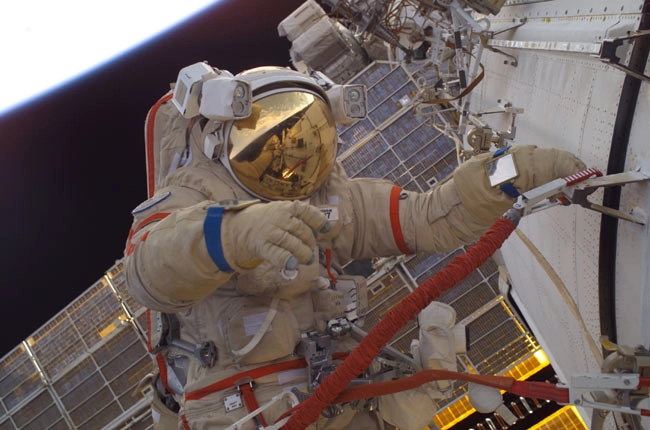
Under the plan, paying spacewalkers would don a Russian-built Orlan spacesuit,exit a Russian-built airlock and be accompanied by a Federal Space Agency cosmonaut during a spacewalk, Space Adventures spokesperson Stacey Tearne told SPACE.com. At all times the spacewalkers would be tethered to the ISS, she added.
Space Adventures has brokered deals with Russia's space agency to launch three space tourists - or spaceflight participants - to the ISS since 2001, when U.S.entrepreneur Dennis Tito rode a Soyuz spacecraft to the orbital laboratory. South African businessman Mark Shuttleworth followed in 2002, with American scientist-turned-entrepreneur Gregory Olsen reaching the ISS in 2005.
Japanese businessman Daisuke Enomoto is now set to become the fourth paying visitor to the ISS no earlier than Sept. 14, when he launches toward the station with Expedition 14 astronauts Michael Lopez-Alegria and Mikhail Tyurin.
Like his predecessors, Enomoto is set to spend 10 days in space, eight of them aboard the ISS, as part of his $20 million deal with Space Adventures and the Federal Space Agency. U.S. entrepreneur and renowned spaceflight supporter Anousheh Ansari, of Texas, is Enomoto's backup.
But Enomoto will not walk in space during his flight because of the additional training needed, Tearne said. An extra month - or about 190 hours - on top of the typical six-month training would be required for spacewalking client, she added.
Meanwhile,NASA officials said they had yet to be notified about any plan by its international partners to sell spacewalk experiences.
"We have not yet been informed by any of our partners about an intention to sell spacewalks," NASA spokesperson Melissa Mathews told SPACE.com, adding that the agency does have processes in place to review ISS crew assignments and spacewalk safety.
Anderson said Space Adventures has spent between one and two years studying the feasibility of a spaceflight participant spacewalk.
"They would just go right out the airlock and they would stay pretty close," Anderson said of prospective paying spacewalkers. "They would just look around and enjoy it;it's not something that involves an incredible amount of risk. They're going out and they're coming back in after an hour an a half."
Russian space officials said they have completed an in-depth study of the risks involved with a space tourist-staged spacewalk.
"At the conclusion of our internal feasibility assessments and after careful consideration, we have come to the conclusion that subject to the personal physical and psychological capabilities and with the completion of additional specific cosmonaut training, spaceflight participants could potentially perform an EVA," Russia's Alexei Krasnov, director of manned spaceflight for the Federal Space Agency, said in a statement.
Accomplished professional spacewalkers said that at the basic level, there is no major obstacle between a space tourist and a 90-minute jaunt outside the ISS.
"There is risk involved in going outside, but if you're going to sign up for that and accept the risk, that's fine," three-time spacewalker and former NASA astronaut Tom Jones told SPACE.com. "I think it is an incomparable personal experience."
Jones, who authored the book Skywalking to document his spaceflight career and serves as an astronaut advisor for Space Adventures, added that as long as space tourists have the finances, training and physical fitness to stage a spacewalk, few hurdles remain to marvel at the Earth and space from inside a spacesuit.
During a 90-minute EVA, which is the time it takes the ISS to make one complete orbit around Earth, a spacewalker would experience orbital sunrise and sunset, Jones said.
"That 90 minutes is like gold to a real spacewalkers," Jones said. "I got a total of five or 10 minutes of doing that in my 19 hours in terms of just unstructured time, so it's literally that precious an experience."
- Next ISS Crew, Space Tourist Ready for Flight
- Space Tourism Special Report: Where Only a Few Have Gone Before
- Wardrobe for the Weightless: Space Inspires Fashion
