


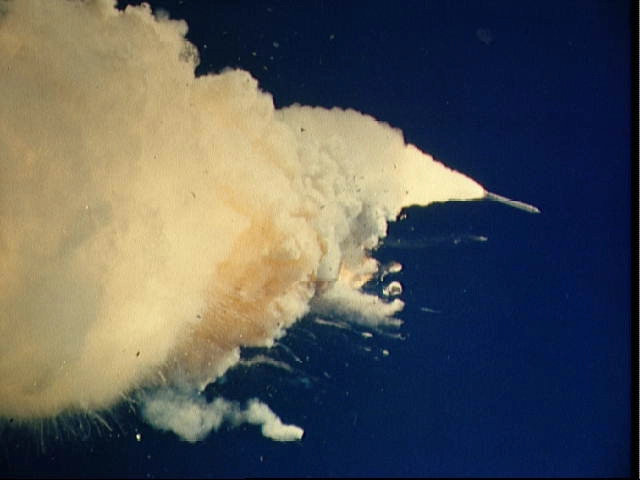
This week marks the somber 25th anniversary of the accident that killed seven astronauts aboard NASA's space shuttle Challenger less than two minutes into their flight, as millions of people around the world were watching.
Challenger launched on its 10th mission on Jan. 28, 1986. A mere 73 seconds after liftoff, live television coverage showed the shuttle break apart and disappear from view. Here is an overview of what happened, how, and the consequences for NASA.
Who were the crew members?
The seven-astronaut crew of Challenger's STS-51L mission consisted of commander Francis "Dick" Scobee, pilot Mike Smith, mission specialists Judy Resnik, Ellison Onizuka and Ron McNair, and payload specialists Greg Jarvis and Christa McAuliffe.
Commander Scobee had first flown as a pilot on Challenger's STS-41C mission, which launched April 6, 1984. A veteran of the Vietnam War, Scobee had been selected as an astronaut candidate in 1978. He was 46 at the time of his death.
Pilot Mike Smith was selected as an astronaut candidate in 1980 and was set to make his first spaceflight on Challenger's STS-51L mission. Smith was also assigned to pilot the future space shuttle mission 61-N, which at the time was scheduled to launch in the fall of 1986.

Smith's voice saying "Uh-oh" was the last thing heard on the crew's voice recorder, just before NASA's Mission Control in Houston lost telemetry data from the shuttle. Smith was 40.
Judy Resnik first flew as a mission specialist on the STS-41D mission – the maiden flight of the space shuttle Discovery. Resnik, who had been selected as an astronaut candidate in 1978, was the second American woman in space. She was 36.
Mission specialist Ellison Onizuka made his first spaceflight on the shuttle Discovery's STS-51C mission, which launched Jan. 24, 1985. Onizuka had been selected as an astronaut candidate in 1978 and went on to log 74 hours in space. He was 40.
Ron McNair previously flew as a mission specialist on Challenger's STS-41B mission, which launched Feb. 3, 1984. From that flight, McNair logged a total of 191 hours in space. McNair, who was the second African-American to fly in space, was 35.
Payload specialist Greg Jarvis was making his first spaceflight on Challenger's STS-51L mission. Jarvis had been selected by NASA as a payload specialist candidate in 1984. He was 41.
Christa McAuliffe was selected on July 19, 1985, as NASA's first educator astronaut under the agency's Teacher in Space Project. McAuliffe, who was 37, taught social studies at Concord High School in New Hampshire. As a civilian and teacher, McAuliffe brought extra public interest to the Challenger mission. Many schoolchildren were watching the TV broadcast of the flight to cheer her on.
Where and when did the accident occur?
Challenger's STS-51L mission was the first shuttle liftoff scheduled for Launch Pad 39B at NASA's Kennedy Space Center in Cape Canaveral, Fla. After several technical and weather-related delays, Challenger launched at 11:38 a.m. EST on Jan. 28, 1986.
What went wrong?
Analysis later showed that a seal, called an O-ring, on the shuttle's right solid rocket booster had failed at liftoff, allowing pressurized hot gas to escape from inside the booster. This vaporized material impinged on the strut connecting the solid rocket booster to the shuttle's huge orange external tank, causing both pieces of hardware to break down.
About 72 seconds into Challenger's flight, there was a massive, almost explosive, burning of the hydrogen that was streaming from the failed tank bottom, combined with liquid oxygen leaking from a part of the fuel tank known as the intertank. Under severe aerodynamic loads, the space shuttle Challenger broke apart over the Atlantic Ocean one second later, or one minute and 13 seconds after launch. [Remembering Challenger: NASA to Mark Space Tragedy Anniversaries]
In video footage of the catastrophe, several large sections of the shuttle can be identified, including the main engine and tail section with the engines still burning, one of the orbiter's wings, and the forward fuselage with a trail of umbilical lines that had been pulled loose from the payload bay.

What led to the accident?
After studying the disaster, a review board determined that exceptionally cold weather contributed to the failure of the O-ring seal. NASA concluded that the shuttle is not safe to fly at such cold temperatures.
How did the crew die?
While the precise timing of the crew's death is unknown, some of the astronauts may have survived the initial disintegration of the spacecraft. Ultimately, however, none survived the impact of the crew cabin hitting the Atlantic Ocean.
Fragments of the orbiter, including the crew compartment, were eventually recovered off the coast of central Florida.
Could Challenger's crew have escaped?
The space shuttle does not have a launch escape system, so the astronauts onboard Challenger would have been unable to safely abandon the orbiter during its breakup.
Following the Challenger catastrophe and, 17 years later, the loss of the space shuttle Columbia and its crew, the possibility of implementing launch escape systems, including ejector seats and tractor rockets, was examined. Ultimately, however, none was put into action.
What happened in the aftermath?
The loss of Challenger and its seven-astronaut crew shone a very public light on NASA and the risks involved with human spaceflight. Media coverage of the launch was extensive due to the involvement of McAuliffe, the agency's first educator astronaut.
The Challenger disaster halted NASA's space shuttle program for almost three years as the agency investigated the causes of the accident. During that time, NASA worked to implement suggestions from the Rogers Commission – the presidential panel charged with studying Challenger's doomed STS-51L mission.
In a 225-page report that was published June 9, 1986, the Rogers Commission meticulously documented the physical and organizational causes of the in-flight catastrophe. The commission found issues in NASA's decision-making processes and construction flaws in O-rings and the shuttle solid rocket boosters.
The commission offered nine main recommendations, and NASA's space shuttle program saw a 32-month hiatus as the agency implemented changes and reformed launch procedures. Space shuttle flights resumed Sept. 29, 1988, with Discovery's STS-26 mission.
The space agency would not see another disaster until Feb. 1, 2003, when seven astronauts lost their lives as the space shuttle Columbia broke apart during its return from its STS-107 mission.
You can follow SPACE.com Staff Writer Denise Chow on Twitter @denisechow.
