


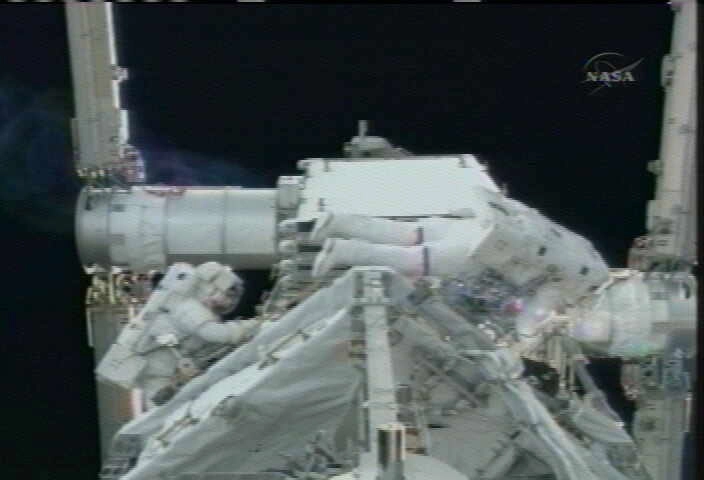
HOUSTON --The International Space Station (ISS) has a new orbital look after a joint teamof astronauts installed a pair of massive trusses and solar arrays to thestarboard side of the high-flying lab Monday.
Despite a latestart, STS-117 spacewalkersJim Reilly II and Danny Olivas installed the 17.5-ton addition to thestation during a six-hour, 15-minute excursion to the starboard-most edge ofthe orbital laboratory.
?That was afull day, and it all went beautifully,? said Reilly, who completed his fourthspacewalk during the activity, after the excursion.
Theextravehicular activity (EVA) began at 4:02 p.m. EDT (2002 GMT), about an hourlater than planned, due to the sheer heft of the 35,678-pound(16,183-kilogram) Starboard3/Starboard 4 (S3/S4) trusses and arrays which overwhelmed the station?sU.S.-built attitude control gyroscopes. But the spacewalkers worked swiftly and, ultimately, made up forlost time.
?It was, ina word, incredible,? Reilly said, adding that Olivas worked like a natural despitemaking his first trek as a spacewalker. ?It?s just something that can?t bematched.?
Monday?sextravehicular activity (EVA) marked the first of three planned spacewalks to install and activate the S3/S4 truss segments and arrays hauledto the ISS aboard NASA?s space shuttle Atlantis. Once deployed, the new solarwings will help provide the power supply necessary to support new ISS modulesand international laboratories slated to launch over the next eight months.
DuringMonday?s spacewalk, NASA mission managers addeda fourth spacewalk and two extra days to the STS-117mission.
Atlantisshuttle pilot Lee Archambault and mission specialist SunitaWilliams wielded the space station?s robotic arm to install the S3/S4 truss toits berth at the tip of the station?s Starboard 1 segment. Fellow STS-117astronaut Patrick Forrester choreographed the spacewalkers movements from theAtlantis shuttle?s flight deck.
During a weekof joint activities, Atlantis? STS-117 crew and their ISS counterparts willunfurl the new solar arrays to their 240-foot (73-meter) wingspan and stowaway in older solar array reaching to starboard over the S3/S4 truss from thestation?s mast-like Port 6 (P6) power tower. Atlantis docked at the ISS Sundayafternoon to kick off the first of NASA?s four planned construction missions tothe station this year.
Power inhand
The 45-foot(16-meter) long S3/S4 truss segment is the latest addition to the spacestation?s main truss, which serves as the orbital laboratory?s metallicbackbone and, when complete, will include 11 sections that together would rivala U.S. football field in length.
At thestarboard-most tip of the S4 segment are the foldedaway solar arrays, which Reilly and Olivas moved into position and primedfor deployment during their spacewalk. The astronauts also freed a radiator tocool the new power plant, set up struts to reinforce the S3/S4 trusses andremoved some 100 bolts to prepare the outboard S4 element to rotate like apaddlewheel later so its solar arrays can track the Sun.
But thatdidn?t mean the spacewalkers didn?t take some time out to take in the view.
?I neverreally understood how dark it gets,? Olivas said. ?Every 45 minutes a sunriseand a sunset, absolutely phenomenal.?
Monday?sspacewalk marked the 84th devoted to ISS construction or maintenanceand the 56th to begin from the space station itself. By theexcursion?s end, Reilly?s career spacewalking tally increased to four EVAs totaling 22 hours, 45 minutes.
Olivas, whois making his first spaceflight along with first spacewalks during the STS-117mission, now has six hours and 15 minutes of spacewalking time.
?The smileson those guys faces go from one ear all the way around to the same ear,? saidExpedition 15 flight engineer Clayton Anderson after the spacewalk.
NASA isbroadcasting the space shuttle Atlantis' STS-117 mission live on NASA TV. Click here for mission updates andSPACE.com's video feed.
- VIDEO: A Look at STS-117's First Spacewalk
- SPACE.com Video Interplayer: Space Station Power Up with STS-117
- STS-117 Power Play: Atlantis Shuttle Crew to Deliver ISS Solar Wings
- Complete Shuttle Mission Coverage
