





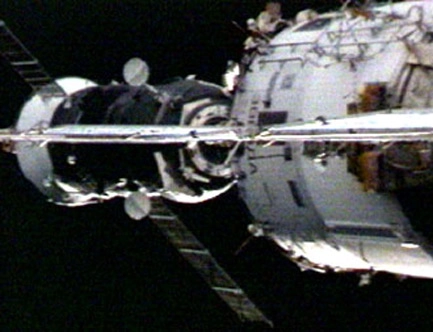
Astronautsaboard the International Space Station welcomed the arrival of a fresh cargoship early Tuesday after a flawless automated docking by the incomingspacecraft.
The Russian-builtProgress 25 supply ship arrived right on time at 1:10 a.m. EDT (0510 GMT),guiding itself to a berth at the aft end of the station's Zvezda service moduleas both spacecraft passed 220 miles (354 kilometers) above the northeast coastof Australia, NASA officials said.
"Congratulations on a successfuldocking," Russian ISS flight controllers told the station's three-astronautExpedition 15 crew.
Inside theorbital laboratory, Expedition 15 commander Fyodor Yurchikhin stood at theready to take remote control of the arriving cargo ship should its autonomousdocking plan encounter a glitch. But the spacecraft remained on target after athree-day spaceflight that began with a lateFriday launch (Eastern Time) from the Central Asian spaceport of BaikonurCosmodrome in Kazakhstan.
Progress 25is laden with more than 2.5 tons of fresh supplies for the ISS crew. Tuckedamong that 5,125 pounds (2,324 kilograms) of cargo are about 100 pounds (45kilograms) of air, 925 pounds (419 kilograms) of water, and 3,042 pounds (1,379kilograms) of dry supplies that range from new equipment and spare parts toclothing for NASAastronaut Clayton Anderson, an Expedition 15 crewmember slated to launchtowards the ISS aboard a NASA shuttle next month, the space agency said.
Russia's InterfaxNews Agency reported that a batch of 50 snails were also riding to the ISSaboard Progress 25 as part of a Russian Federal Space Agency experiment to studytissue regeneration in microgravity.
Yurchikhinand Expedition 15 flight engineers Oleg Kotov and Sunita Williams are slated tobegin unloading the new cargo ship at about 6:00 a.m. EDT (1000 GMT), NASAsaid.
Progress 25'ssuccessful Tuesday docking brings raises the station's total number of visitingspacecraft to three. The unmanned Progress 24 cargo ship remains moored to thestation's Pirs docking compartment while the Soyuz TMA-10 spacecraft thatferried Yurchikhin and Kotov to the ISS last month is docked at an Earth-facingport on the orbital laboratory's Russian-built Zarya control module.
- VIDEO: Meet the Space Station Crew of Expedition 15
- Training Hits High Gear for Next Space Station Astronaut
- Complete Space Station Mission Coverage
