This story was updated at 7:30 p.m. EDT.
HOUSTON - A massive new motorized gearaboard the InternationalSpace Station (ISS) is postitioned to aid the deployment of two sunlight-hungry solar arrays despite a stubborn bolt that challengedtwo Atlantisastronauts and lost, mission managers said Wednesday.
"It's truethat just one of those bolts may have prevented the [gear] from rotating, but wegot it done and you can see the fruit of our labor," said John Haensly, leadspacewalk officer for Atlantis' STS-115mission, in a briefing here at NASA's Johnson Space Center.

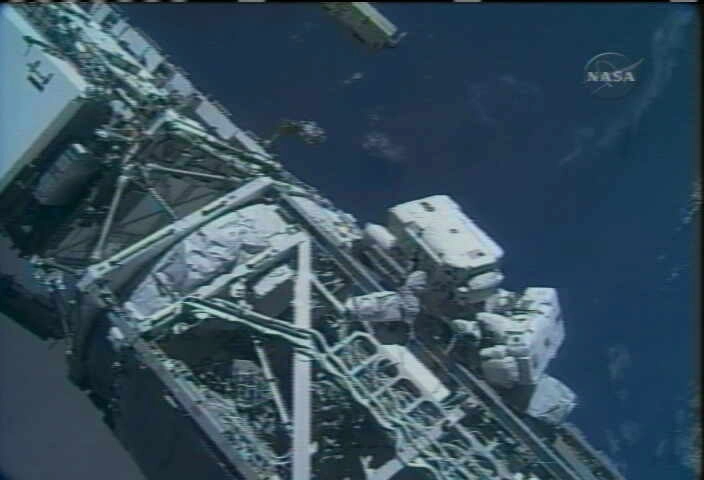
STS-115astronauts DanielBurbank and StevenMacLean - of the Canadian Space Agency - worked for more than seven hours outsidethe ISS and Atlantis to successfully ready a gear assembly dubbed the SolarAlpha Rotary Joint (SARJ) to slowly turn a new truss into position.
The firstmotion of two new solar arrays aboard the ISS is now set to begin at about 7:00p.m. EDT (2300 GMT) tonight while astronauts aboard Atlantis and the ISS -where the shuttle remains docked - sleep. The arrays will then be deployed inseveral stages throughout early Thursday to warm up the solar panels andprevent from sticking together, ISS managers said.
Locatedbetween the Port 3 (P3)and Port 4 (P4) truss segments - which Atlantis' STS-115 crew delivered tothe ISS in a Tuesday spacewalk- the SARJ unit is a 2,500-pound (1,133-kilogram) set of motors, gears andwheels built to rotate P4 and other station hardware 360 degrees so their U.S.-builtsolar arrays to track the Sun and generate power.
"It'salmost like giving birth today, the fighting that we went through and the laborpains," lead ISS flight director John McCullough said after the successful spacewalk."This is a turn we could get used to, everything is going really well."
Burbank and MacLean had to succeed inremoving some 243 bolts that held the SARJ wheel in place for its flight to theISS. If they failed, and SARJ would not budge, the two solar arrays packed awayat the end of P4 could not be unfurled on Thursday because they would crosspaths with twoother U.S.-built solar arrays already aboard the ISS.
But the twospacewalkers put their backsinto to it and in the end, the SARJ unit made its 180-degree turn intosolar array deploy position.
"Wenumerous battles with the hardware, but that's the reason we have people inspace...working out there," McCullough said. "Today it took a couple of strongfolks to get the job done."
When fullyactivated, the SARJ is designed to make one full rotation every 90 minutes -which is the time it takes the ISS to circle the Earth, but can be slowed orsped up to one revolution an hour if needed, McCullough said.
Solararrays set to unfurl
Attentionnow turns to the P4 truss' four power-producingsolar blankets - two per array - which have been folded up like an accordionin their respective boxes, while their pop-up masts are tucked in largecylindrical drums. The arrays represent one-fourth of the space station's finalelectrical grid, but will double the outpost's power capability once fullybrought online in December.
The twosolar arrays carry a wing span of about 240 feet (73 meters) and four their individualpanels fold up into a box 15 feet (4.5 meters) long by 20 inches (50 centimeters)high. The solar array mast is split into more than 30 bays of interlockingbattens that pop into place as the array itself deploys.
ISS flightcontrollers on Earth will reel out the first mast bay - which stands betweenthree and four feet (just over one meter) - of both new arrays to save time forthe STS-115 astronauts tomorrow.
"We'regoing to take a day off from spacewalks tomorrow," Haensly said.
The forwardsolar array will roll out to one mast bay at 7:00 p.m. EDT (2300 GMT) tonightwhile the aft solar array reels out to the same distance at about 10:05 p.m.EDT (0200 Sept. 14 GMT).
"The onebay deploy is basically to start the relaxation of the blankets, and basicallyto get ahead," McCullough said. "We want to have the Sun in a certain cone towarm the back of the blankets."
Atlantis'STS-115 crew will awake at 11:15 p.m. EDT (0315 Sept. 14 GMT) tonight andoversee the final solar array deployment beginning at 2:40 a.m. EDT (0640 GMT)Thursday morning.
Once fullydeployed, the new solar arrays will power its own systems until it is broughtinto the space station's power grid in earnest later this year, NASA officialssaid.
- New Gallery: STS-115: Atlantis's Launch Day
- Complete Space Shuttle Mission Coverage
- NASA's STS-115: Shuttle Atlantis to Jump Start ISS Construction
- The Great Space Quiz: Space Shuttle Countdown
- Complete Coverage: ISS Expedition 13
