





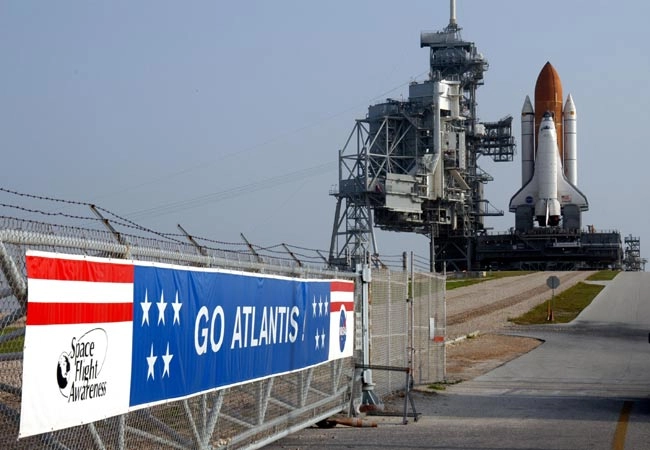
NASA shuttle managers are expected todecide later today whether the Atlantis orbiter and its six-astronautcrew will launch toward the International SpaceStation (ISS) on Aug. 27.
A flock ofup to 300 shuttle engineers, managers and contractors are concluding a two-dayFlight Readiness Review for Atlantis' STS-115mission at NASA's Kennedy Space Center (KSC) in Cape Canaveral, Florida todecide, among other things, whether four bolts connecting the orbiter's Ku-bandantenna to a forward right payload bay wall will haveto be replaced on the launch pad.
"They'llcome together with a plan and get a decision on what we should do," NASA KSCspokesperson Bruce Buckingham told SPACE.com Tuesday, adding that apotential fix is not expected to significantly impact the planned space shot.
Atlantis iscurrently setto launch no earlier than 4:30 p.m. EDT (2030 GMT) from Pad 39Bon an 11-day trip to the ISS. The STS-115 crew, commanded by veteran shuttle flyerBrentJett, will deliver a newsolar array and truss segment to the station in NASA's first majorconstruction flight since late2002.
Shuttle fueltank also under scrutiny
A standardmeeting before any shuttle flight, this week's Flight Readiness Review alsoincludes discussions on whether Atlantis' external tank is fit for the nearlynine-minute trip into orbit. The foam insulation-covered, 15-story fuel tankcarries the same modifications as one which fed the Discovery shuttle's July 4launch.
Those modifications- aimed at reducing the amount of foam insulation debris shed at launch - includethe removal of a large, foam-clad wind screen that once covered wiring andpressurization lines. Like Discovery's fuel tank, Atlantis' does not carry anychanges to a series of 37 so-called ice-frostramps, which are NASA's next target for modifications.
"I particularly,based on what I understand, expect to see no basic change from a debris hazardstandpoint," NASA shuttle program manager Wayne Hale told reporters in a Fridaybriefing.
Fuel tankfoam shedding has been a prime concern since the 2003 Columbia accident, when achunk of insulation fell during launch and breached the orbiter's heat shieldalong its left wing leading edge. The damage led to the loss of the shuttle andits crew during reentry.
A largepiece of foam also fell from an external tank's protuberance air load (PAL)ramp during NASA's first post-Columbia shuttle flight in July 2005,prompting the ramp's removal for Discovery's STS-121mission last month - a fix that performedwell - and Atlantis' upcoming launch.
With the PALramp gone, icefrost ramps are now NASA's next target for elimination, but their continuedpresence on shuttle fuel tanks prompted two top NASA safety officials to voteagainst launching Discovery's STS-121 mission.
"We have afull court press going on to redesign those," Hale said of the ice frost ramps."We're going to be taking them into the wind tunnel in September."
Hale addedthat of the top two candidate modifications for fuel tank ice frost ramps, one callsfor a hardy titanium shell to replace ramp insulation, but tests remain to makesure the potential fix will not form ice when a shuttle tank is filled with itssuper-cold liquid oxygen and liquid hydrogen fuel.
The firstshuttle flight to carry an ice frost ramp fix on its external tank is expectedto be NASA's fourth post-Columbia mission, slated to launch between Februaryand March of 2007, Hale said.
Meanwhile,NASA will discuss the results of today's STS-115 Flight Readiness Reviewmeeting during a live NASATV broadcast to begin no earlier than 2:00 p.m. EDT (1800 GMT).
You areinvited to follow the briefing via SPACE.com's NASATV feed, which is available by clickinghere.
- VIDEO: Shuttle Commander Brent Jett
- NASA Eyes Shuttle Antenna Bolts in Atlantis Flight Review
- Complete Space Shuttle Mission Coverage
- NASA's STS-115: Shuttle Atlantis to Jump Start ISS Construction
