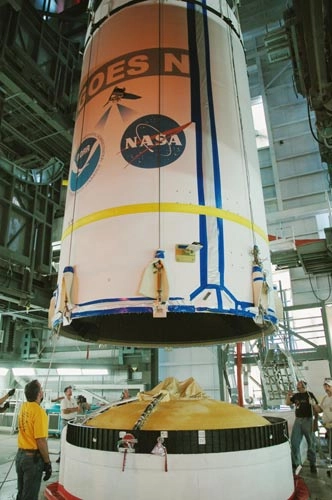
The firstof an advanced batch of Earth-watching satellites is poised to rocket spacewardWednesday after a year of delays that have plagued its weather forecastingmission.
A Boeing Delta4 rocket is set to launch the GOES-N satellite - one of a three newspacecraft aimed at monitoring changes in Earth's weather and environment -from Florida's Cape Canaveral Air Force Station at 6:11 p.m. EDT (2011 GMT). Technicalproblems - including a last-minute launchscrub - and Boeing's worker strikelast year have delayed the mission from its initial May 2005 target.
"It's beena long, challenging effort," said Andre Dress, NASA's GOES deputy programmanager at Goddard Space Flight Center, Tuesday duringa prelaunch briefing. "This satellite does represent the latest in satellitetechnology and promises to improve performance over its predecessor."
Weathersatellites are a key asset for forecasters, especially as the 2006 AtlanticBasin hurricane season - which begins June 1 - approaches, said Steve Letro, the meteorologist-in-charge for the NationalWeather Service's forecast office in Jacksonville, Florida.
"There is verylittle in our arsenal which allows us to gather data from the entire oceanbasin around a storm," Letro said, adding that only satellites can provide thosenecessary weather pattern observations on an hourly basis or faster.
GOES-N's missionwill add a second spare satellite to aid the weather forecasting efforts of theNational Oceanic and Atmospheric Administration (NOAA). NOAA is working withNASA on the planned spaceflight, which has a 60 percent chance of launchingduring its one-hour window on Wednesday, mission weather officials said.
NOAA currentlyoperates GOES-10 and GOES11 to track daily weather and severe storms, such as hurricanes andtornadoes, with another satellite - GOES-12- in a storage orbit. Mission managers plan to rename GOES-N as the observationsystem's 13th satellite once final post-launch checks are complete,then place it into a storage orbit until GOES-10 is retired.
"We havebeen storing satellites on orbit since 1997," NOAA's GOES program manager SteveKirkner told reporters during the briefing, adding that orbital storage cansave more than $3 million in ground storage costs.
NOAA plansto launch two followers - GOES-O and GOES-P - to fly in GOES-N's wake. Kirkner saidGOES-O is currently targeted for an April 2008 launch to be followed in October2009 by GOES-P.
NASA willbroadcast the GOES-N launch live on NASATV beginning at 6:00 p.m. EDT (2000 GMT) on Wednesday. You are invited tofollow along with the planned space shot using SPACE.com's NASA TV feedby clicking here.
- For Boeing, Next Delta 4 Rocket Launch Carries More Than a Satellite
- Boeing's Union Strike Delays Satellite Launch Plans
- Scrub Delays Delta 4 Launch Until October
- Countdown Coverage for GOES-N's First Launch Attempt

