





HOUSTON -NASA managers for the International Space Station (ISS) have formally asked foran extra day of docked operations with the STS-114 astronauts aboard Discovery,shuttle officials said Friday.
NASA spaceshuttle program deputy manager Wayne Hale, who chairs Discovery's MissionManagement Team (MMT), said ISS officials requested the one-day missionextension to allow more time for transfer of material between the orbiter andthe ISS.
Thatmaterial, he said, consists of additional items to the 15 tons of suppliesDiscovery ferried to the ISS.
The MMTwill meet Saturday to discuss adding the extra day, but will likely opt to goalong with the plan.
"I expectthat's what we'll do," Hale said.
Earliertoday, STS-114 mission operations representative Phil Engelauf said an engineeringteam is compilinga list of items Discovery's crew could pluck from their orbiter and leave atthe ISS as a precaution against an extended delay between Discovery's spacestation visit and the next shuttle's arrival. Among the possible items thatcould be pinned for transfer are laptop computers, unique space tools or extrawater produced by Discovery's fuel cells, he added.
TheAtlantis orbiter is next in line to launch toward the ISS - with an initialflight window opening in September - but will likely notfly until NASA address a still unresolved foam debris issue that becameabundantly clear during Discovery's Tuesdaylaunch.
During the July26 space shot, an external tank-mounted video camera caught a large chunk offoam insulation separated from the tank just over two minutes into the flight,but did not impact Discovery. Additional image analysis turned up several smallerfoam pieces that also popped free, one of which may have contacted theorbiter - inspections and impact sensors detected nothing - though it wouldhave hit with 1/10 the energy needed to pose a hazard, Hale said Thursday.
ISSofficials are also discussing the possibility of tacking on an additional taskto the third spacewalk planned for Discovery's crew.
STS-114 spacewalkersSoichi Noguchi and Stephen Robinson will make their first venture outsideDiscovery early Saturday to test new orbiter repair techniques and replace aspace station global position system antenna. A second spacewalk is set forAug. 1, with the final EVA slated for Aug. 3.
It is for thatAug. 3 spacewalk that ISS managers are considering whether to ask Noguchi andRobinson to retrieve a motor from a thermal radiator on the station's exterior,though a formal request has not yet been made, Hale said.
"That is apotential task to be added," Hale said, adding that engineers are hoping toperform a failure analysis on the motor.
Mind thegap filler
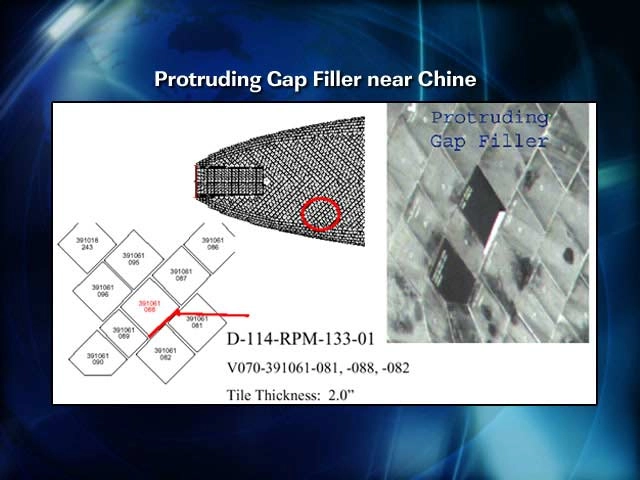
Video andstill photography taken of Discovery's belly-mounted heat-resistant tiles havegiven shuttle engineers their first look of an established phenomena seen inpast shuttle flights.
The imagerycaught two ceramic gap fillers, typically wedged between tiles that are spacedtoo far apart, poking about an inch out into space. While not due to damage, thegap filler images are the first views taken of the phenomena in orbit.Engineers typically don't find protruding gap fillers until orbiters land backon Earth.
"This isreally kind of exciting data," Hale said, adding that other gap fillerprotrusions are behind Discovery's nose landing gear doors, where suchprotrusions have occurred in the past. "There appears to be something going onbehind the nose landing gear door that we'll look at."
Protrudinggap fillers disrupt the aerodynamic flow around shuttles during descent, whichcan cause higher than normal heating aft of the protrusion, Hale said.
Engineers arediscussing whether any measures are needed to address the gap fillers or other incidents,such as a damaged thermal blanket that was found during inspections.
"All ofthese things are not serious in the sense that they don't cause serious alarm,"Hale said.
Analysts havealso pinned down the size of a chipped tilenear the nose landing gear doors after STS-114 astronauts observedit with Discovery's sensor-tipped orbital boom.
The damagedarea is about three inches wide, 3/4ths of an inch long and about 1/3rdof an inch deep, but does not breach any thermal protective barriers.
"That isvery good news," Hale said. "I'm feeling very confident that this is not goingto turn out to be anything very significant."
- Fixing NASA: Complete Coverage of Space Shuttle Return to Flight
