


This story was updatedat 9:44 a.m. EDT.
HOUSTON - After almost three years,a NASA space shuttle is docked at the International Space Station (ISS).
The Discovery orbiter, NASA's firstshuttle to fly since the 2003 Columbia tragedy, successfully docked at the ISSThursday at 7:18 a.m. EDT (1118 GMT) after a flawless rendezvous.
"We see the space station out thewindow and it looks beautiful," said veteran astronaut Eileen Collins,commander of Discovery's STS-114 mission, as the shuttle approached thestation.
Discovery and the space station wereflying over the Pacific Ocean, just west of Chile, during their orbital meeting,NASA officials said.
"We're waiting for you," said ISSExpedition 11 flight engineer John Phillips to Discovery's crew as they docked.
Phillips and ISS Expedition 11commander Sergei Krikalevhave lived aboard the ISS since mid-April, and have been preparing forDiscovery's arrival both in space and during countless hours of preflighttraining on Earth.
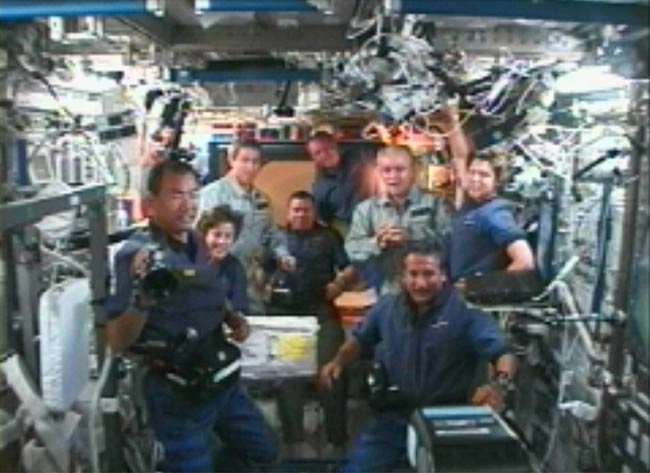
Hooks and latches ensured a gooddocking between Discovery and the ISS soon after the docking, with leak andpressure checks still to be performed before both astronaut crews can meetface-to face. By 8:54 a.m. EDT (1254 GMT), all nine astronauts were inside thespace station.
"Congratulations on a greatdocking," said NASA astronaut Steve Frick, serving as capcom,as his shift ended. "You made it look like very easy."
Discovery's ISS docking marked thefirst shuttle arrival at the station since Nov. 25, 2002, when Endeavour docked atthe orbital facility during NASA's STS-114 mission.
NASA grounded its shuttle fleet inFebruary 2003 after the Columbia orbiter broke apart during reentry, killingits seven-astronaut crew. Columbia was struck by foam debris from its externaltank during launch, which critically damaged the orbiter and led to itsdestruction, investigators later found.
After two years and $1.4 billion,NASA successfully launchedDiscovery Tuesday on its first return to flight mission. But one day later,shuttle officials groundedthe orbiter fleet again after announcing that - despite their best efforts -external tank foam is still a major hazard to the space shuttle during launch.A large chunk of foam peeled off Discovery's external tank just over twominutes into its flight, but did not strike the orbiter, shuttle programmanagers said.
Discovery will likely be the firstand last shuttle to visit the station for awhile as engineers address the foamproblem, though when the next launch may be is unknown at this time, NASAofficials said.
"We're on station now and we'relooking forward to several days of a lot of hard work," Collins told flightcontrollers.
The STS-114 crew will spend abouteight days at the ISS, transferring thousands of pounds of fresh food,equipment and spare parts for the station's crew. Discovery astronauts will performthree spacewalks outside the station before casting off from the orbitalplatform and return home on Aug. 7.
Orbital ballet
During today's space stationrendezvous, Collins took manual control of Discovery and pitched around in a backflip about 600 feet below the ISS.
While a feat of orbital acrobatics,the backflip - known as the Rendezvous Pitch Maneuver(RPM) - was pivotal highlight of Discovery's flight. During the maneuver,Collins slowly flipped Discovery in a circle to give the Expedition 11 crew aclear view of the heat-resistant tiles lining its underside.
Krikalev and Phillips had about 1 minute and40 seconds - a bit longer than the 93 seconds they trained for - to take acarefully rehearsed set of photographsto record the state of Discovery's belly tiles, which protect the orbiter fromthe searing heat of reentry during landings.
"We looking forward to seeing imagesof the RPM," Collins said, thanking the flight instructors and team thatplanned the shuttle's backflip maneuver. "Itworked just as they predicted."
According to their photography plan,Phillips took about nine images with a 400 mm digital camera to gather awide-view look at Discovery's belly tiles. Krikalev,using the equivalent of an 800 mm camera to gather close-up images ofDiscovery's landing gear door seals with an analytical resolution of about oneinch, NASA officials said.
"I thought the process went reallyfine," Phillips said after the photography session. "Neither of us was saw anything really alarming."
Two primary areas of interest forthe engineers that will review the images are a chipped tilenear Discovery's nose landing gear doors, and an "area of interest" furtherback on the orbiter's belly, NASA deputy shuttle program manager Wayne Halesaid Wednesday.
Nine astronauts at ISS
Discovery's STS-114 crew entered theISS about 25 minutes ahead of schedule, as both crews were eager to get on withwhat will be a very busy day.
To prepare for tomorrow'sinstallation of the Italian-built Raffaello Multi-Purpose Logistics Module (MPLM), acargo pod inside Discovery's payload bay, to the station, roboticarms aboard both the orbiter and space station will be put into action.
STS-114 mission specialist WendyLawrence and shuttle pilot James Kelly will control the ISS arm, while theircrewmates Andrew Thomas and Charles Camardamanipulate the arm aboard Discovery. Thomas and Camardawill use Discovery's arm to grapple the shuttle's orbital inspection boom, then hand it off to Lawrence and Kelly, who will use the ISSarm to latch onto the boom and swing it clear of the shuttle and ISS.
The orbital boom handoff is requiredto clear the way for the installation of Raffaellocargo pod, NASA officials said.
Fixing NASA: Complete Coverage ofSpace Shuttle Return to Flight
